
Question 153 marksMedium
In each case, given below, draw a line through point P and parallel to AB :
(i)

Confirming your payment
Sign up now and get 250 free tokens.
Constructions · Question 15 of 49
In each case, given below, draw a line through point P and parallel to AB :
(i)
Solution:
Concept: When a line PQ cuts two lines, the angles on opposite sides of PQ and between the two lines are alternate angles. If a pair of alternate angles is equal, the two lines are parallel. So we copy the angle at Q to P, on the other side of PQ.
Given: The line AB and the point P shown in the figure; a ruler and a pair of compasses only.
Step 1 — Join P to a point of AB.
Mark any point Q on AB and join PQ (dashed in the figure).
Step 2 — Draw an arc at Q.
With Q as centre and a convenient radius, draw an arc cutting QP and QB. It marks the angle PQB.
Step 3 — Draw the same arc at P.
With P as centre and the SAME radius, draw an arc cutting PQ, on the side of PQ opposite to B.
Step 4 — Copy the opening.
Take in the compasses the distance between the two cut points of the arc at Q. With the point where the arc at P cuts PQ as centre, cut the arc at P at R.
Step 5 — Draw the line.
Join PR and produce it both ways to S and T. Equal radii and equal chords give equal angles, so ∠QPR = ∠PQB, and these are alternate angles.
Step 6 — Look at the finished figure and check it.
The finished construction is shown below, drawn for the line AB and the point P of the question.
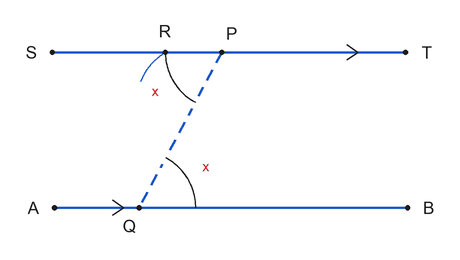
The two angles marked x are equal alternate angles, and the arrow marks show ST ∥ AB.
Watch out: Copy the angle on the OTHER side of PQ; an equal angle on the same side makes the lines meet.
Therefore, ST is the required line through P parallel to AB (∠QPR = ∠PQB, alternate angles).