
Question 441 markMCQEasy
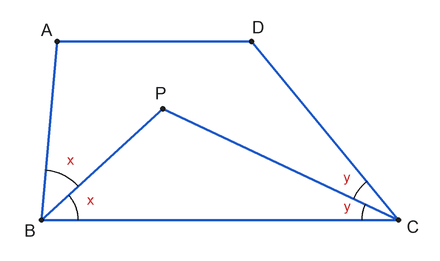
Point P is the point of intersection of the bisectors of angles ABC and DCB, then :
Confirming your payment
Sign up now and get 250 free tokens.
Constructions · Question 44 of 49
Point P is the point of intersection of the bisectors of angles ABC and DCB, then :
(A) PB = PC
(B) P is equidistant from AB = BC
(C) P is equidistant from BC and CD
(D) P is equidistant from AB, BC and CD
Answer: (D) P is equidistant from AB, BC and CD
Concept: Each point on the bisector of an angle is equally far (perpendicular distance) from the two arms of the angle.
Step 1 — Use the bisector of ∠ABC.
P lies on the bisector of ∠ABC, so P is equally far from its arms AB and BC.
Step 2 — Use the bisector of ∠DCB.
P also lies on the bisector of ∠DCB, so P is equally far from its arms BC and CD.
Step 3 — Put the two results together.
Both distances include the distance from P to BC, so all three distances are equal: P is equally far from AB, BC and CD.
Watch out: Being equidistant from a LINE means having equal perpendicular distances to it, not equal lengths PB and PC.
Why the other options are wrong:
Therefore, P is equidistant from AB, BC and CD, option (D).