
Opening your dashboard
Class 7 Maths Chapter 22 Constructions: Practice Questions
41 questions on Chapter 22, each worked through on its own page with the AI tutor. Class 7 Maths, ICSE 2026-27.
41 questions
1–5 marks · Mixed difficulty
- 11 mark
Question 1
Bloom's level: Remember
Which job is done with the pair of compasses in a geometrical construction?
- 21 mark
Question 2
Bloom's level: Remember
To construct 90° at O on the line OA, an arc with centre O cuts OA at B. Arcs of the same radius are then marked from B to C and from C to D on the first arc.
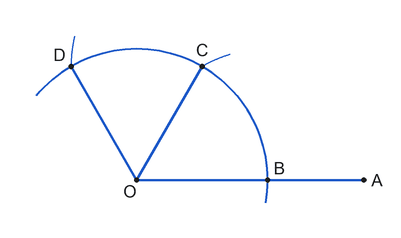
∠AOC and ∠AOD are :
- 31 mark
Question 3
Bloom's level: Understand
An angle of 105° can be constructed with ruler and compasses by bisecting the angle between the arms of :
- 41 mark
Question 4
Bloom's level: Understand
While drawing the perpendicular bisector of a line segment AB, the radius of the arcs drawn from A and B must be :
- 51 mark
Question 5
Bloom's level: Apply
With which of the following sets of side lengths can a triangle be constructed?
- 61 mark
Question 6
Bloom's level: Apply
The vertex angle of an isosceles triangle is 50°. To construct it from its base, the angle to be drawn at each end of the base is :
- 71 mark
Question 7
Bloom's level: Apply
An equilateral triangle has perimeter 16.5 cm. To construct it, the radius of the arcs drawn from the ends of the base is :
- 81 mark
Question 8
Bloom's level: Analyse
A right-angled ΔABC is to be constructed with ∠A = 90°. With which data is the construction not possible?
- 91 mark
Question 9
Bloom's level: Remember
The incentre of a triangle is the point where :
- 101 mark
Question 10
Bloom's level: Understand
Assertion (A): Each angle of an equilateral triangle constructed with side 5 cm measures 60°.
Reason (R): An equilateral triangle can be constructed when only one of its sides is given.
- 111 mark
Question 11
Bloom's level: Evaluate
Assertion (A): A ΔABC with AB = 5 cm, ∠A = 100° and ∠B = 85° can be constructed.
Reason (R): A triangle can be constructed only if the sum of the lengths of every two sides is greater than the third side.
- 121 mark
Question 12
Bloom's level: Analyse
Assertion (A): The circumcentre O of ΔABC is at the same distance from A, B and C.
Reason (R): Every point on the perpendicular bisector of a line segment is at the same distance from the two ends of the segment.
- 131 mark
Question 13
Bloom's level: Remember
Name the two instruments used in a construction “with ruler and compasses only”, and give one use of each.
- 142 marks
Question 14
Bloom's level: Understand
To draw a line through a point P parallel to a line AB, we mark a point Q on AB, join PQ, and at P copy ∠PQB on the other side of PQ, getting ∠QPR = ∠PQB. Line ST is then drawn through R and P.
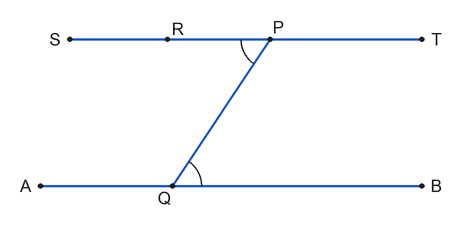
Explain why ST is parallel to AB.
- 152 marks
Question 15
Bloom's level: Apply
ΔPQR is isosceles with PQ = PR and ∠P = 90°. Find ∠Q and ∠R. Hence construct ΔPQR with base QR = 6 cm using ruler and compasses only, and measure PQ.
- 162 marks
Question 16
Bloom's level: Apply
List, in order, the compass steps needed to make an angle of 150° at a point O on a straight line XY, without a protractor.
- 172 marks
Question 17
Bloom's level: Apply
Construct a right-angled ΔPQR in which ∠Q = 90°, PQ = 6 cm and QR = 8 cm. Measure the hypotenuse PR.
- 182 marks
Question 18
Bloom's level: Apply
Construct an equilateral triangle whose perimeter is 13.5 cm.
- 192 marks
Question 19
Bloom's level: Analyse
Ravi wants to construct ΔABC with AB = 4 cm, BC = 5 cm and CA = 9.5 cm. (a) Can he? Give a reason. (b) Find the greatest and the least whole-number lengths of CA (in cm) for which the triangle can be constructed.
- 202 marks
Question 20
Bloom's level: Evaluate
Sara says : “To construct 75°, I bisect the angle between the 60° arm and the 120° arm.” Is she right? Justify, and state the correct method.
- 212 marks
Question 21
Bloom's level: Understand
Give two differences between the circumcircle and the incircle of a triangle.
- 222 marks
Question 22
Bloom's level: Understand
Name the three cases (sets of given parts) in which this chapter constructs a triangle. Give one example of data for each case.
- 234 marks
Question 23
Bloom's level: Apply
Construct ΔXYZ in which YZ = 5 cm, ∠Y = 120° and ∠Z = 30°, using ruler and compasses only. (a) Find ∠X by calculation. (b) Measure XY and XZ. (c) Explain why XY = YZ.
- 243 marks
Question 24
Bloom's level: Understand
In the construction of 90° at O on line OA :
- An arc with centre O cuts OA at B.
- With centre B and the same radius, the arc is cut at C; with centre C and the same radius, it is cut at D.
- With C and D as centres, arcs of equal radii cut each other at E. OE is joined.
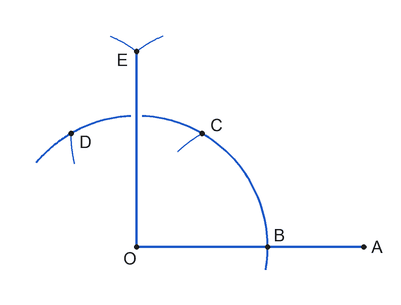
Explain why each step works and show that ∠AOE = 90°.
- 254 marks
Question 25
Bloom's level: Analyse
Construct ΔPQR with ∠Q = 90°, PQ = 4.5 cm and QR = 6 cm. (a) Construct its circumcircle. (b) Measure the circumradius and the hypotenuse PR. (c) Where does the circumcentre lie, and how is the circumradius related to PR?
- 265 marks
Question 26
Bloom's level: Analyse
Case study — Planning a bus stop
On a town map (scale 1 cm = 100 m) a straight road is drawn as line XY. House P is 3 cm from the road and house Q is 2 cm from the road, on the same side. The feet of the perpendiculars from P and Q on the road are 5 cm apart.
(a) The shortest path from P to the road is to be marked. Which construction gives it? Construct it and find the real length of this path.
(b) A new lane is to pass through P, parallel to the road. Construct it.
(c) A bus stop S is to be placed on the road so that it is at equal distances from P and Q. Construct S. How far is S from the foot of the perpendicular from P (real distance), and about how far is S from each house?
- 275 marks
Question 27
Bloom's level: Apply
Case study — The warning sign
A triangular road sign has a base of 4 m, and each of its two base angles is 60°.
(a) Find the third angle. What kind of triangle is the sign? What are the lengths of its other two sides?
(b) Using the scale 1 cm = 1 m, construct the shape of the sign with ruler and compasses only.
(c) The sign is to be fixed by a rod from its top corner straight down to the middle of the base. Construct this rod as a perpendicular and measure it. What is the real length of the rod?
- 284 marks
Question 28
Bloom's level: Evaluate
Neha tries to construct a right-angled ΔABC with ∠B = 90°, AB = 6 cm and hypotenuse AC = 5 cm. Her arc from A does not cut the other arm. (a) Explain why the construction fails. (b) She changes the hypotenuse to AC = 7.5 cm. Construct the triangle. (c) Measure BC.
- 294 marks
Question 29
Bloom's level: Create
The angles of a triangle are in the ratio 1 : 2 : 3, and its longest side is 6 cm. (a) Find the angles. (b) Plan a construction with ruler and compasses only — which side will you draw first and which angles at its ends? (c) Construct the triangle and measure its shortest side. What do you notice?
- 305 marks
Question 30
Bloom's level: Create
Design a school logo: an equilateral triangle of side 6 cm with both its circumcircle and its incircle. (a) Plan the steps, using as few construction lines as possible. (b) Construct the logo. (c) Measure the two radii. What do you notice about the two centres and the two radii?
- 313 marks
Question 31
Construct a triangle ABC with AB = 10 cm, ∠B = 60° and ∠A = 45°. Write the steps of construction.
- 321 mark
Question 32
A angle is constructed with ruler and compasses. It is bisected, and the angle so obtained is bisected once again. The angle finally obtained is :
- 331 mark
Question 33
is the mid-point of the line segment cm, and is a point on the perpendicular bisector of with cm.
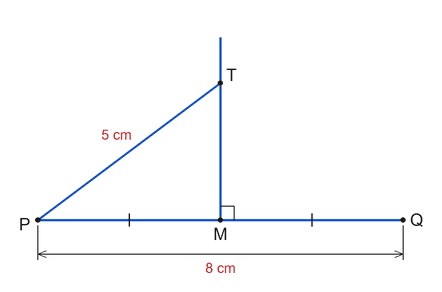
The distance is :
- 341 mark
Question 34
A triangle cannot be constructed with the given measurements in :
- 352 marks
Question 35
Construct an isosceles triangle in which cm and cm, using ruler and compasses only. Measure and write the measure of and .
- 362 marks
Question 36
Construct an equilateral triangle of side 7 cm. Draw the perpendicular from to , meeting at . Measure and .
- 372 marks
Question 37
Construct a right-angled triangle in which , cm and the hypotenuse cm. Measure and check your measurement by calculation.
- 382 marks
Question 38
Draw a line segment cm. Mark a point on such that cm. At construct a perpendicular to and mark a point on it with cm. Join and and measure them.
- 393 marks
Question 39
(a) Draw a line and, using ruler and compasses only, construct .
(b) Bisect with the ray . Write the measure of .
(c) Produce backwards to a point . Find by calculation.
- 404 marks
Question 40
(a) In , cm, and . Find by calculation.
(b) Construct the triangle with ruler and compasses only.
(c) Measure and .
(d) Which side is the longest, and which angle is opposite to it ?
- 414 marks
Question 41
Construct with cm, cm and cm.
(a) Construct its circumcircle and measure the circumradius.
(b) Construct its incircle and measure the inradius.
(c) Which of the two circles has its centre equidistant from the sides, and which has its centre equidistant from the vertices ?