
Opening your dashboard
Class 7 Maths Chapter 22 Constructions: Competency-Based Questions (CBQ)
40 questions on Chapter 22, each worked through on its own page with the AI tutor. Class 7 Maths, ICSE 2026-27.
40 questions
1–5 marks · Mixed difficulty
- 11 mark
Question 1
Competency: Application
Rehan is drawing a clock face. He has drawn the line from the centre O to the mark for 12. He now needs the line from O to the mark for 1, using ruler and compasses only.

The 12 hour-marks are equally spaced around the centre. Which construction gives the angle he needs?
- 21 mark
Question 2
Competency: Understanding
Meena's notebook shows the figure below. First she drew an arc with centre P to cut the line AB at C and D. Then she drew two equal arcs with centres C and D to cut each other at E, and joined PE.
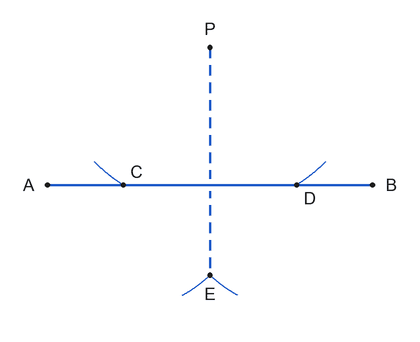
What has Meena constructed?
- 31 mark
Question 3
Competency: Application
A triangular park has sides 60 m, 80 m and 100 m. Ria makes a scale drawing of it, taking 1 cm for 20 m.
Which triangle must she construct?
- 41 mark
Question 4
Competency: Analysis
Raj draws a line segment AB = 6 cm. With A as centre he draws an arc of radius 6 cm. With B as centre he draws an arc of radius 4 cm, cutting the first arc at C. He joins AC and BC.
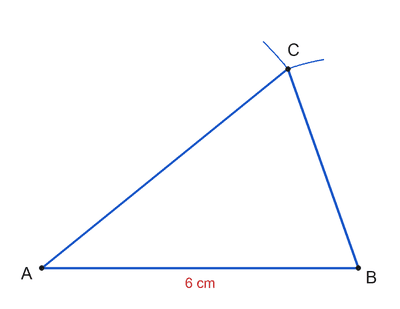
Without measuring, what kind of triangle is ABC?
- 51 mark
Question 5
Competency: Evaluation
Assertion (A): The centre of the incircle of a triangular lawn is at the same distance from the three edges of the lawn.
Reason (R): The incentre of a triangle is the point where the perpendicular bisectors of its sides meet.
- 61 mark
Question 6
Competency: Application
A ladder 6.5 m long leans against a vertical wall. Its foot is 2.5 m from the wall. Asif makes a scale drawing, taking 1 cm for 1 m.
He draws AB = 2.5 cm for the ground, with A at the foot of the wall. At A he constructs ∠BAP = 90°, so that the ray AP stands for the wall.

Which step fixes the top C of the ladder on the wall?
- 72 marks
Question 7
Competency: Application
A round pizza is to be cut into 8 equal slices by straight cuts through its centre O. One cut AB through O has already been made.
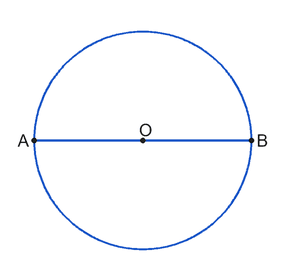
(a) What must be the angle at the centre for each slice?
(b) Describe how to mark the other cuts using ruler and compasses only.
- 82 marks
Question 8
Competency: Evaluation
Ravi and Sana each draw the perpendicular bisector of the same line segment AB = 6 cm. Ravi uses arcs of radius 4 cm from A and B. Sana uses arcs of radius 5 cm.
Ravi says, “Our arcs cut at different points, so we will get two different perpendicular bisectors.”
Is Ravi right? Give reasons.
- 92 marks
Question 9
Competency: Analysis
Neha constructed a triangle with these steps.
- She drew BC = 6 cm.
- At B she constructed an angle of 90° and then bisected it.
- At C she constructed an angle of 60°.
- The two arms met at A.
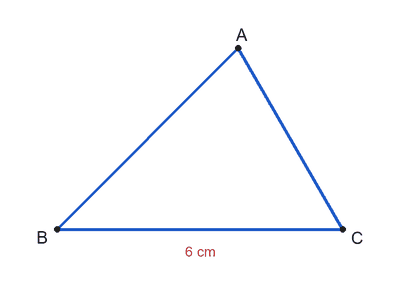
Without measuring, find the three angles of ΔABC. Is the triangle acute-angled, right-angled or obtuse-angled?
- 102 marks
Question 10
Competency: Understanding & Analysis
A triangular park has a gate at each of its three corners and a straight wall along each of its three sides.
(a) A lamp post must be at the same distance from all three gates.
(b) A round fountain must touch all three walls.
For each, name the point of the triangle that must be used as the centre, and say which lines are constructed to find it.
- 113 marks
Question 11
Competency: Application
A triangular plot ABC has AB = 70 m and AC = 50 m. The angle between these two sides is 60°.
(a) Construct a scale drawing of the plot with ruler and compasses, taking 1 cm for 10 m.
(b) Measure BC on your drawing, to the nearest 0.1 cm, and find the real length of the third side (approximately).
(c) About how many metres of fencing are needed to go once around the plot?
- 123 marks
Question 12
Competency: Analysis & Evaluation
Tara has to construct a right-angled ΔABC with ∠B = 90°, AB = 4 cm and hypotenuse AC = 5 cm. She writes these steps.
- Draw AB = 4 cm.
- At B, construct ∠ABP = 90°.
- With B as centre and radius 5 cm, draw an arc to cut BP at C. Join AC.
(a) Which step is wrong? Explain the mistake.
(b) In Tara's triangle, which side is 5 cm? Is her side AC longer or shorter than 5 cm? Give a reason.
(c) Write the correct step, and find the length of BC in the correct triangle.
- 133 marks
Question 13
Competency: Creativity
A flag for sports day is to be an isosceles triangle. All its angles must be angles that you can construct with ruler and compasses only (no protractor).
(a) Choose the length of the base and the size of the base angles for your flag. Find the third angle.
(b) Write the steps of construction for your flag.
(c) Construct it and measure the two equal sides, to the nearest 0.1 cm.
- 144 marks
Question 14
Competency: Application & Analysis
Case study — One tower for three villages
A mobile tower is to be built for three villages A, B and C. The table gives the straight-line distances between them.
Villages A and B B and C C and A Distance 7 km 6 km 5 km A scale drawing is made, taking 1 cm for 1 km.
(a) Check that a triangle can be constructed with these distances. Construct ΔABC.
(b) The tower must be at the same distance from all three villages. Construct its position. Measure and find this distance in kilometres, to the nearest 0.1 km.
(c) A villager says, “Put the tower at M, the mid-point of AB. It is equally far from A and B.” Measure MC, to the nearest 0.1 cm. Is M equally far from all three villages?
- 155 marks
Question 15
Competency: Application & Evaluation
Case study — A round flower bed in a corner lawn
A school lawn is a right-angled triangle. The two sides that form the right angle are 9 m and 12 m long. A round flower bed, as large as possible, is to be made inside the lawn so that it touches all three edges.
A scale drawing is made, taking 1 cm for 1.5 m.
(a) Find the two lengths to be used in the drawing. Construct the triangle and find the real length of the third edge of the lawn.
(b) Construct the circle that stands for the flower bed. Measure its radius and find the real radius of the bed.
(c) A sprinkler at the centre of the bed waters the ground up to 4 m away in every direction. The gardener says, “All the water will fall inside the lawn.” Is he right? Give a reason.
- 161 mark
Question 16
Competency: Understanding
Dev has to construct an angle of 90° at a point P of a line, using "ruler and compasses only". Four things he might do are listed below.
Which one breaks the rule?
- 171 mark
Question 17
Competency: Analysis
Ishaan draws a ray OP and constructs ∠POQ = 60° with ruler and compasses. He bisects ∠POQ to get the ray OR, and then bisects ∠ROQ to get the ray OS. The figure shows his final rays.

What is the measure of ∠POS?
- 181 mark
Question 18
Competency: Understanding
Anita draws a line segment AB = 7.4 cm. With A and B as centres she draws arcs of the same radius, 4.5 cm, on both sides of AB. The arcs cut at C and D, and CD meets AB at P.
What are the length AP and the measure of ∠APC?
- 191 mark
Question 19
Competency: Analysis
Kavya must construct ΔABC with AB = 5.5 cm, BC = 4 cm and ∠B = 75°.
Which list of steps is correct?
- 201 mark
Question 20
Competency: Understanding & Evaluation
Assertion (A): Rani constructs ΔABC with BC = 6 cm and ∠B = ∠C = 75°. In her triangle, AB = AC.
Reason (R): The sides opposite to equal angles of a triangle are equal.
- 211 mark
Question 21
Competency: Evaluation
Three students want to find the incentre of ΔABC.
Tanvi bisects ∠A and ∠B, and marks the point where the two bisectors meet. Roy bisects ∠A and draws the perpendicular bisector of BC, and marks the point where they meet. Sam bisects all three angles ∠A, ∠B and ∠C, and marks the point where the bisectors meet.
Whose point is the incentre of the triangle?
- 221 mark
Question 22
Competency: Analysis
Neha draws a circle with centre O and radius 5 cm, and marks a point P on the circle. Keeping the compasses open at 5 cm, she puts the needle at P and cuts the circle at Q. Then she puts the needle at Q and cuts the circle at R, and goes on in the same way until she comes back to P.
How many points, P included, does she mark on the circle, and what angle does each step make at the centre O?
- 231 mark
Question 23
Competency: Application
Ananya wants to construct a right-angled ΔPQR with ∠Q = 90°, PQ = 4 cm and hypotenuse PR = 7 cm. Her four actions, written in the wrong order, are:
- With P as centre and radius 7 cm, draw an arc to cut the perpendicular at R.
- Draw the line segment PQ = 4 cm.
- Join PR.
- At Q, construct a perpendicular to PQ.
In which order must she do them?
- 241 mark
Question 24
Competency: Evaluation
Assertion (A): An angle of 15° can be constructed with ruler and compasses only.
Reason (R): Bisecting an angle of 60° once gives an angle of 15°.
- 251 mark
Question 25
Competency: Application
Meera needs an angle of exactly 7.5° for a craft template, and she has only a ruler and compasses.
Which plan gives exactly 7.5°?
- 262 marks
Question 26
Competency: Analysis
Priya wants to construct ∠BOC = 60° at O on the ray OA. She draws an arc with centre O and radius 3 cm, cutting OA at B. Then she narrows the compasses to 2 cm, and with centre B she cuts the first arc at C. She joins OC.
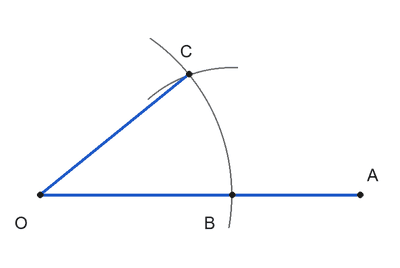
Is ∠BOC equal to 60°, more than 60° or less than 60°? Give a reason.
- 272 marks
Question 27
Competency: Understanding & Analysis
Aman constructs an equilateral ΔABC with each side 5 cm. On the side BC, on the opposite side from A, he constructs another equilateral ΔDBC. He joins AB, AC, DB and DC.
(a) Find ∠ABD.
(b) What special quadrilateral is ABDC? Give a reason.
- 282 marks
Question 28
Competency: Application & Analysis
A straight pipeline AB is 9 m long. On a plan, 1 cm stands for 2 m, so AB is drawn as 4.5 cm. A valve is to be fixed at the mid-point of the pipeline, and a branch pipe is to leave the valve at right angles to AB.
(a) Which single construction on the plan gives both the position of the valve and the direction of the branch?
(b) For this construction the compasses can be set to a radius of 2 cm, 2.25 cm or 3 cm. Which of these can be used? Give a reason.
- 292 marks
Question 29
Competency: Evaluation
Arun and Beena each construct a triangle ABC with ∠A = 45°, ∠B = 60° and ∠C = 75°. Arun's triangle has AB = 5 cm and Beena's has AB = 8 cm.
Ria says, "The angles are the same, so the two triangles must be exactly the same."
Is Ria right? What must be given along with two angles to fix the triangle?
- 302 marks
Question 30
Competency: Application
A school gardener has three jobs on a plan of a lawn. Name the construction that does each job, and state its first step.
(a) Fix a tap at the exact middle of a straight edge AB of a flower bed.
(b) Run a path from a point P on the line AB at right angles to AB.
(c) Lay a second rope through a point T outside the line AB so that it never meets AB.
- 312 marks
Question 31
Competency: Analysis
Rahul constructs ΔABC in two ways.
Method 1: He draws AB = 6 cm, constructs ∠B = 90°, and cuts off BC = 8 cm.
Method 2: He draws AB = 6 cm, constructs ∠B = 90°, and draws an arc with centre A and radius 10 cm to cut the perpendicular at C.
Will the two methods give the same triangle? Give a reason without measuring.
- 323 marks
Question 32
Competency: Application & Analysis
Hari draws a line segment AB = 7 cm and constructs its perpendicular bisector, which meets AB at M.
(a) Describe how he constructs the perpendicular bisector.
(b) On the perpendicular bisector he marks the two points X and Y that are 5 cm from A. How does he find them?
(c) He joins XB and measures it, and does the same for YB. What does he find? Give a reason.
- 333 marks
Question 33
Competency: Evaluation
Aman and Beena both construct an equilateral triangle ABC of side 6 cm.
Aman draws BC = 6 cm, and with B and C as centres and radius 6 cm he draws two arcs that meet at A.
Beena draws BC = 6 cm, constructs 60° at B and 60° at C, and the two arms meet at A.
(a) Why is every side of Aman's triangle 6 cm?
(b) Show that Beena's triangle is also equilateral.
(c) Whose method needs fewer arcs? Give a reason.
- 343 marks
Question 34
Competency: Analysis
A student starts with an angle of 120° and bisects it. Then he bisects the angle he got, and so on, bisecting the last angle each time.
(a) Find the angle after 1, 2 and 3 bisections.
(b) How many bisections are needed before the angle first becomes less than 10°?
(c) Another student wants to end with 26.25° after exactly two bisections. What angle must she start with, and how can she construct that angle?
- 353 marks
Question 35
Competency: Creativity
Make up a real-life problem of your own in which a point at the same distance from the three straight sides of a triangular place is needed.
(a) Write your problem in two or three sentences.
(b) Name the point and the circle you would construct.
(c) Write the first three steps of the construction.
- 363 marks
Question 36
Competency: Application
A pair of compasses has two legs, each 8 cm long. When the legs are opened to make an angle of 45° at the hinge, the needle tip and the pencil tip are some distance apart.
(a) Construct this triangle with ruler and compasses: the legs AB and AC are 8 cm each and ∠A = 45°. Say how you get 45°.
(b) Measure the distance BC between the tips, to the nearest 0.1 cm.
(c) For the tips to be exactly 8 cm apart, what must the angle between the legs be? Give a reason.
- 374 marks
Question 37
Competency: Application & Evaluation
Case study — Which ramp reaches the platform?
A shop's loading platform is 0.7 m above the ground. A ramp must run from the ground up to the edge of the platform. The ramp, the vertical wall of the platform and the level ground form a right-angled triangle. Three ramps are being considered. (Hypothetical data.)
Ramp Length of ground covered Length of the ramp A 2.4 m 2.5 m B 1.2 m 1.3 m C 1.8 m 1.95 m A scale drawing is made, taking 1 cm for 0.5 m.
(a) Find the two lengths needed to draw ramp A. Construct the triangle with ruler and compasses.
(b) Measure the height reached by the top of the ramp on your drawing, and find the real height.
(c) Find the heights reached by ramps B and C in the same way. Which ramp reaches the platform exactly?
- 385 marks
Question 38
Competency: Application & Analysis
Case study — A circle graph of favourite sports
A teacher asked 36 students of Class 7 for their favourite sport. (Hypothetical data.)
Sport Cricket Football Kabaddi Others Students 12 9 6 9 The result is to be shown in a circle graph, in which the whole circle (360°) stands for all 36 students.
(a) How many degrees stand for one student? Find the angle at the centre for each sport.
(b) For each of these angles, say whether it can be made by the 60° construction directly, by the 90° construction, or by adding two constructed angles.
(c) Next year 24 students are asked, and the counts are Cricket 5, Football 6, Kabaddi 7 and Others 6. Find the new angles. Two of them are not 60°, 90° or 120°. Say how each of these two can be constructed.
- 394 marks
Question 39
Competency: Application & Evaluation
Case study — The surveyor's rope test
A surveyor marks the corner of a plot with a rope made of three parts. She lays the rope as a triangle, and the corner between the two shorter parts is square only if it is 90°. Three ropes are available, and the table gives the lengths of their three parts. (Hypothetical data.)
Rope Part 1 Part 2 Part 3 A 9 m 12 m 15 m B 9 m 12 m 16 m C 8 m 15 m 17 m A scale drawing is made, taking 1 cm for 2 m.
(a) Find the lengths needed to draw rope A. Construct the triangle and measure the angle between the two shorter parts.
(b) Without drawing, test ropes A, B and C by comparing the square of the longest part with the sum of the squares of the other two.
(c) Construct rope B on the same scale and measure the angle between its two shorter parts. Which ropes can the surveyor use for a square corner?
- 405 marks
Question 40
Competency: Application & Analysis
Case study — Making a kite
Rohan makes a kite from thin bamboo sticks. The cross-stick BC is 24 cm long. Two sticks, AB and AC, each 20 cm long, join the ends of BC to the top A. Two other sticks, DB and DC, each 16 cm long, join the ends of BC to the bottom D, on the other side of BC. A scale drawing is made, taking 1 cm for 4 cm.
(a) Find the lengths for the drawing. Construct ΔABC and ΔDBC, with A and D on opposite sides of BC.
(b) The spine is the stick AD. Measure AD on the drawing, to the nearest 0.1 cm, and find the length of the spine in centimetres.
(c) Rohan says, "The spine AD cuts BC at its mid-point and at a right angle." Is he right? Which construction of this chapter explains your answer?