
Question 273 marksMedium
Construct an isosceles Δ ABC such that :
(i) base BC = 4 cm and base angle = 30°
Confirming your payment
Sign up now and get 250 free tokens.
Constructions · Question 27 of 49
Construct an isosceles Δ ABC such that :
(i) base BC = 4 cm and base angle = 30°
Solution:
Concept: In an isosceles triangle the angles opposite the equal sides (the base angles) are equal. So we construct the given base angle at BOTH ends of the base; the two arms meet at the vertex. The angles of a triangle add up to 180°.
Given: Base BC = 4 cm and base angles = 30°; a ruler and a pair of compasses only.
Step 1 — Draw the base.
Draw the base BC = 4 cm.
Step 2 — Construct 30° at B.
With B as centre and any convenient radius, draw an arc cutting BC. With that cut point as centre and the same radius, cut the arc again, and draw a ray from B through this second point. B and the two cut points form an equilateral triangle, so the ray makes 60° with BC. Now bisect this 60° angle: with the two cut points as centres and equal radii, draw arcs meeting inside the angle, and draw a ray from B through the meeting point. It makes 60° ÷ 2 = 30° with BC.
Step 3 — Construct 30° at C.
On the SAME side of BC, construct 30° at C in the same way, measured from CB.
Step 4 — Mark the vertex.
The two rays meet at A. The base angles are equal, so AB = AC.
Step 5 — Look at the finished figure and check it.
The finished construction is shown below, with the given measurements marked on it.
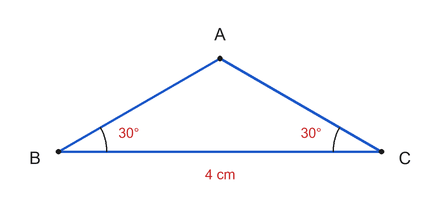
Watch out: Construct the angles on the SAME side of the base, or the arms never meet.
Therefore, ΔABC is the required isosceles triangle (AB = AC).