
Question 293 marksMedium
Construct an isosceles Δ ABC such that :
(iii) base AC = 5 cm and base angle = 75°. Measure the other two sides of the triangle.
Confirming your payment
Sign up now and get 250 free tokens.
Constructions · Question 29 of 49
Construct an isosceles Δ ABC such that :
(iii) base AC = 5 cm and base angle = 75°. Measure the other two sides of the triangle.
Solution:
Concept: In an isosceles triangle the angles opposite the equal sides (the base angles) are equal. So we construct the given base angle at BOTH ends of the base; the two arms meet at the vertex. The angles of a triangle add up to 180°.
Given: Base AC = 5 cm and base angles = 75°; a ruler and a pair of compasses only.
Step 1 — Draw the base.
Draw the base AC = 5 cm.
Step 2 — Construct 75° at A.
At A, mark the 60° point and draw the 90° ray as described above (one arc about A, two equal steps along it, then a bisector). Bisect the angle between the 60° point and the 90° ray, using the 60° point and the point where the arc cuts the 90° ray. The bisector lies half-way between 60° and 90°, so it makes 60° + 15° = 75° with AC.
Step 3 — Construct 75° at C.
On the SAME side of AC, construct 75° at C in the same way, measured from CA.
Step 4 — Mark the vertex.
The two rays meet at B. The base angles are equal, so BA = BC.
Step 5 — Measure the other two sides.
With the ruler, AB and BC each measure about 9.7 cm. They are equal because the base angles are equal, and they are long because 75° base angles make a tall, narrow triangle (the vertex angle is only 180° − 150° = 30°).
Step 6 — Look at the finished figure and check it.
The finished construction is shown below, with the given measurements marked on it.
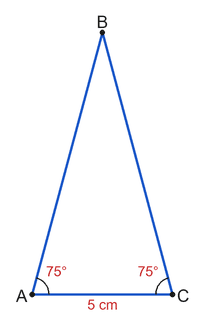
Watch out: Construct the angles on the SAME side of the base, or the arms never meet.
Note: A printed answer of 9.6 cm is the same length cut short; to one decimal place the length is 9.7 cm (more exactly 9.66 cm). A measured length can differ by 0.1 cm.
Therefore, on measuring, AB = BC ≈ 9.7 cm.