
Question 313 marksMedium
Construct an isosceles Δ ABC such that :
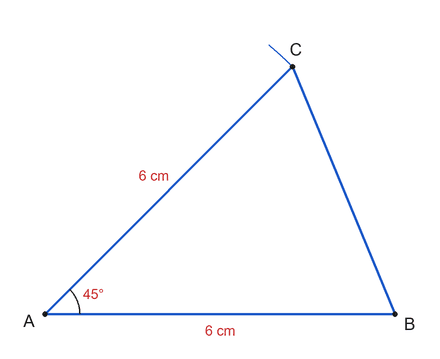
(ii) One of the equal sides = 6 cm and vertex angle = 45°. Measure the base angles.
Confirming your payment
Sign up now and get 250 free tokens.
Constructions · Question 31 of 49
Construct an isosceles Δ ABC such that :
(ii) One of the equal sides = 6 cm and vertex angle = 45°. Measure the base angles.
Solution:
Concept: When two sides and the angle between them are known, we draw one side, construct the angle at its end, and cut off the other side on the new arm with the compasses. Joining the two free ends completes the triangle. In an isosceles triangle the base angles (opposite the equal sides) are equal, and the angles of a triangle add up to 180°.
Given: One of the equal sides = 6 cm and the vertex angle = 45°; a ruler and a pair of compasses only.
Step 1 — Draw one equal side.
Draw AB = 6 cm.
Step 2 — Construct 45° at A.
With A as centre draw an arc cutting AB; keeping the same radius, step off two equal arcs along it to mark the 60° and the 120° points. With these two points as centres and equal radii, draw arcs meeting outside the first arc, and draw a ray from A through the meeting point. It bisects the angle between 60° and 120°, so it makes 90° with AB. Now bisect this right angle, using the points where the first arc cuts AB and the 90° ray. The bisector makes 90° ÷ 2 = 45° with AB.
Step 3 — Cut off the other equal side.
With A as centre and radius 6 cm, cut the new ray at C. Now AB and AC are both 6 cm.
Step 4 — Complete the triangle.
Join BC.
Step 5 — Measure and check the base angles.
With the protractor, ∠B and ∠C each read 67.5°. The base angles are equal and share the 135° left over from 180°.
Step 6 — Look at the finished figure and check it.
The finished construction is shown below, with the given measurements marked on it.
Watch out: The given angle is the VERTEX angle between the equal sides; do not construct it at the base.
Therefore, on measuring, each base angle = 67.5° (67° 30′).