
Question 333 marksMedium
Construct an equilateral Δ ABC such that :
(i) AB = 5 cm. Draw the perpendicular bisectors of BC and AC. Let P be the point of intersection of these two bisectors. Measure PA, PB and PC.
Confirming your payment
Sign up now and get 250 free tokens.
Constructions · Question 33 of 49
Construct an equilateral Δ ABC such that :
(i) AB = 5 cm. Draw the perpendicular bisectors of BC and AC. Let P be the point of intersection of these two bisectors. Measure PA, PB and PC.
Solution:
Concept: All three sides of an equilateral triangle are equal, so the third vertex is where arcs of radius equal to the side, drawn from both ends of the base, meet. A point on the perpendicular bisector of a side is equally far from the two ends of that side.
Given: AB = 5 cm; a ruler and a pair of compasses only.
Step 1 — Draw the base.
Draw AB = 5 cm.
Step 2 — Mark C.
With A and B as centres and radius 5 cm, draw arcs meeting at C. Join AC and BC. Every side is 5 cm, so ΔABC is equilateral.
Step 3 — Draw the perpendicular bisector of BC.
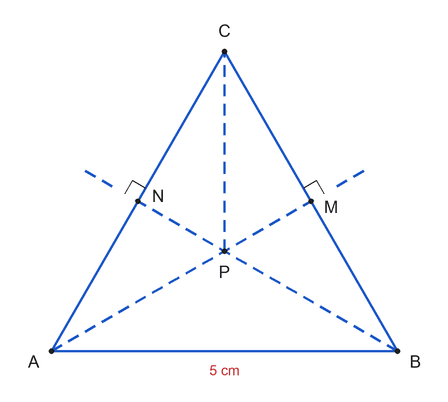
With B and C as centres and equal radii (more than half of BC), draw arcs on both sides of BC and join their crossing points. This line meets BC at its mid-point M at right angles; in an equilateral triangle it also passes through A.
Step 4 — Draw the perpendicular bisector of AC.
In the same way, draw the perpendicular bisector of AC, meeting AC at its mid-point N; it passes through B. Let the two bisectors meet at P.
Step 5 — Measure PA, PB and PC.
Join PC and measure the three lengths: each is about 2.9 cm. P is on the perpendicular bisector of BC, so PB = PC; it is on the perpendicular bisector of AC, so PA = PC.
Step 6 — Look at the finished figure and check it.
The finished construction is shown below, with the given measurements marked on it.
Watch out: The perpendicular bisector cuts the side at its MID-point; check that BM = MC before going on.
Therefore, ΔABC is the required equilateral triangle; P is equally far from all three vertices: PA, PB and PC are each about 2.9 cm.