
Question 353 marksMedium
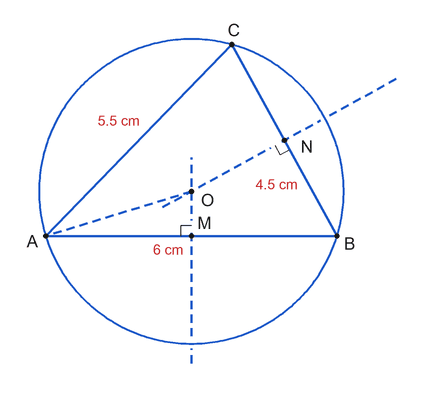
(i) Construct a Δ ABC such that AB = 6 cm, BC = 4·5 cm and AC = 5·5 cm. Construct a circumcircle of this triangle.
Confirming your payment
Sign up now and get 250 free tokens.
Constructions · Question 35 of 49
(i) Construct a Δ ABC such that AB = 6 cm, BC = 4·5 cm and AC = 5·5 cm. Construct a circumcircle of this triangle.
Solution:
Concept: The circumcircle of a triangle passes through all three vertices. Its centre, the circumcentre O, is equally far from the three vertices, so it lies on the perpendicular bisector of every side (each point of a side's perpendicular bisector is equally far from the two ends of that side). Two perpendicular bisectors are enough to find O.
Given: AB = 6 cm, BC = 4.5 cm and AC = 5.5 cm; a ruler and a pair of compasses only.
Step 1 — Construct the triangle.
Draw AB = 6 cm. With A as centre and radius 5.5 cm, and with B as centre and radius 4.5 cm, draw arcs meeting at C. Join AC and BC.
Step 2 — Draw the perpendicular bisector of AB.
With A and B as centres and equal radii (more than half of AB), draw arcs on both sides of AB and join their crossing points. This line meets AB at its mid-point M at right angles.
Step 3 — Draw the perpendicular bisector of BC.
With B and C as centres and equal radii (more than half of BC), draw arcs on both sides of BC and join their crossing points. This line meets BC at its mid-point N at right angles.
Step 4 — Mark the circumcentre.
Let the two perpendicular bisectors meet at O. O is equally far from A and B, and from B and C, so OA, OB and OC are all equal.
Step 5 — Draw the circle.
With O as centre and radius OA, draw a circle. It passes through A, B and C; on measuring, its radius OA is about 3.1 cm.
Step 6 — Look at the finished figure and check it.
The finished construction is shown below, with the given measurements marked on it.
Watch out: The circle's centre is where the perpendicular bisectors of the SIDES meet, not where the angle bisectors meet.
Therefore, the circle through A, B and C is the required circumcircle (radius OA ≈ 3.1 cm).