
Opening your dashboard
Class 12 Physics Chapter 7: Moving Charges and Magnetism Solutions
124 textbook questions with step-by-step answers, free to read, for ISC 2026-27.
Get talked through Ch 7, not just shown the answer
Reading a finished solution is not the same as being able to do it. The AI tutor takes one question at a time and works it with you, in your own words, until you can.
- Ask it out loud, in your own words
- It gives you the next step, not the answer
- Stuck on part (ii)? Start there
124 questions with solutions
1–5 marks · Mixed difficulty
The first 14 solutions are on this page. This chapter is a long one, so the rest open on their own page to keep this one quick to load.
- 11 mark
Question 1
Magnetic field at a distance from an infinitely long straight conductors carrying a steady current varies as
Solve with AIAnswer
(A)
- Correct
(B)
(C)
(D)
Answer: (B)
Key idea: The field of an infinitely long straight wire carrying a steady current follows from Ampère's circuital law (or from the Biot–Savart law). Its field lines are circles round the wire, and the field strength falls off inversely with the perpendicular distance from the wire.
Step 1 — Write the field of a long straight wire.
We take a circular loop of radius round the wire. By symmetry has the same size at every point of this loop and points along it, so Ampère's law gives the field directly.
Step 2 — Read off how depends on .
Everything in the formula except is fixed for a given wire and current, so the field is inversely proportional to the distance.
Why the other options are wrong:
- (A) is wrong: The law belongs to the field of a single short current element (the Biot–Savart law); adding up all the elements of an infinitely long wire turns it into a law.
- (C) is wrong: A fall-off describes the far field of a small current loop (a magnetic dipole), not the field of a long straight wire.
- (D) is wrong: By Step 2, doubling halves , whereas a law would reduce it only to about of its value.
Therefore, the field of an infinitely long straight wire varies as 1/r: option (B).
- 21 mark
Question 2
If a long hollow copper pipe carries a direct current, the magnetic field associated with the current will be
Solve with AIAnswer
(A) Only inside the pipe
- Correct
(B) Only outside the pipe
(C) Neither inside nor outside the pipe
(D) Both inside and outside the pipe
Answer: (B) Only outside the pipe
Key idea: Ampère's circuital law says that the line integral of round any closed loop equals times the current enclosed by the loop. For a long straight pipe the field lines are circles coaxial with the pipe, so we use circular loops centred on its axis.
Step 1 — Apply the law inside the hollow.
We take a circle of radius smaller than the inner radius of the pipe. All the current flows in the copper wall, which lies outside this circle, so the enclosed current is zero.
Step 2 — Apply the law outside the pipe.
Now we take a circle of radius larger than the outer radius. This circle encloses the whole current .
This is not zero, so there is a field outside the pipe, just as for a thin straight wire.
Note: Within the copper wall itself the field rises from zero at the inner surface to its full outside value at the outer surface; the options ask only about the hollow and the region outside.
Why the other options are wrong:
- (A) is wrong: The hollow encloses no current (Step 1), so the field there is zero; the field exists outside, the opposite of what this option says.
- (C) is wrong: Outside the pipe the loop encloses the whole current (Step 2), so the field there is and not zero.
- (D) is wrong: Although there is a field outside, the field in the hollow is zero, so the field is not present on both sides.
Therefore, the magnetic field of the current exists only outside the pipe: option (B).
- 31 mark
Question 3
A current loop in a magnetic field
Solve with AIAnswer
- Correct
(A) Can be in equilibrium in two orientation, one stable while the other is unstable
(B) Experiences a torque whether the field is uniform or non-uniform in all orientations
(C) Can be in equilibrium in one orientation
(D) Can be in equilibrium in two orientation, both the equilibrium states are unstable
Answer: (A) Can be in equilibrium in two orientation, one stable while the other is unstable
Key idea: A current loop of magnetic moment in a uniform field feels a torque of size , where is the angle between and . Its potential energy is , and an equilibrium is stable where is least and unstable where is greatest.
Step 1 — Find the orientations with zero torque.
The loop is in equilibrium only where the torque is zero, so we need to vanish.
So the loop is in equilibrium at or at : two orientations.
Step 2 — Test the equilibrium at .
Here points along and the potential energy has its least value.
If the loop is turned slightly, the torque turns it back towards , so this equilibrium is stable.
Step 3 — Test the equilibrium at .
Here points opposite to and the potential energy has its greatest value.
If the loop is turned slightly, the torque turns it further away, towards , so this equilibrium is unstable.
Why the other options are wrong:
- (B) is wrong: The torque is zero at and (Step 1), so the loop does not feel a torque in every orientation.
- (C) is wrong: Step 1 gives two equilibrium orientations, not just one.
- (D) is wrong: The orientation is the minimum of energy and is stable (Step 2); only is unstable.
Therefore, a current loop in a magnetic field can be in equilibrium in two orientations, one stable (θ = 0°) and one unstable (θ = 180°): option (A).
- 41 mark
Question 4
The magnetic induction at a point which is at a distance 4 cm from a long current-carrying wire is tesla. The field of induction at a distance 12 cm from the same current would be
Solve with AIAnswer
- Correct
(A) tesla
(B) tesla
(C) tesla
(D) tesla
Answer: (A) tesla
Key idea: The field of a long straight wire is . For the same current, is inversely proportional to the distance from the wire.
Step 1 — Write the ratio of the two fields.
The current, and hence , is the same at both points, so it cancels in the ratio.
Step 2 — Substitute the values.
The field at (4 cm) is ( T), and we want the field at (12 cm). The length unit cancels, so the distances can stay in centimetres.
As a check, the point is three times farther from the wire, so the field is one third as large.
Why the other options are wrong:
- (B) is wrong: A value of T is over ten thousand times larger than T, but moving three times farther from the wire must reduce the field to one third.
- (C) is wrong: A value of T is also far larger than the field at cm, so it cannot be the field at the greater distance of cm.
- (D) is wrong: A value of T is larger still; the field farther from the wire is always weaker, so this cannot be right.
Therefore, the field at 12 cm from the wire is about 3.33 × 10⁻⁹ T: option (A).
- 51 mark
Question 5
A horizontal overheads power line is at a height of 4 m from the ground and carries a current of 100 A from east to west. The magnetic field directly below it on the ground is ()
Solve with AIAnswer
(A) T northward
- Correct
(B) T southward
(C) T northward
(D) T southward
Answer: (B) T southward
Key idea: The field of a long straight current is . Its direction follows the right-hand thumb rule, which is the same as taking the cross product of the current direction with the unit vector from the wire to the point.
Step 1 — Find the size of the field.
The point on the ground is m below the line, and the current is A.
Step 2 — Find the direction of the field.
We take east as , north as and vertically up as . The current flows west, along , and the unit vector from the wire down to the point on the ground is . The field points along their cross product.
The direction is south. The right-hand thumb rule agrees: with the thumb pointing west, the curled fingers pass under the wire towards the south.
Why the other options are wrong:
- (A) is wrong: Its size is right, but the direction is reversed; a northward field below the line would need the current to flow from west to east.
- (C) is wrong: A field of T is twenty times smaller than the value from Step 1, and northward is the reversed direction as well.
- (D) is wrong: Southward is the right direction, but T is twenty times smaller than the value from Step 1.
Therefore, the field on the ground directly below the line is 5 × 10⁻⁶ T towards the south: option (B).
- 61 mark
Question 6
Consider two straight parallel conductor and separated by a distance and carrying individual currents and respectively. If the two conductors attract each other, it indicates that
Solve with AIAnswer
- Correct
(A) the two currents are parallel in direction
(B) the two currents are anti-parallel in direction
(C) the magnetic lines of induction are parallel
(D) the magnetic line of induction are parallel to length of conductors
Answer: (A) the two currents are parallel in direction
Key idea: Each conductor lies in the magnetic field of the other, so each feels a force . Working out the direction of this force shows that parallel currents attract and antiparallel currents repel.
Step 1 — Find the field of at the position of .
We place along the -axis with its current along , and a distance away along . By the right-hand thumb rule (current direction crossed with the direction from to ), the field of at is along .
Step 2 — Find the force on when its current is also along .
The force on is along , with along its own current.
The force on points along , back towards , so parallel currents attract. Reversing either current reverses this force and gives repulsion.
Step 3 — Read the result backwards.
Since the two conductors attract, the currents in them must flow in the same direction.
Why the other options are wrong:
- (B) is wrong: Reversing one current reverses the force found in Step 2, so antiparallel currents repel and cannot cause attraction.
- (C) is wrong: The attraction tells us about the current directions, not the field lines; in fact, between two parallel currents the two fields point in opposite directions.
- (D) is wrong: The field lines of a straight conductor are circles in planes perpendicular to the conductor, so they are never parallel to its length.
Therefore, the attraction shows that the two currents flow in the same direction: option (A).
- 71 mark
Question 7
In using Ampere’s law to find the magnetic field of a straight, long solenoid, the loop (Amperian loop) that is taken as
Solve with AIAnswer
(A) A circular loop, coaxial with the solenoid
(B) A rectangular loop in a plane perpendicular to the axis of the solenoid
(C) A rectangular loop in a place containing the axis of the solenoid, the loop being totally within the solenoid
- Correct
(D) A rectangular loop in a plane containing the axis of the solenoid, the loop being partially inside the solenoid, and partially outside it
Answer: (D) A rectangular loop in a plane containing the axis of the solenoid, the loop being partially inside the solenoid, and partially outside it
Key idea: Ampère's law, , gives a field only if the loop has along part of its path and also encloses some current. Inside a long solenoid is uniform and along the axis; outside it is almost zero.
Step 1 — Choose the loop.
We take a rectangle in a plane containing the axis. Side , of length , runs inside the solenoid parallel to the axis, side runs outside, and sides and cross the winding at right angles to the axis.
Step 2 — Work out the line integral.
Along the field is along the path and gives . Along and the field inside is perpendicular to the path and the field outside is nearly zero, and along the field is nearly zero, so these sides add nothing.
Step 3 — Count the enclosed current.
The rectangle is threaded by the turns that lie along length , each carrying current .
Step 4 — Apply Ampère's law.
We equate the line integral to times the enclosed current and cancel .
Why the other options are wrong:
- (A) is wrong: A circle coaxial with the solenoid lies in a plane perpendicular to the axis, so the axial field is perpendicular to every element of it; the line integral is zero and gives no value of .
- (B) is wrong: A rectangle in a plane perpendicular to the axis also has the axial field perpendicular to all its sides, so again the line integral is zero and tells us nothing about .
- (C) is wrong: A rectangle wholly inside encloses no turns, so Ampère's law shows only that the field is the same on its two long sides (uniform), not how large it is.
Therefore, the Amperian loop is a rectangle in a plane containing the axis, partly inside and partly outside the solenoid: option (D).
- 81 mark
Question 8
A long straight wire of radius carries a steady current . The current is uniformly distributed over its cross-section. The ratio of the magnetic field and , at radial distances and respectively, from the axis of the wire is
Solve with AIAnswer
(A)
(B)
- Correct
(C) 1
(D) 4
Answer: (C) 1
Key idea: Ampère's law on a circle of radius coaxial with the wire gives . Inside the wire, a uniform current encloses only the fraction of ; outside, the whole current is enclosed.
Step 1 — Find the field inside, at .
The circle of radius encloses the current .
Putting :
Step 2 — Find the field outside, at .
The circle of radius encloses the whole current .
Step 3 — Take the ratio.
The two fields have the same value, so their ratio is one.
Why the other options are wrong:
- (A) is wrong: The value comes from using the inside rule at both points, as ; outside the wire instead.
- (B) is wrong: The value is the ratio of the field at to the field at the surface ; the stem asks about , where the field has fallen back to the value it has at .
- (D) is wrong: The value comes from treating the inside point like an outside one; using at both points gives .
Therefore, B/B′ = 1: option (C).
- 91 mark
Question 9
The magnetic field within the solenoid having turns per metre length and carrying a current of ampere is given by
Solve with AIAnswer
(A)
- Correct
(B)
(C)
(D)
Answer: (B)
Key idea: Ampère's law, , applied to a rectangle that is partly inside a long solenoid gives the uniform field inside. Only the inside side of the rectangle contributes to the line integral.
Step 1 — Write the line integral.
We take a rectangle whose side of length runs inside the solenoid along the axis; the other sides add nothing because the field is perpendicular to them or nearly zero outside.
Step 2 — Apply Ampère's law.
The rectangle is threaded by turns, each carrying current , and we cancel on both sides.
Why the other options are wrong:
- (A) is wrong: Dividing by would give units of , not tesla; the electronic charge has no place in the field of a solenoid.
- (C) is wrong: The factor is already part of (about ), so multiplying by again makes the field times too large.
- (D) is wrong: The product is the magnetising field , measured in ; the flux density in tesla needs the factor .
Therefore, the field inside the solenoid is B = μ₀ni: option (B).
- 101 mark
Question 10
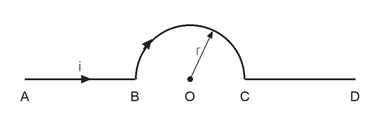
In the given figure, the magnetic induction at the centre of the arc due to the current in portion will be
 Solve with AI
Answer
(A)
(B)
(C)
- Correct
(D) Zero
Answer: (D) Zero
Key idea: By the Biot–Savart law, an element carrying current gives a field at a point at distance , where is the angle between the element and the line joining it to the point. A point on the line of a straight conductor gets no field from it.
Step 1 — Locate relative to .
In the figure, , , , and lie on one straight line, so lies on produced.
Step 2 — Find the angle between each element and the line to .
For every element of , the line from the element to runs along itself, so the angle is .
Step 3 — Add up the elements.
Every element of gives zero field at , so the whole of gives zero field there.
Why the other options are wrong:
- (A) is wrong: The value is twice the field at the centre of a full circular loop of radius ; no part of this conductor gives a field that large, and gives none at all.
- (B) is wrong: The value is the field at the centre of a complete circular loop, not of a straight part lying on a line through .
- (C) is wrong: The value is the field at due to the curved part (a semicircle), not due to the straight part .
Therefore, the field at O due to the portion AB is zero: option (D).
- 111 mark
Question 11
In the above question (10) the magnetic induction at due to the whole length of the conductor is
Solve with AIAnswer
(A)
(B)
- Correct
(C)
(D) Zero
Answer: (C)
Key idea: The field at is the sum of the fields of the three parts , and (superposition). A straight part whose line passes through gives no field there, and every element of a circular arc centred at gives a field in the same direction.
Step 1 — Find the field of the straight parts.
The straight parts and lie along the line through , so for each of their elements the angle between the element and the line to is or , and is zero.
Step 2 — Find the field of the semicircle .
Every element of the semicircle is at distance from and perpendicular to the radius, so each gives in the same direction. The total length of the semicircle is .
The current runs clockwise round (from over the top to ), so this field points into the page.
Step 3 — Add the three parts.
Only the semicircle contributes.
Why the other options are wrong:
- (A) is wrong: The value is four times the field of the semicircle; even a complete circle gives only .
- (B) is wrong: The value is the field of a complete circle, but here there is only a half circle, which gives half of it.
- (D) is wrong: The straight parts give zero, but the semicircle gives , so the total is not zero.
Therefore, the field at O due to the whole conductor is μ₀i/(4r), directed into the page: option (C).
- 121 mark
Question 12
The number of lines of the force passing through a unit area placed perpendicularly to the magnetic lines of force is termed as
Solve with AIAnswer
(A) Magnetic induction
(B) Magnetic flux density
(C) Intensity of magnetic field
- Correct
(D) All of the above
Answer: (D) All of the above
Key idea: The number of field lines crossing unit area held perpendicular to them measures the magnitude of , the quantity in . This one quantity goes by several names.
Step 1 — Identify the quantity.
Lines per unit perpendicular area is magnetic flux per unit area, measured in (tesla). That is exactly the magnitude of .
Step 2 — List the names of .
In this book is called the magnetic induction, the magnetic flux density (because it is flux per unit area) and the intensity of the magnetic field. These are three names for the same quantity, so each of options (A), (B) and (C) describes it.
Note: Some books keep the name "magnetic intensity" for the magnetising field (in ); in this chapter "intensity of magnetic field" means .
Why the other options are wrong:
- (A) is wrong: This name is correct, but it is only one of the three names offered, so choosing it alone leaves out two correct answers.
- (B) is wrong: This name is also correct, since is flux per unit area, but choosing it alone misses the other two names.
- (C) is wrong: This is the book's third name for ; on its own it is incomplete, since (A) and (B) are correct too.
Therefore, all three names describe the number of lines per unit perpendicular area: option (D).
- 131 mark
Question 13
A cyclotron is used to accelerate protons, deuterons, -particles etc. If the energy attained after acceleration by the proton is , the energy attained by -particles will be
Solve with AIAnswer
(A)
(B)
- Correct
(C)
(D)
Answer: (C)
Key idea: In a cyclotron with dees of radius and field , a particle leaves with kinetic energy . In the same machine ( and fixed) this energy is proportional to .
Step 1 — Derive the maximum energy.
At the outermost radius the magnetic force provides the centripetal force, , so we find the speed and then the kinetic energy.
Step 2 — Compare the α-particle with the proton.
The proton has charge and mass ; the α-particle has charge and mass . With and the same, the energies are in the ratio of .
Step 3 — State the energy.
The ratio is one, so the α-particle also gains energy .
Note: The cyclotron frequency of the α-particle is half that of the proton, so the oscillator is retuned for it; the energy result assumes the same and .
Why the other options are wrong:
- (A) is wrong: The value comes from squaring the charge ratio () but forgetting that the α-particle is four times heavier.
- (B) is wrong: The value comes from using the charge ratio without squaring it and without dividing by the mass ratio.
- (D) is wrong: The value comes from dividing by the mass ratio but forgetting the factor from the larger charge.
Therefore, the α-particle reaches the same energy E as the proton: option (C).
- 141 mark
Question 14
A charged particle moving in a magnetic field experiences a resultant force
Solve with AIAnswer
(A) In the direction of field
(B) In the direction opposite to the field
- Correct
(C) In the direction perpendicular to both the field and its velocity
(D) None of the above
Answer: (C) In the direction perpendicular to both the field and its velocity
Key idea: The magnetic (Lorentz) force on a charge moving with velocity in a field is . A cross product is always perpendicular to both of the vectors in it.
Step 1 — Write the force.
We start from the Lorentz force law for a magnetic field alone.
Step 2 — Use the property of the cross product.
The vector has no component along or along , so its dot product with each of them is zero.
So the force is perpendicular to both the field and the velocity.
Why the other options are wrong:
- (A) is wrong: Step 2 shows is zero, so the force has no component along the field.
- (B) is wrong: For the same reason the force has no component opposite to the field either.
- (D) is wrong: Option (C) correctly describes the force, so "none of the above" cannot be right.
Therefore, the force is perpendicular to both the field and the velocity: option (C).
- 151 mark
Question 15
The radius of curvature of the path of the charged particle in a uniform magnetic field is directly proportional to
- 161 mark
Question 16
An electron having mass kg, charge C and moving with a velocity of m/s enters a region where magnetic field exists. If it describes a circle of radius 0.10 m, the intensity of magnetic field must be
- 171 mark
Question 17
A negatively charges particle projected towards east is deflected towards north by a magnetic field. The field may be
- 181 mark
Question 18
A charged particle is projected along the direction of uniform magnetic field, then its velocity
- 191 mark
Question 19
Is the source of magnetic field analogue to the source of electric field?
- 201 mark
Question 20
Write an expression for the magnetic field produced by an infinitely long straight wire carrying a current , at a short perpendicular distance from itself.
- 211 mark
Question 21
State the rule that is used to find the direction of field acting at a point near a current-carrying conductor.
- 221 mark
Question 22
How will the magnetic intensity at the centre of a circular coil carrying charge, if the current through the coil is doubled and the radius of the coil is halved?
- 231 mark
Question 23
How much is the flux density at the centre of a long solenoid?
- 241 mark
Question 24
In what respect does a wire carrying a current differ from a wire which carries no current?
- 251 mark
Question 25
What is S.I. unit of ?
- 261 mark
Question 26
State the rule related to the direction of current through a linear conductor and the magnetic field.
- 271 mark
Question 27
What type of fields are produced (i) by moving electron and (ii) by stationary electron?
- 281 mark
Question 28
What is the path of a charged particle moving in a uniform magnetic field with initial velocity (i) parallel to the field, (ii) perpendicular to the field and (iii) at an arbitrary angle with the field direction?
- 291 mark
Question 29
The force experienced by a particle of charge moving with velocity in magnetic field is given by . Which pairs of vectors are always at right angles to each other?
- 301 mark
Question 30
What is the work done by the magnetic field on a moving charged particle? Give reason.
- 311 mark
Question 31
A charged particle moves through a region of uniform magnetic field. Is the momentum of the particle affected?
- 321 mark
Question 32
A charge moving in a straight line is accelerated by a potential difference . It enters a uniform magnetic field perpendicular to its path. Deduce in terms of an expression for the radius of the circular path in which it travels.
- 331 mark
Question 33
A current-carrying conductor placed in a uniform magnetic field experiences a force, even though its net charge is zero why?
- 341 mark
Question 34
A charged particle in a certain field experiences a force when it moves with a velocity and no force when it is at rest. What is the nature of the field?
- 351 mark
Question 35
An electron is projected into a region where there are both electric and magnetic fields pointing in the same direction. If electron is moving in the same direction as the directions of the fields, will there any change in kinetic energy?
- 361 mark
Question 36
Give the principle of cyclotron.
- 371 mark
Question 37
What is the function of (i) electric field and (ii) magnetic field in a cyclotron?
- 381 mark
Question 38
Cyclotron is not used for accelerating electrons. Why?
- 391 mark
Question 39
When is the force acting on a conductor carrying current placed in a uniform magnetic field (i) maximum and (ii) minimum?
- 401 mark
Question 40
Does the time spent by a proton inside the dee of a cyclotron depend on (i) the radius of the circular path and (ii) the velocity of the proton?
- 411 mark
Question 41
What is meant by cyclotron frequency?
- 421 mark
Question 42
Write down the expression for the force experienced by a current-carrying conductor placed in a uniform magnetic field?
- 431 mark
Question 43
A current-carrying conductor is placed in a uniform magnetic field. It does not experience any force. Why?
- 441 mark
Question 44
Name the rule used to find the direction of force experienced by the current-carrying conductor.
- 451 mark
Question 45
What is the nature of force between two conductors carrying currents in the same direction?
- 461 mark
Question 46
What is the nature of the force between two conductors carrying currents in the opposite direction?
- 471 mark
Question 47
Write down the expression for the force between two long parallel conductors carrying current.
- 481 mark
Question 48
What is a cyclotron?
- 491 mark
Question 49
Neutrons are not accelerated in a cyclotron. Why?
- 501 mark
Question 50
The frequency of the charged particle rotating inside a cyclotron does not depend upon the speed of the charged particle. Why?
- 511 mark
Question 51
The distance between two current-carrying parallel conductors is doubled. What happens to the force between them?
- 521 mark
Question 52
The current passing through the current-carrying parallel conductors is doubled, keeping the distance constant. What happens to the force between them?
- 531 mark
Question 53
A straight wire of length carrying a current stays suspended horizontally in mid air in a region where there is uniform magnetic field . The linear mass density of the wire is . Obtain the magnitude and direction of the magnetic field.
- 542 marks
Question 54
Explain Biot–Savart law.
- 552 marks
Question 55
How will you find the direction of field due to a circular current?
- 562 marks
Question 56
Explain Ampere’s circuital theorem.
- 572 marks
Question 57
Using Ampere’s circuital theorem, derive an expression for the magnetic field due to a toroid at any point inside the toroid.
- 582 marks
Question 58
Draw a graph to show the variation of magnetic field due to a current-carrying circular coil with distance, along its axis.
- 592 marks
Question 59
What is the magnetic dipole moment of a current loop? Give its direction.
- 602 marks
Question 60
A current is passed through a long copper pipe. Is there a magnetic field (a) inside and (b) outside the pipe?
- 612 marks
Question 61
State the laws regarding parallel currents.
- 622 marks
Question 62
Two straight long parallel wires carry equal currents in the same direction. Write down the expression for the force between the two wires.
- 632 marks
Question 63
What is the principle of working of a cyclotron?
- 642 marks
Question 64
A body is suspended from the lower end of a vertical spring. A direct current is passed through the spring. What will happen?
- 652 marks
Question 65
In a television tube, suppose the electron beam is moving horizontally. The vertical component of Earth’s magnetic field is directed downward. What is the direction of deflection of the beam?
- 662 marks
Question 66
“A solenoid tends to contract when a current is passed through it”. Why?
- 672 marks
Question 67
“In a conductor the free electrons are in motion. But no force acts on them in a magnetic field unless a current is passed through it”. Why?
- 682 marks
Question 68
A current is passed through a copper pipe. A straight wire carrying current is placed (i) inside the pipe and (ii) at a point outside the pipe. Will the straight wire experience any force? Why?
- 692 marks
Question 69
Two parallel wires carrying current attract each other but two electrons beams moving in the same direction repel each other. Why?
- 702 marks
Question 70
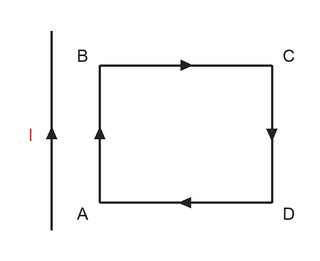
A rectangular loop carrying a current is situated near a long straight wire such that the wire is parallel to one of the sides of the loop and in the plane of the loop. If a steady current is established in the wire as shown in the given figure, what will happen to the loop?
- 712 marks
Question 71
How will the magnetic field intensity at the centre of a circular coil carrying current change, if the current through the coil is doubled and the radius of the coil is halved?
- 722 marks
Question 72
Consider the circuit shown in the figure, where and are semicircles. What will be the magnetic field at the centre of the circular loop?

- 732 marks
Question 73
Two parallel wires carrying currents in the same direction attract each other, while the two beams of electrons travelling in the same direction repel each other. Give reason.
- 742 marks
Question 74
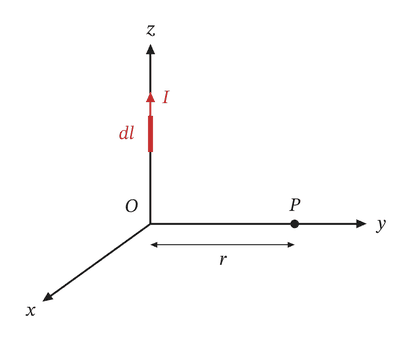
A current flows in a conductor placed perpendicular to the plane of the paper. Indicate the direction of the magnetic field due to a small element at a point situated at a distance from the element as shown in the given figure.
- 752 marks
Question 75
Two circular coils and having radii and respectively are placed in horizontal plane with their centres coinciding with each other. Coil has a current flowing through it in the clockwise sense. What must be the current in the coil to make the total magnetic field at the common centre of the two coils zero?

- 762 marks
Question 76
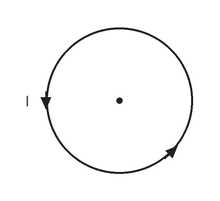
The given figure shows a circular loop carrying a current . Show the direction of the magnetic field with the help of lines of force.
- 773 marks
Question 77
Describe Oersted’s experiment. State Biot–Savart law and hence define tesla.
- 783 marks
Question 78
Using Ampere’s circuital law, obtain an equation for the magnetic field due to a current-carrying toroid.
- 793 marks
Question 79
Derive an equation for the force acting on a straight wire carrying current kept in a uniform magnetic field.
- 803 marks
Question 80
Draw a labelled diagram of a cyclotron. Explain its working.
- 813 marks
Question 81
Write an expression for Biot–Savart law in vector form. Derive an expression for magnetic field at the centre of a circular current-carrying coil of radius with turns.
- 823 marks
Question 82
Obtain an expression for the magnetic flux density at the centre of a circular coil of radius having turns when a current flows through it.
- 833 marks
Question 83
Using Ampere’s circuital law, obtain an expression for the magnetic flux density at a point , at a perpendicular distance from a long current-carrying conductor.
- 845 marks
Question 84
(a) State Biot–Savart law.
(b) Derive an expression for the magnetic field due to an infinitely long straight conductor.
(c) How will you find the direction of the magnetic field?
- 855 marks
Question 85
(a) Derive an expression for the magnetic field due to a current-carrying circular coil at a point on the axial line. How will you find its direction?
(b) What is the field at the centre of the coil?
- 865 marks
Question 86
Derive an expression for the magnetic field at the centre of a circular current-carrying coil of radius having turns. Indicate the direction of field.
- 875 marks
Question 87
(a) Derive an expression for the force acting on a current-carrying conductor placed in a uniform magnetic field.
(b) Discuss the force between the two current-carrying wires.
- 885 marks
Question 88
Describe a cyclotron and explain its working with necessary theory. Give its limitations.
- 895 marks
Question 89
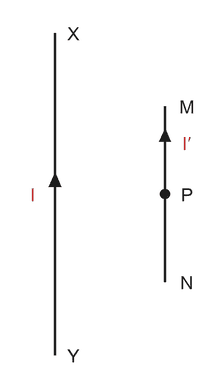
The given figure shows a point near a long conductor carrying a current . is a short current-carrying conductor () kept at point , parallel to the conductor .
(i) What is the direction of magnetic flux density at the point due to the current fluxing through ?
(ii) What is the direction of the force experienced by the conductor due to current flowing through ?
- 905 marks
Question 90
The given figure shows two infinitely long and thin current-carrying conductors and kept in vacuum parallel to each other at a distance .
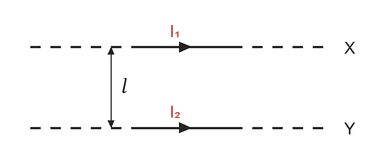
(a) How much force per unit length acts on the conductor due to the current flowing through ? Write the answer in terms of and .
(b) Define ampere, in terms of force between two current-carrying conductors.
- 915 marks
Question 91
Write an expression for the force per unit length between two long current-carrying straight wires, kept parallel to each other in vacuum and hence define ampere, the SI unit of current.
- 925 marks
Question 92
(a) Explain the principle of working of cyclotron.
(b) Derive an expression for kinetic energy obtained when a charged particle is accelerated in a cyclotron.
(c) What are the limitations of a cyclotron?
- 933 marks
Question 93
An electron moves along the -axis with a speed of m/s. The electron is under a uniform magnetic field of T directed at an angle of to the -axis and lying in the plane. Find the initial acceleration of the electron.
- 943 marks
Question 94
An electron accelerated by a p.d. of V enters a uniform magnetic field of perpendicular to its direction of motion. Find the radius of the circular path of the electron.
- 953 marks
Question 95
A magnetic field intensity G is crossed with the electric field between two parallel plates cm apart and having a potential difference of V. Find the velocity of the charged particles, which can travel undeflected in a direction perpendicular to both the fields.
- 964 marks
Question 96
An electron is moving with a velocity m/s in an electric field of intensity and a magnetic field of T. Find the magnitude and direction of Lorentz force acting on the electron.
- 973 marks
Question 97
A copper wire, cm in diameter carries a current of A. Calculate the magnetic field at the surface of the wire H/m.
- 983 marks
Question 98
A horizontal overhead power line carries a current of A from south to north. Calculate the magnitude and the direction of the magnetic field due to the current at a point m above the line.
- 993 marks
Question 99
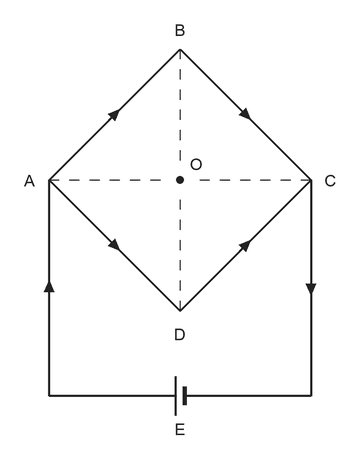
The square is made out of four identical copper wires. A battery of e.m.f. is connected as shown in figure. What is the magnetic field at the centre ?
- 1003 marks
Question 100
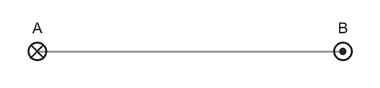
The end-view of two long, straight parallel wires perpendicular to the plane of the paper. The distance between the two conductors and is cm. They carry electric currents A and A in opposite directions. Find the point on the line where the resultant magnetic field is zero.
- 1013 marks
Question 101
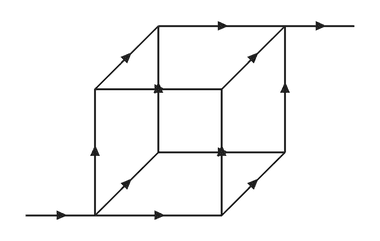
A cube is made of a copper wire of uniform thickness. A current is passed through the wire as shown in given figure. What is the magnetic field at the centre of the cube?
- 1023 marks
Question 102
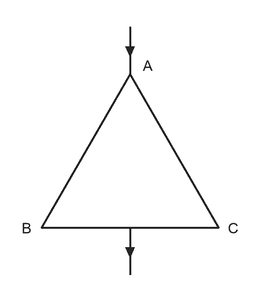
A long copper wire is bent into an equilateral triangle and a current is passed through it as shown in the given figure. What is the magnetic field at the centre of the triangle?
- 1033 marks
Question 103
A square of side '' is made of a wire of uniform thickness and a current is passed through the loop. The current enters the loop at the point and leave it at the point . What is the magnetic field at the centre of the loop?

- 1043 marks
Question 104
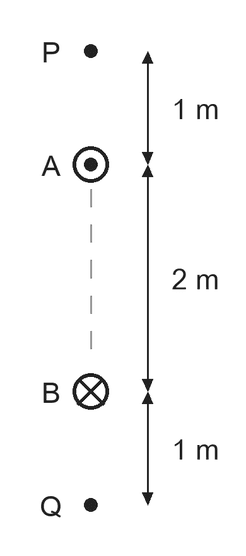
Two very long straight parallel wires and are kept perpendicular to the plane of the paper, each carrying a current of A in opposite directions. The distance between the two wires is m. Find the resultant magnetic field at the point and , where m and m.
- 1053 marks
Question 105
The current passing through a flat circular coil is A. If its radius is cm and the total number of turns in it is ; calculate the flux density at the centre of the coil.
- 1063 marks
Question 106
A coil of turns and diameter cm has a current of A flowing through it. What is the magnetic field at the centre of the coil?
- 1073 marks
Question 107
A helium nucleus makes full rotation in a circle of radius m in seconds. Find the magnetic field at the centre of the circle.
- 1083 marks
Question 108
A closely wound coil of turns, cm in radius carries a current of A. Find the magnetic flux density at the centre of the coil.
- 1093 marks
Question 109
An electron is revolving round a proton in a circular orbit of diameter Å. With what angular velocity should the electron rotate so that the magnetic field at the site of the proton is ?
- 1103 marks
Question 110
Using two identical wires of the same length, two flat circular coils are made. The number of turns in one coil is and that in the other coil is . In which coil the magnetic field at the centre will be greater?
- 1113 marks
Question 111
Two circular coils having turns and turns are wound concentrically and they lie in the same plane. Their radii are cm and cm and carry currents of A and A respectively in the anti-clockwise direction. Find the resultant field at the centre of the coils.
- 1123 marks
Question 112
A solenoid of turns and area of cross-section carrying current of A is suspended through it centre. What is the magnetic moment associated with the solenoid?
- 1133 marks
Question 113
A solenoid has a length m and an inner diameter cm. It has five layers of windings of turns each and carries a current of A. What is at the centre?
- 1143 marks
Question 114
A horizontal wire m long carries a current of A. Find the magnitude and direction of the magnetic field which can support the weight of the wire, assuming its mass to be kg?
- 1153 marks
Question 115
A uniform long straight wire is shaped to a regular hexagon of side cm and carries a current A. What is the magnetic induction at the centre of the hexagon?
- 1163 marks
Question 116
A solenoid of turns is wound uniformly in a single layer on a glass tube m long and m in diameter. Find the strength of the magnetic field at the centre of the solenoid when a current of A flows through it.
- 1173 marks
Question 117
A straight solenoid of length cm and radius cm is wound with two layers of wires. The inner layer has turns and the outer layer has turns. The current is A in the same direction in both the layers. What is the magnetic field at the centre of the coil?
- 1183 marks
Question 118
A solenoid of square cross-section has turns per unit length and carries a current . The cross-sectional dimension is ''. Assuming the solenoid to be very long, find the magnetic field at its centre.
- 1193 marks
Question 119
The frequency applied to the dees of a cyclotron is MHz. What must be the magnetic induction if protons are to be accelerated? kg, C.
- 1203 marks
Question 120
An electron moves with a speed cm/s due east, horizontally. Find the magnitude and direction of the magnetic field which could support the weight of the electron. Mass of the electron kg, charge C.
- 1213 marks
Question 121
An electron moves along the -axis with a speed of m/s. The electron is under a uniform magnetic field of T directed at an angle of to the -axis and lying in the plane. Find the initial acceleration of the electron.
- 1223 marks
Question 122
An electron accelerated by a p.d. of V enters a uniform magnetic field of perpendicular to its direction of motion. Find the radius of the circular path of the electron.
- 1233 marks
Question 123
A magnetic field intensity G is crossed with the electric field between two parallel plates cm apart and having a potential difference of V. Find the velocity of the charged particles, which can travel undeflected in a direction perpendicular to both the fields.
- 1243 marks
Question 124
An electron after being accelerated through a potential difference of V enters a uniform magnetic field of T perpendicular to the direction of motion. Calculate the radius of the path described by the electron.
What Class 12 Physics Ch 7 covers
The sections of the chapter, in the order the book takes them. Every question above comes from one of these.
- 01Magnetic Field and Oersted's Experiment
- 02Biot-Savart Law
- 03Magnetic Field of a Straight Wire and a Circular Loop
- 04Ampere's Circuital Law and Its Applications
- 05Lorentz Force
- 06Motion of a Charged Particle in a Magnetic Field
More ways to study this chapter
The same chapter asked three other ways. Practise it, revise it, and see what the board has set on Ch 7 before.
- Competency-Based Questions (CBQ)Case study questions: a situation, and the part of the chapter that answers it.40questionsOpen
- Previous Year QuestionsQuestions that have actually appeared in board papers, each tagged with its year.29questionsOpen
- Practice QuestionsExtra questions per chapter, for when one attempt at a method is not enough.150questionsOpen
Ch 7 in past ISC papers
The same chapter as the board has actually asked it. These are worded differently from the textbook exercise, which is the point of reading them.
- 11 mark
Board paper question 1
A moving electron enters a uniform and perpendicular magnetic field. Inside the magnetic field, the electron travels along:
Solve with AIAnswer
(A) a straight line.
(B) a parabola
- Correct
(C) a circle
(D) a hyperbola
Answer: (C) a circle
Key idea: The magnetic force on a moving charge is . It is always at right angles to the velocity, so it changes the direction of motion but never the speed.
Step 1 — Find the size of the force.
The electron enters at right angles to the field, so and the force has the constant size .
Step 2 — Find the path.
A force of constant size that always acts at right angles to the velocity is exactly the centripetal force of uniform circular motion. So the electron moves in a circle, of radius , in the plane perpendicular to the field.
Why the others are wrong:
- (A) A straight path happens only when the velocity is parallel to the field, so that the force is zero; here the velocity is perpendicular to the field.
- (B) A parabola comes from a constant force in one fixed direction, as for a charge in a uniform electric field; the magnetic force keeps turning with the velocity.
- (D) A hyperbola comes from a repulsive inverse-square force from a fixed centre (as in alpha-particle scattering), not from a force of fixed size at right angles to the motion.
Therefore, the electron travels along a circle, option (C).
- 23 marks
Board paper question 2
Obtain an expression for magnetic flux density B at the centre of a circular coil of radius R, having N turns and carrying a current I.
Solve with AIWritten solution
Solution:
Key idea: The Biot-Savart law gives the field of a small current element: , where is the distance from the element to the point and is the angle between the element and the line joining it to the point.
Step 1 — Draw the coil and choose a small element.
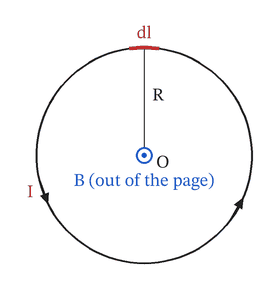
The figure shows one turn of radius with centre O, carrying a current . Take a small element of length on the coil.
Step 2 — Apply the Biot-Savart law to the element.
The line joining the element to O is a radius, so its length is and it is at right angles to the element (). The field due to the element at O is
Step 3 — Find the direction of each contribution.
By the right-hand rule, points along the axis of the coil for every element, so every contribution at O points the same way (out of the page for an anticlockwise current, as in the figure). So the contributions simply add.
Step 4 — Add the contributions of the whole turn.
The sum of all the element lengths round the turn is its circumference, , while and are the same for every element.
Step 5 — Include all N turns.
The coil has turns of the same radius, all carrying the same current in the same sense, so their fields at the centre add.
Therefore, the magnetic flux density at the centre of the coil is , directed along the axis of the coil.
- 31 mark
Board paper question 3
Write the expression for the Lorentz force F in vector form.
Solve with AIWritten solution
Solution:
Key idea: A charge moving with velocity through a magnetic field feels a force at right angles to both and . This is the (magnetic) Lorentz force.
Step 1 — Write the force in vector form.
The force is times the cross product of the velocity with the field, taken in this order.
Step 2 — Note its size and direction.
Its magnitude is , where is the angle between and ; its direction follows the right-hand rule for (reversed for a negative charge).
Note: If an electric field is also present, the total Lorentz force is .
Therefore, the Lorentz force in vector form is .
- 43 marks
Board paper question 4
(i) Two infinitely long current carrying conductors X and Y are kept parallel to each other, apart in vacuum. They carry currents of and respectively, in the same direction, as shown in Figure 5 below. Find the position of a neutral point, i.e. a point where resultant magnetic flux density is zero. (Ignore earth's magnetic field).
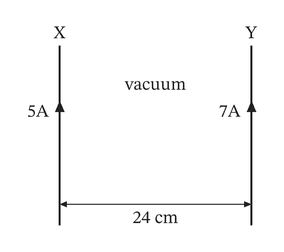
(ii) If current through the conductor Y is reversed in direction, will neutral point lie between X and Y, to the left of X or to the right of Y?
Solve with AIWritten solution
Solution:
Key idea: A long straight wire carrying current produces a field at distance . Its lines are circles round the wire, and its direction follows the right-hand grip rule. At a neutral point the fields of the two wires are equal in size and opposite in direction.
Step 1 — Decide where the fields are opposite (part (i)).
Both currents flow upwards. By the right-hand grip rule, at a point between the wires the field of X is into the page and the field of Y is out of the page, so they can cancel there. Outside the wires both fields point the same way and cannot cancel. So the neutral point lies between X and Y.
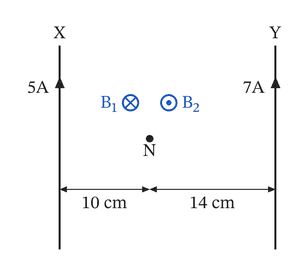
Step 2 — Equate the two fields.
Let the neutral point N be at distance (in cm) from X; then its distance from Y is cm. The fields there are equal in size.
Step 3 — Find where the neutral point lies when Y is reversed (part (ii)).
Now the currents are opposite. Between the wires both fields point the same way (into the page), so they add and cannot cancel. Outside the wires they are opposite, and they can be equal only nearer the smaller current, 5 A in X, so that its smaller current is made up for by a shorter distance. So the neutral point lies to the left of X. Taking it at distance to the left of X:
Therefore, (i) the neutral point is between the wires, 10 cm from X (14 cm from Y), and (ii) with the current in Y reversed it lies to the left of X (60 cm from X).
- 52 marks
Board paper question 5
(i) Define Ampere in terms of force between two current carrying conductors.
(ii) What is an ideal transformer?
Solve with AIWritten solution
Solution:
Key idea: Two long parallel wires carrying currents and a distance apart in vacuum exert a force per unit length on each other. Putting and equal to 1 A and equal to 1 m gives .
Step 1 — Define the ampere (part (i)).
One ampere is that steady current which, flowing in each of two infinitely long, straight, parallel conductors of negligible cross-section placed 1 m apart in vacuum, makes each conductor exert on the other a force of newton per metre of length.
Note: Since 2019 the SI defines the ampere by fixing the elementary charge at ; the force between parallel wires still has this value and is how the ampere was defined when this paper was set.
Step 2 — State what an ideal transformer is (part (ii)).
An ideal transformer is one in which there is no loss of energy: there is no leakage of magnetic flux (all the flux of the primary links the secondary), the windings have no resistance, and the core has no eddy-current or hysteresis loss. So the output power equals the input power.
For such a transformer the voltage ratio equals the turns ratio, .
Therefore, (i) one ampere is the current that gives a force of per metre between two long parallel wires 1 m apart in vacuum, and (ii) an ideal transformer is one with no energy losses, so its output power equals its input power.
- 61 mark
Board paper question 6
Calculate magnetic flux density of the magnetic field at the center of a circular coil of 50 turns, having radius of and carrying a current of .
Solve with AIWritten solution
Solution:
Key idea: The magnetic flux density at the centre of a circular coil of turns and radius carrying current is .
Step 1 — Write down the data.
The coil has turns, radius and current ; is .
Step 2 — Substitute in the formula.
We put the values into .
Therefore, the magnetic flux density at the centre of the coil is about (that is, ), along the axis of the coil.
All 29 board paper questions for this chapter, solved the same way.
Class 12 Physics Ch 7 questions students ask
How many questions are there in Class 12 Physics Ch 7?
124 questions. Every one is solved step by step on this page.
Are these Class 12 Physics solutions free?
Yes. Every question and its full working is free to read, with no account needed.
Can I download the Class 12 Physics Ch 7 solutions as a PDF?
There is no PDF to download. Every solution is on this page instead, which means it is searchable, always the current syllabus, and readable on a phone. Use your browser's print option if you want it on paper.