
Question 885 marksMedium
Describe a cyclotron and explain its working with necessary theory. Give its limitations.
Confirming your payment
Sign up now and get 250 free tokens.
Moving Charges and Magnetism · Question 88 of 124
Describe a cyclotron and explain its working with necessary theory. Give its limitations.
Solution:
Key idea: A cyclotron accelerates ions many times across one gap. A magnetic field bends them back to the gap, and the time for each half-turn does not depend on their speed.
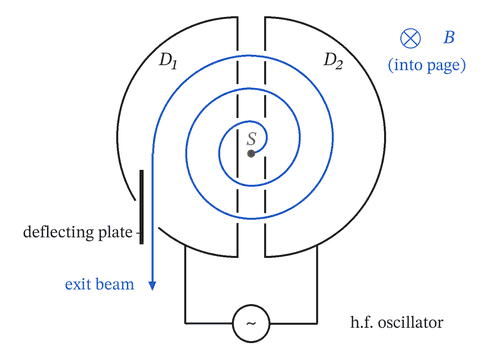
Step 1 — Describe the cyclotron.
Two hollow D-shaped metal chambers, the dees and , face each other with a narrow gap, inside an evacuated chamber. This sits between the poles of a powerful electromagnet that gives a uniform field perpendicular to the dees. A high-frequency oscillator applies an alternating p.d. across the dees. The ion source is at the centre, and a deflecting plate near the edge takes the beam out.
Step 2 — Explain the working.
An ion leaving is accelerated across the gap into the dee that is negative at that instant. Inside the dee there is no electric field, so the magnetic force makes it go round a semicircle. When it comes back to the gap the p.d. has reversed, so it is accelerated again into the other dee. Its speed and radius grow at each crossing, and it spirals outward.
Step 3 — Find the radius of the path.
Inside a dee the magnetic force provides the centripetal force.
Step 4 — Find the time for a semicircle.
The ion covers half a circle, , at speed .
This does not depend on or , so the ion always reaches the gap after the same time.
Step 5 — State the resonance condition.
The oscillator frequency must equal the frequency of revolution of the ion.
Step 6 — Find the maximum kinetic energy.
At the edge the radius equals the radius of the dees, so the greatest speed is .
Step 7 — State the limitations.
The cyclotron has these limitations:
Therefore, a cyclotron uses an oscillating electric field at the gap, in step with the speed-independent revolution frequency , to give ions energies up to ; it cannot accelerate electrons or neutral particles, and relativistic effects limit its energy.