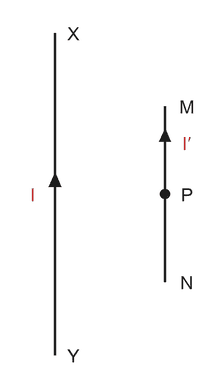
The given figure shows a point near a long conductor XY carrying a current I .
Question 895 marksMedium
The given figure shows a point near a long conductor XY carrying a current I. MN is a short current-carrying conductor (I′) kept at point P, parallel to the conductor XY.
(i) What is the direction of magnetic flux density B at the point P due to the current fluxing through XY?
(ii) What is the direction of the force experienced by the conductor MN due to current flowing through XY?
Solution:
Key idea: A long straight current produces circular field lines round itself (right-hand thumb rule). A second current in that field feels the force I′l×B, so parallel currents in the same direction attract.
Step 1 — Find the direction of the field at P, part (i).
The current in XY flows upward, from Y to X, and P lies to its right. By the right-hand thumb rule (thumb pointing up along the current), the curled fingers go into the paper on the right-hand side of the wire. So the field at P is perpendicular to the plane of the paper, into the paper.
Step 2 — Write the size of the field at P.
If r is the distance of P from XY, the field there is:
B=2πrμ0I
Step 3 — Find the direction of the force on MN, part (ii).
Conductor MN carries I′ upward, from N to M, in a field into the paper. The force is along I′l×B: with l upward and B into the paper, this points to the left. So the force on MN lies in the plane of the paper, perpendicular to MN, towards XY. This is an attraction, as expected for parallel currents in the same direction.
Step 4 — Write the size of the force.
If l is the length of MN, the force on it is I′lB.
F=2πrμ0II′l
Therefore, (i) the field at P due to XY is perpendicular to the paper, into it; (ii) the force on MN is in the plane of the paper, perpendicular to MN and towards XY (attraction), of size 2πrμ0II′l.