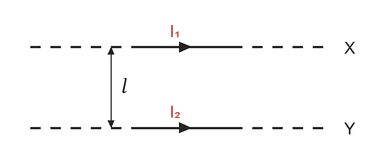
Solution:
Key idea: The field of one long straight wire at the other is 4πμ0⋅l2I at distance l, and the second wire, carrying its current across this field, feels a force IB per unit length.
Step 1 — Find the field of X at Y, part (a).
Conductor X carries I1 and Y is at distance l from it. The field of X at Y is perpendicular to Y, of size:
BX=4πμ0⋅l2I1
Step 2 — Find the force per unit length on Y.
Conductor Y carries I2 at right angles to this field, so the force on each metre of it is I2BX.
LF=I2BX
LF=4πμ0⋅l2I1I2
Here L is a length of conductor Y. Both currents flow in the same direction, so the force on Y is towards X (attraction).
Step 3 — Find the force for unit currents 1 m apart.
We put both currents equal to 1 A and the separation equal to 1 m in the result, using 4πμ0≈10−7 T m A−1.
LF=10−7×12×1×1
LF=2×10⁻⁷ N m−1
Step 4 — Define the ampere in terms of this force, part (b).
One ampere is that steady current which, flowing in each of two infinitely long, straight, parallel conductors of negligible cross-section placed 1 m apart in vacuum, produces between them a force of 2×10⁻⁷ newton per metre of length.
Note: This force definition was the SI definition of the ampere from 1948 until May 2019. Since 2019 the ampere is defined by fixing the elementary charge at exactly 1.602176634×10⁻¹⁹ C, so one ampere is a flow of 1.602176634×10−191 elementary charges per second. The force between two such wires is still 2×10⁻⁷ N m−1 to better than one part in a billion.
Therefore, (a) the force per unit length on Y is 4πμ0⋅l2I1I2, directed towards X; (b) one ampere is the current that, in each of two long parallel conductors 1 m apart in vacuum, gives a force of 2×10⁻⁷ N per metre.