
Question 875 marksMedium
(a) Derive an expression for the force acting on a current-carrying conductor placed in a uniform magnetic field.
(b) Discuss the force between the two current-carrying wires.
Confirming your payment
Sign up now and get 250 free tokens.
Moving Charges and Magnetism · Question 87 of 124
(a) Derive an expression for the force acting on a current-carrying conductor placed in a uniform magnetic field.
(b) Discuss the force between the two current-carrying wires.
Solution:
Key idea: The force on a current-carrying conductor is the sum of the magnetic forces on its drifting electrons. Two parallel currents each sit in the other's field, so each feels such a force.
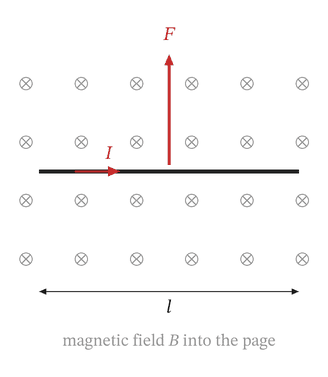
Step 1 — Write the force on one electron, part (a).
Take a conductor of length and cross-sectional area in a uniform field , with free electrons per unit volume drifting with velocity . Each electron, of charge , feels the force .
Step 2 — Add the forces on all the electrons.
The number of free electrons in the conductor is , and all have the same drift velocity.
Step 3 — Bring in the current.
The current is , flowing opposite to . Let be a vector of length along the current.
So the force on the conductor is:
The force is greatest when the conductor is perpendicular to and zero when it is parallel; its sense is given by Fleming's left-hand rule.

Step 4 — Find the field of one wire at the other, part (b).
Take two long parallel wires a distance apart carrying and . Wire 1 produces at wire 2 a field perpendicular to wire 2, of size:
Step 5 — Find the force on a length of wire 2.
Wire 2 carries at right angles to this field, so the force on a length of it is .
By Newton's third law, wire 1 feels an equal and opposite force.
Step 6 — Decide whether the force attracts or repels.
By Fleming's left-hand rule, when the currents are in the same direction the forces pull the wires together (attraction). When they are in opposite directions the forces push the wires apart (repulsion).
Therefore, (a) the force on a conductor is , of size ; (b) two parallel wires exert per unit length on each other, attracting for like currents and repelling for unlike currents.