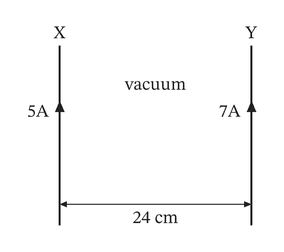
Solution:
Key idea: A long straight wire carrying current I produces a field B=2πdμ0I at distance d. Its lines are circles round the wire, and its direction follows the right-hand grip rule. At a neutral point the fields of the two wires are equal in size and opposite in direction.
Step 1 — Decide where the fields are opposite (part (i)).
Both currents flow upwards. By the right-hand grip rule, at a point between the wires the field of X is into the page and the field of Y is out of the page, so they can cancel there. Outside the wires both fields point the same way and cannot cancel. So the neutral point lies between X and Y.
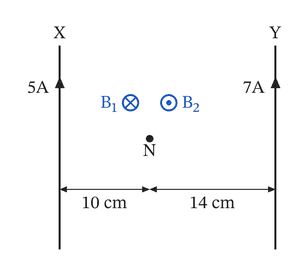
Step 2 — Equate the two fields.
Let the neutral point N be at distance x (in cm) from X; then its distance from Y is (24−x) cm. The fields there are equal in size.
2πxμ0×5=2π(24−x)μ0×7
5(24−x)=7x
120=12x
x=10 cm
Step 3 — Find where the neutral point lies when Y is reversed (part (ii)).
Now the currents are opposite. Between the wires both fields point the same way (into the page), so they add and cannot cancel. Outside the wires they are opposite, and they can be equal only nearer the smaller current, 5 A in X, so that its smaller current is made up for by a shorter distance. So the neutral point lies to the left of X. Taking it at distance d to the left of X:
d5=d+247
5d+120=7d
d=60 cm
Therefore, (i) the neutral point is between the wires, 10 cm from X (14 cm from Y), and (ii) with the current in Y reversed it lies to the left of X (60 cm from X).