
Question 793 marksMedium
Derive an equation for the force acting on a straight wire carrying current kept in a uniform magnetic field.
Confirming your payment
Sign up now and get 250 free tokens.
Moving Charges and Magnetism · Question 79 of 124
Derive an equation for the force acting on a straight wire carrying current kept in a uniform magnetic field.
Solution:
Key idea: A current in a wire is a stream of drifting free electrons. The magnetic force on the wire is the sum of the magnetic forces on all these electrons.
Step 1 — Write the force on one electron.
Consider a straight wire of length and cross-sectional area in a uniform field , with free electrons per unit volume drifting with velocity . Each electron, of charge , feels the magnetic force:
Step 2 — Count the electrons and add their forces.
The volume of the wire is , so the number of free electrons in it is:
They all have the same drift velocity, so their forces add up.
Step 3 — Bring in the current.
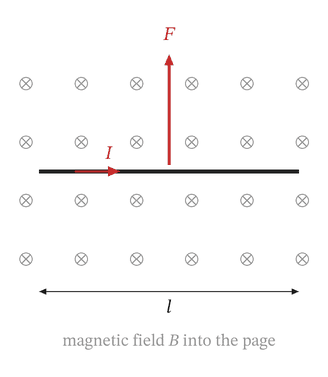
The current in the wire is . It flows opposite to , because electrons are negative. Let be a vector of length pointing along the current, so that points along .
Step 4 — Write the force on the wire.
We substitute this into the expression for .
Its size is:
Here is the angle between the wire and the field.
Step 5 — Describe the direction and the special cases.
The force is perpendicular to both the wire and , in the sense given by Fleming's left-hand rule. It is greatest () when the wire is at right angles to the field, and it is zero when the wire is parallel to the field. In the figure the current is to the right and is into the page, so the force is upward.
Therefore, the force on a straight wire of length carrying current in a uniform field is , of size .