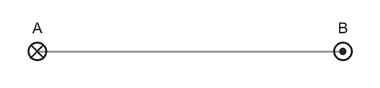
Solution:
Key idea: Each long wire sets up a field 2πrμ0I in circles round it. For opposite currents the two fields point the same way between the wires and opposite ways outside them, so the null point lies outside, nearer the wire with the smaller current (B).
Step 1 — Choose where to look for the null point.
Between A and B the fields add, so the field cannot be zero there. Beyond A the point would be nearer the larger current, whose field would always win.
So the null point lies beyond B. Let it be x cm beyond B, so that its distance from A is (12+x) cm.
Step 2 — Write the condition for zero field.
At the null point the two fields are equal in size. The factor 2πμ0 cancels, and the distances can stay in cm because only their ratio matters.
12+x8=x4
Step 3 — Cross-multiply.
We multiply both sides by x(12+x).
8x=4(12+x)
8x=48+4x
Step 4 — Solve for x.
We take 4x from both sides and divide by 4.
4x=48
x=12 cm
Step 5 — Check the answer.
At this point the distances are 24 cm from A and 12 cm from B. The ratios 248 and 124 are both 31, so the two fields are indeed equal.
Therefore, the resultant field is zero on line AB produced, 12 cm beyond B (that is, 24 cm from A).