Opening your dashboard
Class 12 Physics Chapter 7 Moving Charges and Magnetism: Practice Questions
150 questions on Chapter 7, each worked through on its own page with the AI tutor. Class 12 Physics, ICSE 2026-27.
150 questions
1–3 marks · Mixed difficulty
- 11 mark
Question 1
A long straight wire is held vertically and carries a steady current upwards. Ignoring the Earth's magnetic field, the magnetic field due to the wire at a point due east of the wire points
- 23 marks
Question 2
In a repeat of Oersted's experiment, a long straight wire is stretched along the magnetic meridian, vertically above a compass needle that rests in the north–south direction. A current is passed through the wire from south to north. The horizontal component of the Earth's magnetic field there is . The needle settles at to the meridian. (Hypothetical data.)
(i) In which direction (east or west) does the north pole of the needle turn? Give a reason.
(ii) Find the current in the wire.
(iii) The wire is now placed below the needle, with the same current. State what changes in the observation.
(Take .)
- 31 mark
Question 3
Which one of the following statements about magnetic field lines is incorrect?
- 42 marks
Question 4
A narrow beam of electrons travels horizontally from south to north in an evacuated tube. A compass needle, resting in the north–south direction, is placed just below the tube.
(i) In which direction does the north pole of the needle turn? Explain.
(ii) What would happen to the needle if the electrons were brought to rest in the tube? Give a reason.
- 52 marks
Question 5
In Oersted's experiment, a compass needle rests in the north–south direction. A wire is stretched east–west, directly above the needle, and a small current is passed through it from east to west.
(i) Find the direction of the wire's magnetic field at the needle, and explain why the needle is not deflected.
(ii) How should the wire be placed to obtain the largest deflection?
- 61 mark
Question 6
A short current element of length lies along the -axis at the origin and carries a current of in the direction. The magnetic field it produces at the point is (take )
- 71 mark
Question 7
A small current element produces a field at a point at distance from it, on the line perpendicular to the element. Another point is at distance from the element, on a line making with the element. The field at due to the element is
- 83 marks
Question 8
(i) Compare Coulomb's law for the electric field of a point charge with the Biot–Savart law for the magnetic field of a current element. Give one similarity and two differences.
(ii) Taking and , calculate and name the quantity it gives.
- 93 marks
Question 9
(i) Starting from the Biot–Savart law, show that a point charge moving with velocity produces a magnetic field
at a point whose position vector from the charge is .
(ii) At one instant a proton is at the origin, moving with speed along the -axis. Point lies in the -plane, at a distance from the proton, on a line making with the -axis (on the side). Find the magnitude and direction of the magnetic field at at that instant. (Hypothetical data.)
(Take , .)
- 101 mark
Question 10
A long straight wire in a wall carries a steady current of . The Earth's magnetic field at the place is . At what distance from the wire is the wire's magnetic field equal in size to the Earth's field? (Take .)
- 113 marks
Question 11
A straight wire of length lies in the plane of the paper and carries a current of from to (upwards on the page). Point is in the same plane, to the right of end , such that is perpendicular to . Ignore the field of the leads that bring current to the wire.
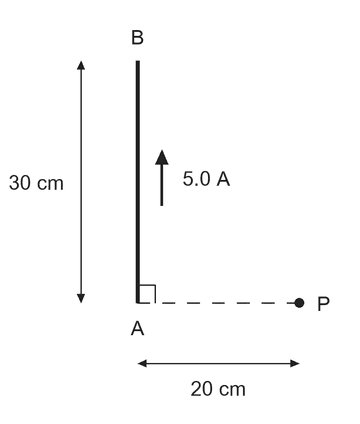
(i) Find the magnitude and direction of the magnetic field at due to .
(ii) Express this as a fraction of the field that an infinitely long wire carrying the same current would produce at .
(Take .)
- 121 mark
Question 12
A circular loop lies flat on a horizontal table. Seen from above, the current in it flows anticlockwise. Which of the following correctly describes the magnetic field at the centre and the polarity of the upper face of the loop?
- 133 marks
Question 13
A long straight wire lies in the plane of the paper and carries a current of upwards on the page. A single-turn circular loop of radius lies in the same plane, with its centre at to the right of the wire.
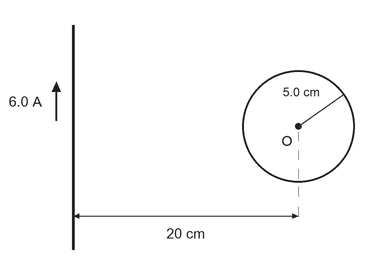
(i) What current must flow in the loop, and in which sense (clockwise or anticlockwise as seen by the reader), so that the resultant magnetic field at is zero?
(ii) If this loop current is reversed, what is the resultant field at ?
(Take .)
- 141 mark
Question 14
A long straight wire carries a current of . A square path of side is drawn in a plane perpendicular to the wire, with the wire passing through its centre. The value of taken once round the square, in the sense of the field, is (take )
- 153 marks
Question 15
A coaxial cable has a thin central wire surrounded by insulation and then by a thin cylindrical copper sheath of radius . A current of flows along the central wire and returns along the sheath. (Hypothetical data.)
(i) Use Ampere's circuital law to find the magnetic field at a point in the insulation from the axis.
(ii) Find the magnetic field at a point outside the cable, from the axis.
(iii) State one practical advantage of the result of part (ii).
(Take .)
- 163 marks
Question 16
A student wants to wind a long solenoid, long, that gives a field of well inside it, using a power supply that can deliver at most . The insulated copper wire available has an overall diameter of , and the turns are wound side by side, touching. (Hypothetical data.)
(i) How many turns per metre are needed?
(ii) How many complete layers of winding must be used? What field does this give at the centre with ?
(iii) What is the field near either end of the finished solenoid?
(Take .)
- 171 mark
Question 17
A long solenoid of length with turns carries a current , and the field well inside it is . The coil is stretched to length (still long and with the same turns, evenly spread), and the current is changed to . The new field well inside is
- 181 mark
Question 18
For a certain closed path in a magnetic field, . Which one of the following must be true?
- 191 mark
Question 19
A proton moves with a constant, non-zero velocity through a region in which there are a uniform electric field and a uniform magnetic field , both non-zero. Ignoring gravity, which statement must be true?
- 201 mark
Question 20
An electron and a proton enter the same uniform magnetic field with the same velocity, perpendicular to the field. The magnetic forces on them at the moment of entry are
- 213 marks
Question 21
A region contains a uniform magnetic field of unknown magnitude and direction. A proton fired through it along the direction with speed experiences no force. When it is fired along the direction with the same speed, it experiences a force of along the direction. (Hypothetical data.)
(i) What can you conclude from the first observation?
(ii) Find the magnitude and direction of the magnetic field.
(iii) Find the force on the proton if it is fired along with the same speed.
(Take .)
- 223 marks
Question 22
An electron moves with velocity through a region where and . (Hypothetical data.)
(i) Find the electric force and the magnetic force on the electron, as vectors.
(ii) Find the net (Lorentz) force, and state the direction in which the electron starts to deflect.
(iii) What would the net force be on a proton moving with the same velocity in the same fields?
(Take .)
- 232 marks
Question 23
An alpha particle (charge ) moves with speed in a uniform magnetic field of and experiences a magnetic force of . (Hypothetical data.)
(i) Find the possible angle(s) between its velocity and the field.
(ii) What is the greatest magnetic force it could experience at this speed, and when?
(Take .)
- 241 mark
Question 24
A proton and an electron enter the same uniform magnetic field with the same speed, at right angles to the field. If and are their periods of revolution, is (, )
- 253 marks
Question 25
In a simple mass spectrograph, singly charged ions of neon-20 (mass ) and neon-22 (mass ) start from rest and are accelerated through a potential difference of . They then enter a uniform magnetic field of at right angles to it, travel through a semicircle and strike a photographic plate in the plane of the entry slit. (, .)
(a) Show that the radius of the path is .
(b) Find the radius of the path of each ion.
(c) How far apart are the two marks on the plate?
(Hypothetical data.)
- 261 mark
Question 26
A charged particle moves in a circle at right angles to a uniform magnetic field. Its kinetic energy is now doubled, the field remaining the same. Then
- 273 marks
Question 27
The -plane is the plane of the paper, with to the right and upwards; the axis points out of the paper towards you. A uniform magnetic field acts along . A proton is moving along at the origin.
(a) Find the direction of the magnetic force on the proton at that instant.
(b) Does the proton go round clockwise or anticlockwise, as seen by you?
(c) An electron moves along at the origin with the same speed. State the direction of the force on it and its sense of rotation.
- 283 marks
Question 28
An alpha particle (charge , mass ) moves in a circle of radius at right angles to a uniform magnetic field of . Find
(a) its speed,
(b) its kinetic energy in MeV,
(c) the time it takes to go once round the circle.
(, .) (Hypothetical data.)
- 291 mark
Question 29
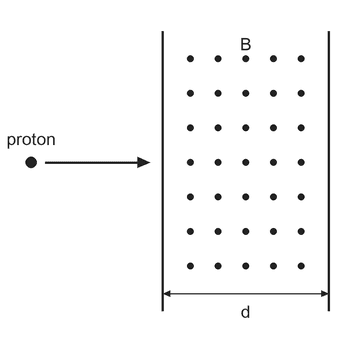
A uniform magnetic field, perpendicular to the plane of the paper, fills the space between two parallel boundary lines a distance apart. A proton enters the field at right angles to the first boundary. Inside the field its path has radius . By what angle has its direction of motion turned when it leaves through the second boundary?
- 303 marks
Question 30
A horizontal electron beam travelling east at has to be turned so that it travels north, along a quarter-circle of radius in the horizontal plane, by a uniform magnetic field. (, .)
(a) Find the strength of the field needed.
(b) Should the field point vertically upwards or vertically downwards? Explain.
(Hypothetical data.)
- 311 mark
Question 31
A cyclotron accelerates protons. The magnetic field is doubled, the radius of the dees remaining the same. For the protons to be accelerated properly and leave at the edge of the dees,
- 323 marks
Question 32
A cyclotron is to give deuterons (charge , mass ) a kinetic energy of , using a magnetic field of .
(a) What must the radius of the dees be?
(b) At what frequency must the oscillator work?
(, .) (Hypothetical data.)
- 331 mark
Question 33
In a cyclotron, the alternating p.d. between the dees is doubled, while the magnetic field, the radius of the dees and the oscillator frequency are kept the same. For the ions that come out,
- 343 marks
Question 34
A cyclotron has been set up to accelerate protons with a magnetic field and an oscillator of fixed frequency . Protons leave it with a kinetic energy of . Now deuterons are to be accelerated (same charge as a proton, take mass ), keeping the same oscillator frequency and the same dees.
(a) Explain why the deuterons would not be accelerated if were left unchanged.
(b) What magnetic field is needed?
(c) With this field, what kinetic energy do the deuterons leave with?
(Hypothetical data.)
- 351 mark
Question 35
In a cyclotron, a proton starts almost at rest at the centre. It gains the same energy at every crossing of the gap, and after the th crossing it moves on its th semicircle. The ratio of the radius of the 2nd semicircle to that of the 8th semicircle is
- 363 marks
Question 36
A hospital cyclotron makes radioactive isotopes for scanning by firing a proton beam at a target. Its dees have a radius of and its magnetic field is . The beam current at the target is .
(a) Find the kinetic energy of the protons leaving the cyclotron, in MeV.
(b) How many protons reach the target per second?
(c) At what rate does the beam deliver energy to the target?
(, , .) (Hypothetical data.)
- 371 mark
Question 37
A wire bent into a semicircle of radius carries a current of . It lies in a plane perpendicular to a uniform magnetic field of . The magnitude of the resultant magnetic force on the wire is
- 383 marks
Question 38
A metal rod of mass rests across two horizontal rails apart, at right angles to them. A battery drives a current of through the rod by way of the rails. A uniform magnetic field of acts vertically. The coefficient of friction between the rod and the rails is . (.)
(a) Find the magnetic force on the rod and state its direction.
(b) Show that the rod starts to slide.
(c) Find its acceleration.
(Hypothetical data.)
- 391 mark
Question 39
A straight wire long lies along the -axis and carries a current of in the direction. The magnetic field is . The force on the wire is
- 402 marks
Question 40
In a loudspeaker, a circular coil of turns and radius sits in the gap of a magnet, where the magnetic field is radial (pointing straight out from the axis of the coil at every point of the wire) and has strength . The coil carries a current of .
(a) Explain why the forces on all parts of the coil add up instead of cancelling, and state the direction of the resultant force.
(b) Find the resultant force on the coil.
(Hypothetical data.)
- 411 mark
Question 41
A horizontal cable long runs east–west and carries a current of towards the east. The horizontal component of the earth's magnetic field there is , pointing north. The force on the cable due to this component is
- 423 marks
Question 42
A copper wire of cross-section carries a current of . A length of it lies at right angles to a uniform magnetic field of . Copper has free electrons per ; .
(a) Find the drift speed of the electrons.
(b) Find the magnetic force on one drifting electron.
(c) Add up the forces on all the free electrons in the length and show that the total equals .
- 431 mark
Question 43
Three long, straight, parallel wires lie in one plane, equally spaced a distance apart. Each carries a current in the same direction. The magnitude of the force per unit length on one of the outer wires is
- 443 marks
Question 44
Three long, straight, parallel wires , and pass through the corners of an equilateral triangle of side , as shown in the end view. Each carries a current of out of the page. (.)
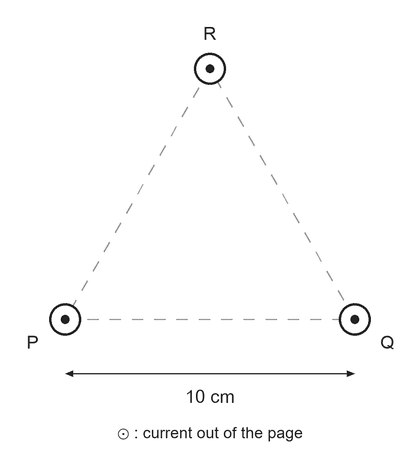
(a) Find the force per unit length on due to , and due to .
(b) Find the resultant force per unit length on .
(c) State its direction.
(Hypothetical data.)
- 451 mark
Question 45
Two long parallel wires and are apart in air. Wire carries . The force on each metre of is and pushes it away from . The current in is ()
- 462 marks
Question 46
Two long parallel wires carry unequal currents and in the same direction, a distance apart. A student says the wire with the larger current must pull harder on the other one. Show, by finding the force on a length of each wire, that the two forces are equal and opposite.
- 473 marks
Question 47
In a simple current balance, a horizontal wire long on a balance arm lies directly above a fixed parallel wire. The same current flows through both wires, in opposite directions. When the current is switched on, the arm is pushed up; a rider of mass placed on the arm directly above the upper wire brings it back to balance. (, .)
(a) Why is the upper wire pushed up?
(b) Find the current. (Treat the wires as long, since is small compared with .)
(Hypothetical data.)
- 481 mark
Question 48
Give the dimensional formula for .
- 491 mark
Question 49
What are the C.G.S. and S.I. unit of ? How are they related?
- 501 mark
Question 50
What is the dimensional formula of ?
- 511 mark
Question 51
What is a current element? Give its significance.
- 522 marks
Question 52
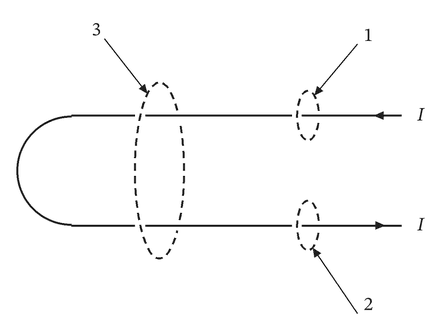
Find the magnetic fields for the paths 1, 2, and 3, shown in the given figure, by applying Ampere’s circuital theorem.
- 532 marks
Question 53
An electron is not deflected, while moving through a certain region of space. Can we say that there is no magnetic field in that region?
- 541 mark
Question 54
What is the work done by the magnetic field on a charged particle moving in a field?
- 551 mark
Question 55
What happens to the K.E. of a charged particle moving in a uniform magnetic field?
- 561 mark
Question 56
When a charged particle moves perpendicular to a uniform magnetic field, which of the following quantities changes: (a) speed, (b) kinetic energy or (c) momentum?
- 571 mark
Question 57
A charged particle enters an environment of a strong and non-uniform magnetic field, varying from point to point, both in magnitude and direction, and comes out of it, following a complicated trajectory. Would its final speed equal the initial speed, if it suffered no collision with the environment?
- 582 marks
Question 58
An electron is travelling west to east, entering a chamber, having a uniform electrostatic field in a north to south direction. Specify the direction in which a uniform magnetic field should be set up to prevent the electron from deflecting from its straight line path.
- 591 mark
Question 59
A charged particle in a plasma trapped in a magnetic bottle leaks out after a milli second. What is the total work done by the magnetic field during the time the particle is trapped?
- 601 mark
Question 60
Is it possible to accelerate neutrons using a cyclotron?
- 612 marks
Question 61
Describe qualitatively the path of a charged particle moving in
(a) a uniform electrostatic field with initial velocity (i) parallel to the field, (ii) perpendicular to the field and (iii) at an arbitrary angle with the field direction and
(b) a uniform magnetic field with initial velocity (i) parallel to the field, (ii) perpendicular to the field and (iii) at an arbitrary angle with the field direction.
- 622 marks
Question 62
An electron is deflected both in the electric and magnetic fields. Mention the difference between the deflections.
- 632 marks
Question 63
An electron beam moving with uniform velocity is gradually diverging. When it is accelerated to a high velocity, it starts converging. Why?
- 643 marks
Question 64
A straight wire carries a current of A. Calculate the magnitude of the magnetic field at a point cm away from the wire.
- 653 marks
Question 65
An electron in an atom revolves around the nucleus in an orbit of radius Å. Calculate the equivalent magnetic moment, if the frequency of electron is MHz.
- 663 marks
Question 66
A proton enters a magnetic field of flux density T with a velocity of at an angle of with the field. Calculate the magnitude of force on the proton.
- 673 marks
Question 67
A m long solenoid has turns and has a flux density of T at its centre. Find the current in the solenoid.
- 683 marks
Question 68
Calculate the force per unit length on a long straight wire carrying current of A due to a parallel wire carrying A current. Distance between the wires cm.
- 693 marks
Question 69
A current of A flows through each of two parallel long wires. The wires are cm apart. Calculate the force acting per unit length of each wire.
- 703 marks
Question 70
A proton enters a magnetic field of flux density T with a velocity of at an angle of with the field. Calculate the magnitude of force on the proton.
- 713 marks
Question 71
Calculate the force per unit length on a long straight wire carrying current of A due to a parallel wire carrying A current. Distance between the wires cm.
- 723 marks
Question 72
A current of A flows through each of two parallel long wires. The wires are cm apart. Calculate the force acting per unit length of each wire.
- 733 marks
Question 73
An electron is projected with a velocity of at right angles to a magnetic field of G. Calculate the radius of the circular path described by the electron.
- 743 marks
Question 74
A charged particle is moving in a magnetic field of intensity with a velocity of m/s in a circular path of radius cm. Find out the specific charge of the particle.
- 751 mark
Question 75
How much is the flux density at the centre of a long solenoid?
- 762 marks
Question 76
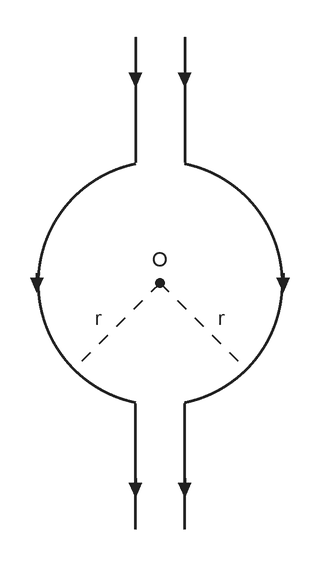
The given figure shows two separate wires forming a circle of radius with centre at . Both wire carry equal currents . Find out the total magnetic field at the centre due to the two currents.
- 771 mark
Question 77
Write in vector form the defining equation for a magnetic field at a point.
- 781 mark
Question 78
Write an expression for the magnetic field at the centre of a circular coil of radius and -turns carrying a current .
- 792 marks
Question 79
A wire of length cm, carrying current ampere is placed at an angle of with respect to a magnetic field of strength T. Find the force experienced by the wire.
- 802 marks
Question 80
Calculate the magnitude of the force acting on the electron moving with a velocity at right angles to a magnetic field of T.
- 811 mark
Question 81
A charge moving around a circle with a frequency of produces a magnetic field of at the centre of the circle. The radius of the circle is
- 821 mark
Question 82
The magnetic field due to a current-carrying circular loop of radius at a point on the axis at a distance of from the centre is . What will be its value at the centre of the loop?
- 831 mark
Question 83
A circular coil of radius carries an electric current. The magnetic field due to the coil at a point on the axis of the coil located at a distance from the centre of the coil, such that , varies as
- 841 mark
Question 84
In hydrogen atom, an electron is revolving in the orbit of radius with rotations/second. Magnetic field produced at the centre of the orbit is
- 851 mark
Question 85
A square conducting loop of side length carries a current . The magnetic field at the centre of the loop is
- 861 mark
Question 86
Ampere's circuital law is equivalent to
- 871 mark
Question 87
A long wire carries a steady current. It is bent into a circle of one turn and the magnetic field at the centre of the coil is . It is then bent into a circular loop of turns. The magnetic field at the centre of the coil for same current will be
- 881 mark
Question 88
An arc of a circle of radius subtends an angle at the centre. It carries a current . The magnetic field at the centre will be
- 891 mark
Question 89
A wire carrying current and other carrying in the same direction produces a magnetic field at the midpoint. What will be the field when wire is switched off?
- 901 mark
Question 90
A long straight wire of radius carries a steady current . The current is uniformly distributed across its cross section. The ratio of the magnetic field at and is
- 911 mark
Question 91
Two concentric coils each of radius equal to are placed at right angles to each other. ampere and ampere are the currents flowing in each coil respectively. The magnetic induction in weber/m at the centre of the coil will be ()
- 921 mark
Question 92
A circular coil 'A' has a radius and the current flowing through it is . Another circular coil 'B' has a radius and if is the current flowing through it, then the magnetic fields at the centre of the circular coil are in the ratio of (i.e. to )
- 931 mark
Question 93
A current flows along the length of an infinitely long, straight and thin-walled pipe. Then
- 941 mark
Question 94
A closely wound flat circular coil of turns of wire has diameter of and carries a ampere current. Determine the flux density at the centre of coil.
- 951 mark
Question 95
A magnetic field can be produced by
- 961 mark
Question 96
Two particles X and Y having equal charges, after being accelerated through the same potential difference, enter a region of uniform magnetic field and describe circular path of radius and respectively. The ratio of mass of X to that of Y is
- 971 mark
Question 97
A proton is moving perpendicular to a uniform magnetic field of tesla. The force on the proton is
- 981 mark
Question 98
The electron in the beam of a television tube moves horizontally from South to North. The vertical component of the Earth's magnetic field points down. The electron is deflected towards
- 991 mark
Question 99
A wire loop is rotated in magnetic field. The frequency of change of direction of the induced emf is
- 1001 mark
Question 100
A cyclotron is used to accelerate
- 1011 mark
Question 101
Two concentric circular loops of radii and carry current of and respectively in opposite sense (i.e., clockwise in one coil and counter-clockwise in the other coil). The resultant magnetic field at their common centre is
- 1021 mark
Question 102
The magnetic field on the axis of a long solenoid having turns per unit length and carrying a current is
- 1031 mark
Question 103
If a current is passed in a spring, it
- 1041 mark
Question 104
A current-carrying small loop behaves like a small magnet. If be its area and its magnetic moment, the current in the loop will be
- 1051 mark
Question 105
Two thin, long, parallel wires, separated by a distance carry a current of A in the same direction. They will
- 1061 mark
Question 106
In order to increase the sensitivity of a moving coil galvanometer, one should decrease
- 1071 mark
Question 107
A circular loop has a radius of and it is carrying a current of amp. Its magnetic moment is
- 1081 mark
Question 108
Due to the flow of current in a circular loop of radius , the magnetic induction produced at the centre of the loop is . The magnetic moment of the loop is ( = permeability constant)
- 1091 mark
Question 109
A stream of electrons is projected horizontally to the right. A straight conductor carrying a current is supported parallel to electron stream and above it. If the current in the conductor is from left to right, what will be the effect on the electron stream?
- 1101 mark
Question 110
A small cylindrical soft iron piece is kept in a galvanometer so that
- 1111 mark
Question 111
A straight conductor carries a current of . An electron travelling with a speed of parallel to the wire at a distance of from the conductor, experiences a force of
- 1121 mark
Question 112
A circular disc of radius is placed in a uniform magnetic field of induction in such a way that its axis makes an angle of with vector . The magnetic flux linked with the disc is
- 1131 mark
Question 113
An ionised gas contains both positive and negative ions. If it is subjected simultaneously to an electric field along the direction and a magnetic field along the direction, then
- 1141 mark
Question 114
Two galvanometer A and B require and respectively to produce the same deflection of divisions. Then,
- 1151 mark
Question 115
A wire of length is bent into a circular loop. When a current of is passed through the loop, there the magnetic moment of the loop is
- 1161 mark
Question 116
A particle of charge and mass move in a circular orbit of radius with angular speed . The ratio of the magnitude of its magnetic moment to that of its angular momentum depends on
- 1171 mark
Question 117
An elastic circular wire of length carries a current . It is placed in a uniform magnetic field (out of paper) such that its plane is perpendicular to the direction of . The wire will experience

- 1181 mark
Question 118
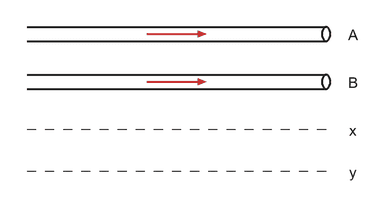
A and B are two conductors carrying a current in the same direction. x and y are two electron beams moving in the same direction
- 1191 mark
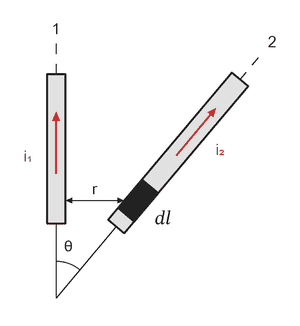
Question 119
Wires 1 and 2 carrying currents and respectively are inclined at an angle to each other. What is the force on a small element of wire 2 at a distance of from wire 1 due to the magnetic field of wire 1?
- 1201 mark
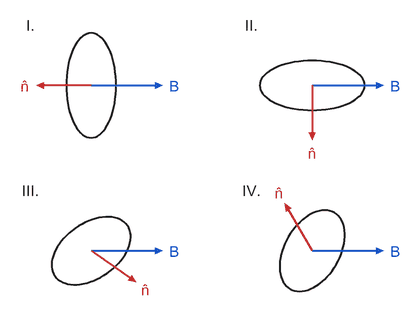
Question 120
A current-carrying loop is placed in a uniform magnetic field in four different orientations, I, II, III & IV. Arrange them in the decreasing order of potential energy.
- 1211 mark
Question 121
The magnetic force acting on a charge particle of charge in a magnetic field of acting in direction, when the particle velocity is is
- 1221 mark
Question 122
A ring of radius , made of an insulating material carries a charge uniformly distributed on it. If the ring rotates about the axis passing through its centre and normal to plane of the ring with constant angular speed , then the magnitude of the magnetic moment of the ring is
- 1231 mark
Question 123
A metallic rod of mass per unit length is lying horizontally on a smooth inclined plane which makes an angle of with the horizontal. The rod is not allowed to slide down by flowing a current through it when a magnetic field of induction is acting on it in the vertical direction. The current flowing in the rod to keep it stationary is
- 1241 mark
Question 124
A solid metal cube of edge length is moving in a positive direction at a constant speed of . There is a uniform magnetic field of in the positive -direction. The potential difference between the two faces of the cube perpendicular to the -axis, is
- 1251 mark
Question 125
A particle having the same charge as an electron moves in a circular path of radius under the influence of a magnetic field of . If an electric field of makes it to move in a straight path, then the mass of the particle is (given charge of electron )
- 1261 mark
Question 126
One of the two identical conducting wires of length is bent in the form of a circular loop and the other one into a circular coil of identical turns. If the same current is passed in both, the ratio of the magnetic field at the centre of the loop () to that at the centre of the coil (), i.e., will be
- 1271 mark
Question 127
In an experiment electrons are accelerated, from rest by applying a voltage of . Calculate the radius of the path if a magnetic field is then applied. [Charge of the electron , mass of electron ]
- 1281 mark
Question 128
A circular coil having turns and radius carries a current . It is held in the plane in a magnetic field . The torque on the coil due to the magnetic field is
- 1291 mark
Question 129
A particle of mass and charge is in an electric and magnetic field given by ; . The charged particle is shifted from the origin to the point along a straight path. The magnitude of the total work done is
- 1301 mark
Question 130
A proton and an α-particle (with their mass in the ratio of and charges in the ratio ) are accelerated from rest through a potential difference . If a uniform magnetic field () is set up perpendicular to their velocities. The ratio of the radii of the circular path described by them will be
- 1311 mark
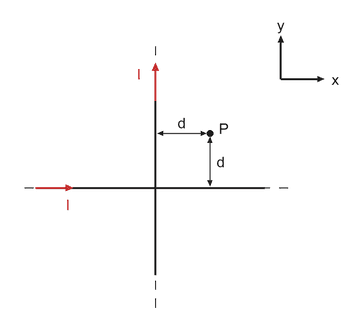
Question 131
Two very long, straight and insulated wires are kept at angle from each other in -plane as shown in the figure. These wires carry currents of equal magnitude , whose directions are shown in the given figure. The net magnetic field at point P will be
- 1321 mark
Question 132
A square loop is carrying a steady current and the magnitude of its magnetic dipole moment is . If this square loop is changed to a circular loop and it carries the same current, the magnitude of the magnetic dipole moment of circular loop will be
- 1331 mark
Question 133
A proton, an electron and a Helium nucleus, have the same energy. They are in circular orbits in a plane due to magnetic field perpendicular to the plane. Let , and be their respective radii, then
- 1341 mark
Question 134
The magnitude of the magnetic field at the centre of an equilateral triangular loop of side which is carrying a current of is [Take ]
- 1351 mark
Question 135
A thin ring of radius carries a uniformly distributed charge. The ring rotates at a constant angular speed of about its axis, perpendicular to its plane. If the magnetic field at its centre is , then the charge carried by the ring is close to ()
- 1361 mark
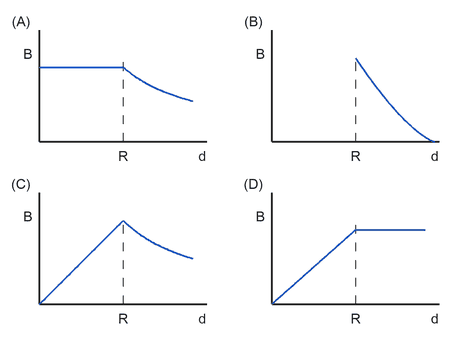
Question 136
A cylindrical conductor of radius is carrying a constant current. The plot of the magnitude of the magnetic field, with the distance, , from the centre of the conductor, is correctly represented by the
- 1371 mark
Question 137
Ionised hydrogen atoms and α-particles with same momenta enters perpendicular to a constant magnetic field B. The ratio of their radii of their path will be
- 1381 mark
Question 138
A particle of mass and charge has an initial velocity . If an electric field and magnetic field act on the particle, its speed will be double after a time
- 1391 mark
Question 139
A beam of protons with speed enters a uniform magnetic field of at an angle of to the magnetic field. The pitch of the resulting helical path of proton is close to (mass of the proton , charge of the proton )
- 1401 mark
Question 140
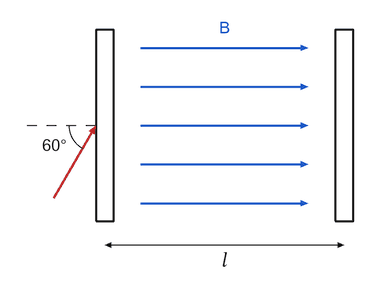
The figure shows a region of length with a uniform magnetic field of in it and a proton entering the region with velocity making an angle with the field. If the proton completes revolutions by the time it cross the region is close to (mass of the proton , charge of the proton )
- 1411 mark
Question 141
A particle of charge and mass is moving with a velocity towards a large screen placed in the - plane at a distance . If there is a magnetic field , the minimum value of for which the particle will not hit the screen is
- 1421 mark
Question 142
An electron is moving along direction with a velocity of . It enters a region of uniform electric field of pointing along direction. The magnitude and direction of the magnetic field set up in this region such that the electron keep moving along the direction will be
- 1431 mark
Question 143
A long solenoid of length having turns carries current of . The magnetic field at the centre of the solenoid is []
- 1441 mark
Question 144
Magnetic fields at two points on the axis of a circular coil at a distance of and from the centre are in the ratio . The radius of coil is
- 1451 mark
Question 145
A charge is moving distance in the magnetic field . Find the value of work done by .
- 1461 mark
Question 146
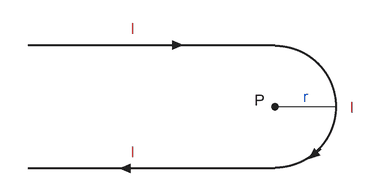
A hair pin like shape as shown in the given figure, is made by bending a long current-carrying wire. What is the magnitude of a magnetic field at a point P which lies on the centre of semicircle?
- 1471 mark
Question 147
A proton and α-particle, having kinetic energies and , respectively, enter into a magnetic field at right angles. The ratio of the radii of trajectory of proton to that of α-particle is . The ratio of is
- 1481 mark
Question 148
Two ions of masses and have charges and respectively. These ions pass through the region of constant perpendicular magnetic field. The kinetic energy of both ions is same. Then
- 1491 mark
Question 149
The fractional change in the magnetic field intensity at distance from centre on the axis of a current-carrying coil of radius to the magnetic field intensity at centre of the same coil is (Take )
- 1501 mark
Question 150
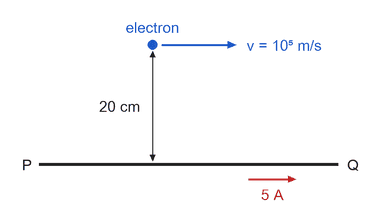
An infinitely long straight conductor carries a current of as shown. An electron is moving with a speed of parallel to the conductor. The perpendicular distance between the electron and the conductor is at an instant. Calculate the magnitude of the force experienced by the electron at that instant.