
Opening your dashboard
Class 12 Physics Chapter 7 Moving Charges and Magnetism: Competency-Based Questions (CBQ)
40 questions on Chapter 7, each worked through on its own page with the AI tutor. Class 12 Physics, ICSE 2026-27.
40 questions
1–5 marks · Mixed difficulty
- 11 mark
Question 1
Competency: Analysis & Evaluation
A student repeats Oersted's experiment with a wire from the a.c. mains (through a suitable resistor) instead of a battery. The compass needle under the wire only trembles slightly and stays pointing north.
Assertion (A): A compass needle placed close to a wire carrying a alternating current shows no steady deflection.
Reason (R): An alternating current produces no magnetic field around the wire.
- 21 mark
Question 2
Competency: Application
A table lamp is run from a d.c. supply through a two-core flexible cord. The two wires inside the cord are apart and carry each. A compass held from the cord hardly moves, although a single wire carrying would give a field of at that distance. Which is the best explanation? (Hypothetical data.)
- 31 mark
Question 3
Competency: Analysis & Evaluation
A student places a magnetic-field probe at different points round a short straight piece of a current-carrying wire, keeping the distance from it the same.
Assertion (A): A short current element produces its strongest magnetic field at points lying along its own line (on its axis).
Reason (R): The field of a current element is , where is the angle between and .
- 41 mark
Question 4
Competency: Analysis & Evaluation
An engineer builds a scale model of a flat wire circuit in which every length (each wire's length, each radius and the distance of the test point from the wires) is twice that in the original. The model carries the same current. If the field at a chosen point of the original is , the field at the corresponding point of the model is
- 53 marks
Question 5
Competency: Application
A teacher has a length of thin wire to make a single-turn loop for a field demonstration. The teacher wants the largest possible field at the centre with a current of , and must choose between bending the wire into a circle or into a square. (Hypothetical data.) (Take .)
(a) Find the field at the centre if the wire is bent into a circle.
(b) The field at perpendicular distance from a straight segment whose ends subtend angles and on either side of the perpendicular is (from the Biot–Savart law). Use it to find the field at the centre if the wire is bent into a square.
(c) Which shape should she choose, and by what percentage is its field larger?
- 63 marks
Question 6
Competency: Analysis & Evaluation
To find the unknown steady current in a long straight cable, students zero a Hall-effect magnetic probe in the Earth's field and then measure the field of the cable at several perpendicular distances :
(cm) 2.0 4.0 5.0 8.0 10.0 (T) 151 74 60 38 30 (Hypothetical data.) (Take .)
(a) Show from the table that .
(b) Find the current in the cable.
(c) What reading do you expect at from the cable?
- 73 marks
Question 7
Competency: Application
To cancel the Earth's horizontal magnetic field (, pointing north) in a small region, a lab uses two identical coaxial circular coils, each of radius with turns, placed a distance apart. The same current flows in both coils in the same sense. The region of interest is the midpoint of their common axis. (Hypothetical data.) (Take .)
(a) Using the field on the axis of a coil, , show that the total field at the midpoint is about .
(b) Find the current needed.
(c) How must the common axis be lined up, and which way must the coil field point at the midpoint?
- 81 mark
Question 8
Competency: Analysis & Evaluation
A student moves a field probe along the axis of a current-carrying circular loop, starting from its centre, and notes that the reading falls steadily.
Assertion (A): The magnetic field at the centre of a circular current loop is greater than at any other point on its axis.
Reason (R): At large distances along the axis, the field of a circular loop varies as .
- 94 marks
Question 9
Competency: Application
A toroid for a current sensor has turns wound evenly on a ring-shaped plastic core whose inner radius is and outer radius . It carries a current of . (Hypothetical data.) (Take .)
(a) Use Ampere's circuital law to write the field at a distance from the centre, inside the core.
(b) Find the field at the inner and at the outer edge of the core.
(c) By what percentage of the field at the mean radius () does the field vary across the core?
(d) What is the field at a point just outside the windings, from the centre? Give a reason.
- 101 mark
Question 10
Competency: Analysis & Evaluation
A student holds a small compass in the open space at the centre of a closely wound toroid carrying a steady current, and finds that the toroid's current has no effect on it.
Assertion (A): A closely wound toroid produces no magnetic field in the open region enclosed by its inner surface.
Reason (R): A circular Amperian loop drawn in that open region, coaxial with the toroid, encloses no current.
- 111 mark
Question 11
Competency: Application
In a power station, a current of is carried by a long copper busbar in the form of a thick-walled tube of inner radius and outer radius . The current is spread uniformly over the copper cross-section. The magnetic field inside the copper, from the axis, is (Hypothetical data.) ()
- 124 marks
Question 12
Competency: Analysis & Evaluation
The probe of a laboratory teslameter is a thin rectangular strip of a semiconductor in which the charge carriers are positive holes (charge ). The strip lies flat on a bench, with its length pointing east and its width pointing north. A current flows through it towards the east, and the holes drift east at . A uniform magnetic field of acts vertically upwards. (Hypothetical data.) ()
(a) Find the magnetic force on one drifting hole, and state its direction.
(b) Holes collect on one edge until the electric field they set up across the width stops further sideways drift. Find this electric field.
(c) Find the potential difference between the north and south edges, and say which edge is at the higher potential.
(d) If the carriers were electrons and the current were still towards the east, which edge would be at the higher potential?
- 131 mark
Question 13
Competency: Application
Near the magnetic equator, the Earth's magnetic field is horizontal and points towards geographic north. A fast cosmic-ray proton arrives there moving vertically downwards. At that instant the magnetic force on it is directed towards the
- 141 mark
Question 14
Competency: Analysis & Evaluation
In a test, a narrow beam of protons is fired exactly along the central axis of a long solenoid carrying a steady current.
Assertion (A): The proton beam passes through the solenoid without being deflected.
Reason (R): Inside a long solenoid the magnetic field is along its axis, so the velocity of each proton is parallel to and the magnetic force is zero.
- 153 marks
Question 15
Competency: Analysis & Evaluation
In a fine-beam tube, electrons from rest are accelerated through a potential difference and then move at right angles to a uniform magnetic field of , tracing a glowing circle. A student records the radius for four values of :
(V) 150 200 250 300 (cm) 4.1 4.8 5.3 5.8 (Hypothetical data.)
(a) Using and , show that should be the same for every reading, and write in terms of and .
(b) Use the table to find for the electron.
(c) Using your value, find the speed of the electrons when .
- 164 marks
Question 16
Competency: Analysis & Evaluation
In a bubble-chamber photograph, a uniform magnetic field of points out of the photograph, towards the viewer. A track left by a particle of charge of magnitude curves clockwise as seen by the viewer. Where the track begins, its radius is ; further along, the track spirals inwards with a steadily smaller radius. (Hypothetical data.) (, )
(a) Is the particle positively or negatively charged? Give a reason.
(b) Find its momentum where the track begins.
(c) Explain why the radius becomes smaller along the track.
(d) If the particle is a proton, find its speed where the track begins.
- 171 mark
Question 17
Competency: Application
Free electrons in the upper atmosphere spiral round the Earth's magnetic field lines, and radio engineers must allow for the frequency of this circling. Where the Earth's field is , the number of revolutions an electron makes per second is close to (, )
- 183 marks
Question 18
Competency: Application
A cyclotron with a magnetic field of delivers protons of kinetic energy . The peak p.d. across the gap between the dees is ; assume each proton crosses the gap at the peak p.d. every time and that the time spent in the gap is negligible. (Hypothetical data.) (, )
(a) How much energy does a proton gain in one complete revolution?
(b) How many revolutions does a proton make before it leaves?
(c) How long does a proton spend inside the cyclotron?
- 191 mark
Question 19
Competency: Analysis & Evaluation
A student watching a simulation of a cyclotron notices that the ions speed up only at the instants they jump across the gap, and move at constant speed along each semicircle.
Assertion (A): In a cyclotron, the ions gain energy only while they cross the gap between the dees.
Reason (R): The frequency of the oscillator is made equal to the frequency of revolution of the ions in the magnetic field.
- 203 marks
Question 20
Competency: Application
To measure the field between the flat poles of a magnet, a rectangular coil of turns hangs from a sensitive spring balance. Only the lower horizontal side of the coil, long, lies inside the field, which is horizontal and points into the page, at right angles to that side. With no current the balance reads ; with a current of it reads . (Hypothetical data.)
(a) In which direction (left to right or right to left, as seen by the reader) does the current flow in the lower side?
(b) Find the magnetic field between the poles.
(c) What would the balance read if the current were reversed?
- 211 mark
Question 21
Competency: Analysis & Evaluation
A rectangular loop carrying a steady current is held in a uniform magnetic field with the plane of the loop parallel to the field lines. It starts to turn when released.
Assertion (A): In this position the loop experiences a net magnetic force, which is what makes it move.
Reason (R): For a closed current loop in a uniform magnetic field, the forces on opposite sides are equal in size and opposite in direction.
- 221 mark
Question 22
Competency: Application
In a classroom demonstration, a strip of aluminium foil passes between the poles of a horseshoe magnet, perpendicular to the plane of the page. The north pole is on the left and the south pole on the right. When a current is passed into the page through the foil, the foil is pushed
- 234 marks
Question 23
Competency: Application
In an electrical substation, two long parallel copper busbars apart carry the outgoing and return currents of a circuit. During a short-circuit fault, the current in each rises briefly to . The busbars are held by insulator supports placed every along them. (Hypothetical data.) (Take .)
(a) Do the busbars attract or repel each other during the fault? Give a reason.
(b) Find the force on each metre of busbar during the fault.
(c) What force must each support withstand?
(d) In normal running the current is . What is the force per metre then?
- 241 mark
Question 24
Competency: Analysis & Evaluation
Two long parallel wires carry alternating currents that are always in the same direction as each other (in phase).
Assertion (A): The wires attract each other, even though each current reverses times a second.
Reason (R): The force between two parallel currents depends only on the sizes of the currents and not on their directions.
- 251 mark
Question 25
Competency: Analysis & Evaluation
In a high-current electric discharge through a gas, the glowing column of moving ions and electrons is seen to become narrower, squeezing towards its axis, as the current is increased. Which is the best explanation?
- 264 marks
Question 26
A loop carries a current of . It is made of a quarter-circle arc of radius and a quarter-circle arc of radius , both centred at , joined by the straight radial segments and , as shown. The loop lies in the plane of the paper.

(i) Using the Biot–Savart law, show that the straight segments and produce no magnetic field at .
(ii) Find the magnetic field at due to each arc.
(iii) Find the magnitude and direction of the resultant field at .
(Take .)
- 274 marks
Question 27
A flat circular coil has turns of radius and carries a current of . (Hypothetical data.)
(i) Find the magnetic field at the centre of the coil.
(ii) Find the magnetic dipole moment of the coil.
(iii) Find the field at a point on the axis from the centre, (a) using the exact formula and (b) treating the coil as a magnetic dipole. By what percentage does the dipole value differ from the exact one?
(Take .)
- 284 marks
Question 28
A long straight wire carries a current of . A rectangular loop lies in the same plane, with its sides and parallel to the wire; is from the wire and the loop is wide. The loop carries as shown. (.)
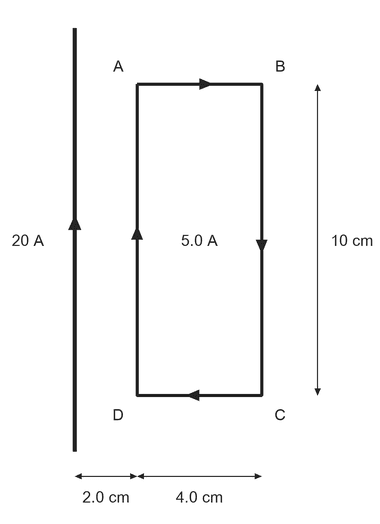
(a) Find the force on side and on side , with directions.
(b) Why do the forces on and have no effect on the net force?
(c) Find the net force on the loop.
(d) What would the net force be if the current in the loop were reversed?
(Hypothetical data.)
- 293 marks
Question 29
A long wire carrying a current of A is placed perpendicular to an external magnetic field of T. Calculate the position of the neutral point.
- 303 marks
Question 30
A current of A is flowing along the sides of an equilateral triangle of side m. Find the magnetic field at the centroid of the triangle.
- 313 marks
Question 31
A particle having charge times that of an electron is revolving in a circular path of radius m with one rotation per second. Find the magnetic field induction produced at the centre of the circular coil.
- 323 marks
Question 32
An electron is moving at in a direction parallel to a current of A flowing through an infinitely long straight wire separated by a perpendicular distance of cm in air. Calculate the magnitude of the force experienced by the electron.
- 333 marks
Question 33
A solenoid is m long and cm in diameter. It has layers of winding of turns each and carries a current of A. What is the magnetic field at its centre?
- 344 marks
Question 34
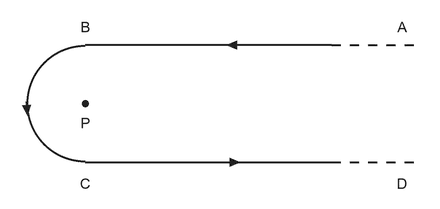
A straight wire is bent in the form of a long hairpin as shown in the given figure. If the radius of the semicircle is cm and the current flowing through the wire is A, find the magnitude and direction of the magnetic field at the point .
- 353 marks
Question 35
An electron is moving at in a direction parallel to a current of A flowing through an infinitely long straight wire separated by a perpendicular distance of cm in air. Calculate the magnitude of the force experienced by the electron.
- 363 marks
Question 36
A proton and alpha particle having the same kinetic energy are allowed to pass through a uniform magnetic field perpendicular to their direction of motion. Compare the radii of the paths of proton and alpha particle.
- 373 marks
Question 37
An electron after being accelerated through a potential difference of V enters a uniform magnetic field of T perpendicular to the direction of motion. Calculate the radius of the path described by the electron.
- 383 marks
Question 38
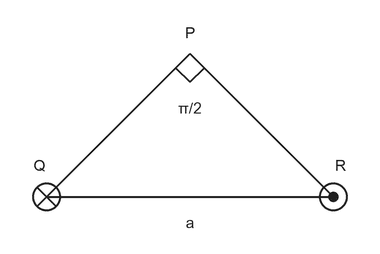
The given figure shows a right-angled isosceles triangle having its base equal to . A current of ampere is passing downwards along a thin straight wire cutting the plane of the paper normally as shown at . Likewise a similar wire carries an equal current moving normally upwards at . Find the magnitude and direction of the magnetic induction at . Assume the wires to be infinitely long.
- 393 marks
Question 39
Two very long conductors carrying currents and are separated by a distance . Give the expressions (do not derive) for the magnetic fields and at points and respectively produced by the electric currents and what are the directions of these fields? Define the S.I. unit of current using above set up.

- 405 marks
Question 40
Competency: Analysis & Evaluation
Fast breeder reactors use liquid sodium as their coolant. Sodium conducts electricity, so an electromagnetic pump with no moving parts can drive it. In a test loop, molten sodium fills a horizontal rectangular duct running from west to east. Over a short length of the duct, a uniform field of acts vertically upwards, across the duct's inner height of . Copper electrodes form the north and south walls, apart, and a steady current of passes through the sodium between them. The outlet valve is closed, so the sodium is at rest. Assume all the current flows through the sodium in the uniform field region. (Hypothetical data.) (Take the density of liquid sodium as and .)
(a) Which electrode, north or south, must be joined to the positive terminal of the supply so that the sodium is pushed towards the east? Explain using .
(b) Show that the pressure difference the pump produces across the field region is , where is the inner height of the duct, and find its value. Hence find the height of a column of liquid sodium that this pressure difference can hold up.
(c) Two engineers suggest ways to double this pressure difference, keeping the same field of and the same current of .
Ravi: "Move the electrodes apart so that the duct is wide and still high. The current then crosses twice as much sodium, so the force doubles."
Meena: "Make the duct wide but only high, so that its cross-section stays the same."
Evaluate each suggestion.