
Question 542 marksMedium
Explain Biot–Savart law.
Confirming your payment
Sign up now and get 250 free tokens.
Moving Charges and Magnetism · Question 54 of 124
Explain Biot–Savart law.
Solution:
Key idea: The Biot–Savart law gives the magnetic field produced by a very small piece (element) of a current-carrying conductor. The field of a whole conductor is the sum of the fields of all its elements.
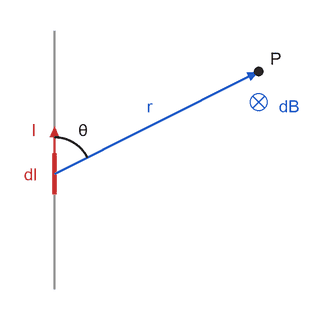
Step 1 — Describe the current element and the point.
Consider a small length of a conductor carrying a current ; the product is called a current element. Let be the position vector of the point from the element, and the angle between and , as in the figure.
Step 2 — State how the field depends on each quantity.
The size of the magnetic field at is found by experiment to be:
Step 3 — Write the law as an equation.
Combining these proportionalities, with as the constant in SI units, we get:
Here is the permeability of free space, . (It was exactly before the 2019 SI redefinition; the difference is less than one part in a billion.)
Step 4 — Give the vector form and the direction.
In vector form the law gives the direction as well:
So is perpendicular to the plane containing and , in the sense given by the right-hand screw rule (into the page at in the figure). It is greatest when is , and it is zero at points on the line of the element itself.
Therefore, the Biot–Savart law states that , with perpendicular to both and .