
Question 925 marksMedium
(a) Explain the principle of working of cyclotron.
(b) Derive an expression for kinetic energy obtained when a charged particle is accelerated in a cyclotron.
(c) What are the limitations of a cyclotron?
Confirming your payment
Sign up now and get 250 free tokens.
Moving Charges and Magnetism · Question 92 of 124
(a) Explain the principle of working of cyclotron.
(b) Derive an expression for kinetic energy obtained when a charged particle is accelerated in a cyclotron.
(c) What are the limitations of a cyclotron?
Solution:
Key idea: A charged particle moving at right angles to a uniform magnetic field goes round in a circle whose period does not depend on its speed. The cyclotron uses this to accelerate the particle again and again across one gap.
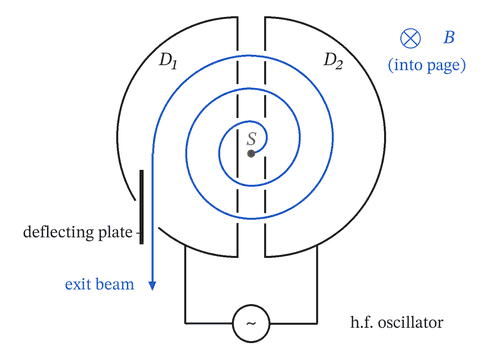
Step 1 — State the principle, part (a).
A positive ion moving perpendicular to a uniform magnetic field describes a semicircle in a time , which does not depend on its speed. An alternating p.d. of matching frequency is applied across the gap between the two dees, so the ion arrives at the gap just as the p.d. reverses and is accelerated every time it crosses. Repeated small accelerations, with the magnetic field bringing the ion back each time, give it a very high energy.
Step 2 — Relate speed to radius in the field, part (b).
Inside a dee the magnetic force provides the centripetal force.
Step 3 — Find the speed when the ion leaves.
The ion leaves when the radius of its path equals the radius of the dees.
Step 4 — Find the kinetic energy.
We put this speed into the formula for kinetic energy.
Step 5 — Write the energy using the oscillator frequency.
The oscillator frequency equals the revolution frequency, so . Substituting for :
Step 6 — State the limitations, part (c).
The cyclotron has these limitations:
Therefore, (a) the cyclotron accelerates ions repeatedly at the gap because their revolution time is independent of speed; (b) the kinetic energy gained is ; (c) it cannot accelerate electrons or neutral particles, and relativistic effects and magnet size limit its energy.