Solution:
Key idea: Each wire sets up a field 2πrμ0I in circles round it. Outside the pair, opposite currents give fields in opposite directions, so the resultant is the difference, pointing the way of the nearer wire's field.
Step 1 — Write down the distances at P.
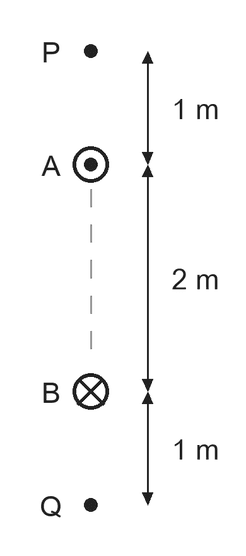
The point P is 1 m beyond A on the line of the wires.
So its distance from A is rA=1 m, and its distance from B is rB=3 m (1 m + 2 m).
Step 2 — Find the resultant field at P.
The two fields are opposite, so we subtract them. We use 2πμ0=2×10⁻⁷ T m A−1 and I=10 A.
BP=2×10−7×10×(11−31)
BP=2×10−6×32
BP≈1.33×10⁻⁶ T
Step 3 — Find the resultant field at Q.
The point Q lies 1 m beyond B, at a distance of 1 m from B and 3 m from A.
The working is the same with the wires exchanged.
BQ≈1.33×10⁻⁶ T
Step 4 — Find the directions.
In the figure A carries current out of the page, so its field goes anticlockwise; at P, above A, it points to the left, and it is the stronger field there. B carries current into the page, so its field goes clockwise; at Q, below B, it points to the left, and it is the stronger field there.
Note: The book's printed answer is 1.33×10⁻⁵ T, which is a misprint of the power of ten; 2πμ0I is 2×10⁻⁶ T m here, and two-thirds of it is 1.33×10⁻⁶ T.
Therefore, the resultant field is about 1.33×10⁻⁶ T at both P and Q, directed to the left in the figure (perpendicular to AB) at each point.