
Opening your dashboard
Class 11 Chemistry Chapter 13: Organic Chemistry: Some Basic Principles and Techniques Solutions
148 textbook questions with step-by-step answers, free to read, for ISC 2026-27.
Get talked through Ch 13, not just shown the answer
Reading a finished solution is not the same as being able to do it. The AI tutor takes one question at a time and works it with you, in your own words, until you can.
- Ask it out loud, in your own words
- It gives you the next step, not the answer
- Stuck on part (ii)? Start there
148 questions with solutions
1–5 marks · Mixed difficulty
The first 58 solutions are on this page. This chapter is a long one, so the rest open on their own page to keep this one quick to load.
- 11 mark
Question 1
The isomers have the same:
Solve with AIAnswer
(A) structural formula
(B) chemical properties
- Correct
(C) molecular formula
(D) physical properties
Answer: (C) molecular formula
Key idea: Isomers are different compounds that have the same molecular formula but a different arrangement of atoms (a different structure or a different arrangement in space).
Step 1 — Recall what all isomers share. By definition, every isomer of a compound contains the same atoms in the same numbers, so their molecular formula is the same. For example, ethanol and dimethyl ether are both .
Step 2 — Recall what makes them different. The atoms are joined in a different order or arranged differently in space, so the compounds are not the same substance.
Why the other options are wrong:
- (A) Isomers are different compounds because their structural formulae differ; ethanol is while dimethyl ether is .
- (B) A different structure usually means different chemistry: ethanol reacts with sodium to give hydrogen, but dimethyl ether does not.
- (D) Isomers usually have different physical properties; butane boils at about −1 °C and its isomer 2-methylpropane at about −12 °C.
Therefore, isomers have the same molecular formula.
- 21 mark
Question 2
How many isomers can be obtained from the alkane ?
Solve with AIAnswer
(A) 6
- Correct
(B) 5
(C) 4
(D) 7
Answer: (B) 5
Key idea: Alkanes show chain isomerism: the same number of carbon atoms can be joined in straight or branched chains. We count the isomers by writing every different carbon skeleton once, naming each so that no skeleton is counted twice.
Step 1 — Write the straight chain. All six carbon atoms in one unbranched chain give hexane.
Step 2 — Use a five-carbon chain with one methyl branch. The branch can sit on carbon 2 or carbon 3; a branch on carbon 4 is the same as one on carbon 2 counted from the other end.
Step 3 — Use a four-carbon chain with two methyl branches. Both branches on carbon 2, or one on carbon 2 and one on carbon 3, are the only possibilities (a branch on carbon 1 would just lengthen the chain).
Step 4 — Count. A three-carbon chain cannot carry the remaining three carbons as branches without making a longer chain, so there are no more skeletons: 1 + 2 + 2 = 5 isomers.
Why the other options are wrong:
- (A) 6 comes from counting one skeleton twice, for example drawing 2-methylpentane again from the other end as "4-methylpentane".
- (C) 4 leaves one skeleton out, for example 3-methylpentane.
- (D) 7 is too many; every other drawing of turns out to be one of the five structures above.
Therefore, has 5 isomers.
- 31 mark
Question 3
An isomer of ethanol is:
Solve with AIAnswer
(A) methanol
- Correct
(B) dimethyl ether
(C) diethyl ether
(D) ethylene glycol
Answer: (B) dimethyl ether
Key idea: An isomer must have the same molecular formula. Ethanol, , has the molecular formula .
Step 1 — Write the molecular formula of each option. We count the atoms in each compound and compare them with .
Step 2 — Find the match. Dimethyl ether, , also contains two carbon atoms, six hydrogen atoms and one oxygen atom, the same atoms as ethanol. It has an ether group instead of an alcohol group, so it is a functional isomer of ethanol.
Why the other options are wrong:
- (A) Methanol, , is ; it has one carbon atom fewer, so it is a homologue of ethanol, not an isomer.
- (C) Diethyl ether, , is ; it is an isomer of the butanols, not of ethanol.
- (D) Ethylene glycol, , is ; it has one more oxygen atom.
Therefore, dimethyl ether is an isomer of ethanol.
- 41 mark
Question 4
The compound can show:
Solve with AIAnswer
(A) metamerism
(B) functional isomerism
(C) positional isomerism
- Correct
(D) all types of isomerism
Answer: (D) all types of isomerism
Key idea: The formula fits both alcohols and ethers, so its structures can differ in the functional group, in the position of the group, in the carbon chain and in the alkyl groups on the ether oxygen.
Step 1 — Find functional isomers. An alcohol and an ether with the same formula are functional isomers, for example butan-1-ol, , and diethyl ether, .
Step 2 — Find position isomers. Moving the –OH group along the same chain gives butan-1-ol and butan-2-ol, .
Step 3 — Find metamers. Ethers with different alkyl groups on the same –O– group are metamers: diethyl ether, , and methyl propyl ether, .
Step 4 — Notice the other kinds too. Butan-1-ol and 2-methylpropan-1-ol have different carbon chains (chain isomers), and butan-2-ol has an asymmetric carbon, so it even shows optical isomerism. In all, has 7 structural isomers (4 alcohols and 3 ethers).
Why the other options are wrong:
- (A) Metamerism does occur (the ethers), but it is only one of the kinds this formula shows, so (D) is the better answer.
- (B) Functional isomerism does occur (alcohol and ether), but it is not the only kind.
- (C) Positional isomerism does occur (butan-1-ol and butan-2-ol), but again it is only one of several kinds.
Therefore, can show all these types of isomerism.
- 51 mark
Question 5
How many isomers are possible for molecule?
Solve with AIAnswer
- Correct
(A) 3
(B) 4
(C) 5
(D) 6
Answer: (A) 3
Key idea: The formula has one double bond (or one ring) more than a saturated compound. At this level the formula is used for the carbonyl compounds, aldehydes and ketones, which are its common stable isomers.
Step 1 — Write the aldehydes. The –CHO group ends a chain of four carbon atoms, which can be straight or branched.
Step 2 — Write the ketones. The C=O group must have a carbon on each side, and with four carbons there is only one way to do this.
Step 3 — Count. Two aldehydes and one ketone give 3 carbonyl isomers.
Why the other options are wrong:
- (B) 4 matches neither full count: the carbonyl compounds number 3 and all structures together number 26. A slip that lands on 4 is counting butanone twice, as "butan-2-one" and "butan-3-one", which are the same molecule numbered from opposite ends.
- (C) 5 matches neither full count either; four carbon atoms allow only two aldehyde skeletons and one ketone, so no fourth or fifth carbonyl compound exists.
- (D) 6 is only the number of cyclic ethers (such as tetrahydrofuran and the oxiranes), which are just one part of the full list of 26; it is not the carbonyl count of 3.
Note: the printed answer 4 is a slip. Counted as aldehydes and ketones the isomers are 3; if every structure is counted (unsaturated alcohols and ethers such as and , cyclic alcohols and cyclic ethers such as tetrahydrofuran, and unstable enols) there are 26 structural isomers, so no full reading of the question gives 4.
Therefore, has 3 isomeric carbonyl compounds.
- 61 mark
Question 6
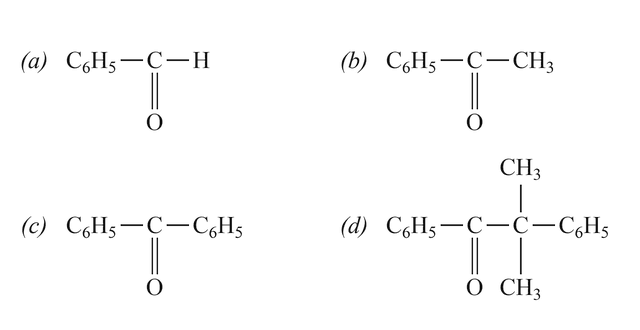
Keto-enol tautomerism is observed in:
 Solve with AI
Answer
(A)
- Correct
(B)
(C)
(D)
Answer: (B)
Key idea: In keto–enol tautomerism a hydrogen atom moves from the carbon next to the C=O group (the α-carbon) to the oxygen, giving an enol, . So a carbonyl compound shows it only if it has at least one α-hydrogen.
Step 1 — Look for α-hydrogens in each structure. The α-carbons are the carbon atoms joined directly to the C=O carbon.
Step 2 — Check acetophenone (B). Its C=O carbon carries a group with three α-hydrogens, so one of them can move to the oxygen.
Why the other options are wrong:
- (A) In benzaldehyde the C=O carbon is joined to a ring carbon that carries no hydrogen, so there is no α-hydrogen to move.
- (C) In benzophenone both neighbours of the C=O carbon are ring carbons without hydrogen, so it cannot form an enol.
- (D) The α-carbon here is , which carries two methyl groups and a phenyl group but no hydrogen, so no enol can form.
Therefore, keto–enol tautomerism is observed in , acetophenone.
- 71 mark
Question 7
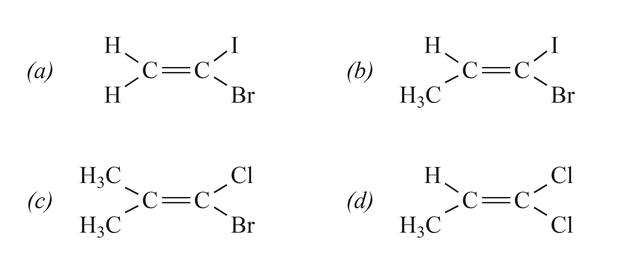
Geometrical isomerism is shown by:
 Solve with AI
Answer
(A) Structure (a)
- Correct
(B) Structure (b)
(C) Structure (c)
(D) Structure (d)
Answer: (B) Structure (b)
Key idea: An alkene shows geometrical (cis–trans) isomerism only when each doubly bonded carbon carries two different groups ( and ). Rotation about the C=C bond is restricted, so the two groups can be fixed on the same side or on opposite sides.
Step 1 — Check each carbon of every structure. We list the two groups on the left carbon and the two on the right carbon.
Step 2 — Find the structure that passes on both carbons. In (b) the left carbon has H and (different) and the right carbon has I and Br (different), so it can exist as two geometrical isomers: one with H and I on the same side, one with H and Br on the same side.
Why the other options are wrong:
- (A) The left carbon carries two hydrogen atoms; swapping them gives the same molecule, so there are no cis and trans forms.
- (C) The left carbon carries two methyl groups, so again only one arrangement is possible.
- (D) The right carbon carries two chlorine atoms, so the two "isomers" would be identical.
Therefore, structure (b) shows geometrical isomerism.
- 81 mark
Question 8
Which of the following compounds will exhibit cis-trans isomerism?
Solve with AIAnswer
- Correct
(A) 2-butene
(B) 2-butyne
(C) 2-butanol
(D) 1-butene
Answer: (A) 2-butene
Key idea: Cis–trans isomerism needs restricted rotation (a C=C bond or a ring) and two different groups on each of the two carbons.
Step 1 — Look at 2-butene. In each doubly bonded carbon carries H and , which are different.
Step 2 — Write the two forms. The two methyl groups can be on the same side (cis-but-2-ene) or on opposite sides (trans-but-2-ene), and the two forms cannot change into each other without breaking the π bond.
Why the other options are wrong:
- (B) 2-Butyne, , is linear around the triple bond, so there are no "sides" for groups to be on.
- (C) 2-Butanol, , has no C=C bond; it shows optical isomerism instead.
- (D) In 1-butene, , the end carbon carries two hydrogen atoms, so no cis and trans forms exist.
Therefore, 2-butene exhibits cis–trans isomerism.
- 91 mark
Question 9
Which can exist in optically active form?
Solve with AIAnswer
(A) 1-butanol
- Correct
(B) 2-butanol
(C) 3-pentanol
(D) 4-heptanol
Answer: (B) 2-butanol
Key idea: A compound can be optically active when it has an asymmetric (chiral) carbon: a carbon atom joined to four different atoms or groups.
Step 1 — Look at C-2 of 2-butanol. In , carbon 2 carries H, OH, and : four different groups.
Step 2 — Conclude. The molecule is not superimposable on its mirror image, so it exists as a pair of optically active enantiomers.
Why the other options are wrong:
- (A) In 1-butanol, , every carbon carries at least two hydrogen atoms, so no carbon is asymmetric.
- (C) In 3-pentanol, , the –OH carbon carries two identical ethyl groups.
- (D) In 4-heptanol, , the –OH carbon carries two identical propyl groups.
Therefore, 2-butanol can exist in optically active form.
- 101 mark
Question 10
Optical activity is expected for:
Solve with AIAnswer
(A) 2-methyl propanoic acid
(B) methyl-2-methyl propanoate
- Correct
(C) methyl-2-chloropropanoate
(D) propanoic acid
Answer: (C) methyl-2-chloropropanoate
Key idea: Optical activity is expected when the molecule has a carbon atom carrying four different groups (an asymmetric carbon) and no plane of symmetry.
Step 1 — Write each structure. We write the condensed formula of each compound and look at carbon 2.
Step 2 — Check methyl 2-chloropropanoate. In , carbon 2 carries H, Cl, and : four different groups, so the molecule is chiral and optically active.
Why the other options are wrong:
- (A) 2-Methylpropanoic acid, , has two identical methyl groups on carbon 2.
- (B) Methyl 2-methylpropanoate, , also has two methyl groups on carbon 2.
- (D) Propanoic acid, , has two hydrogen atoms on carbon 2, so no carbon is asymmetric.
Therefore, optical activity is expected for methyl 2-chloropropanoate.
- 111 mark
Question 11
Meso-tartaric acid is optically inactive because:
Solve with AIAnswer
(A) It has no asymmetric carbon atom
(B) It is spherical
(C) Of external compensation
- Correct
(D) Of internal compensation
Answer: (D) Of internal compensation
Key idea: A meso compound has asymmetric carbon atoms but also a plane of symmetry inside the molecule. The rotation caused by one half of the molecule is cancelled by the equal and opposite rotation caused by the other half. This is called internal compensation.
Step 1 — Look at meso-tartaric acid. has two asymmetric carbons, one with the R and one with the S configuration.
Step 2 — See why the rotations cancel. The two halves are mirror images of each other, so the plane of symmetry between them makes the whole molecule superimposable on its mirror image; the rotations cancel within each molecule.
Why the other options are wrong:
- (A) Meso-tartaric acid does have asymmetric carbon atoms (two of them); its inactivity comes from the symmetry, not from their absence.
- (B) "Spherical" has nothing to do with optical activity; what matters is whether the molecule is superimposable on its mirror image.
- (C) External compensation describes a racemic mixture, where equal amounts of two different enantiomers cancel each other; meso-tartaric acid is a single compound.
Therefore, meso-tartaric acid is optically inactive because of internal compensation.
- 121 mark
Question 12
The optically active tartaric acid is named as D (+) tartaric acid because it has a positive.
Solve with AIAnswer
(A) Optical rotation and is derived from D-glucose
(B) pH in an organic solvent
- Correct
(C) Optical rotation and is derived from D(+) glyceraldehyde
(D) Optical rotation only when substituted by deuterium.
Answer: (C) Optical rotation and is derived from D(+) glyceraldehyde
Key idea: A name such as D(+) has two independent parts. The sign (+) is the measured direction of rotation (to the right, dextrorotatory). The letter D gives the configuration: the arrangement at the asymmetric carbon is related to that of D-(+)-glyceraldehyde, the reference compound of the D–L system.
Step 1 — Explain the sign. The sign (+) means the compound rotates the plane of polarised light clockwise, as seen in a polarimeter.
Step 2 — Explain the letter. D means that, when the compound is written as a Fischer projection, its configuration corresponds (can be related step by step) to D-(+)-glyceraldehyde, which has its –OH on the right.
Why the other options are wrong:
- (A) The reference compound of the D–L system is glyceraldehyde, not glucose; D-glucose is itself called D because of its relation to D-glyceraldehyde.
- (B) The sign in the name refers to the rotation of polarised light; it has nothing to do with pH.
- (D) Tartaric acid is optically active because of its own asymmetric carbon atoms; no deuterium is needed.
Note: the D/L letter and the (+)/(−) sign are independent. With today's convention the dextrorotatory tartaric acid of grapes is usually written L-(+)-tartaric acid, (2R,3R); the question uses the label D(+) to ask what each part of such a name means.
Therefore, the name means a positive optical rotation and a configuration related to D(+) glyceraldehyde.
- 131 mark
Question 13
Which of the following compounds will exhibit geometrical isomerism.
Solve with AIAnswer
- Correct
(A) 1-phenyl-2-butene
(B) 3-phenyl-1-butene
(C) 2-phenyl-1-butene
(D) 1, 1-diphenyl-1-propene
Answer: (A) 1-phenyl-2-butene
Key idea: Geometrical isomerism needs a C=C bond whose two carbon atoms each carry two different groups. A terminal group, or a carbon with two identical groups, rules it out.
Step 1 — Write each structure. We write the condensed formula and look at the groups on each doubly bonded carbon.
Step 2 — Check 1-phenyl-2-butene. In , carbon 2 carries H and , and carbon 3 carries H and ; both pairs are different, so cis and trans forms exist.
Why the other options are wrong:
- (B) 3-Phenyl-1-butene, , has the double bond at the chain end, where carbon 1 carries two hydrogen atoms; it shows optical isomerism instead, because carbon 3 is asymmetric.
- (C) 2-Phenyl-1-butene, , also has a terminal group.
- (D) 1,1-Diphenyl-1-propene, , has two identical phenyl groups on carbon 1.
Note: the book prints this question twice (also MCQ Q22).
Therefore, 1-phenyl-2-butene exhibits geometrical isomerism.
- 141 mark
Question 14
(R) and (S) enantiomers of an optically active compound differ in
Solve with AIAnswer
(A) Their solubility in achiral solution
(B) Their reactivity with achiral reagent
- Correct
(C) Their optical rotation of plane polarised light
(D) Their melting points
Answer: (C) Their optical rotation of plane polarised light
Key idea: Enantiomers are non-superimposable mirror images. In an achiral surrounding they behave identically, because every interaction of one is mirrored exactly by the other. They differ only in the direction in which they rotate plane-polarised light (equal angle, opposite sign) and in their behaviour towards other chiral things.
Step 1 — Compare the physical properties. Melting points, boiling points, densities and solubilities in ordinary (achiral) solvents are the same for both enantiomers.
Step 2 — Compare the optical rotation. One enantiomer rotates the plane of polarised light to the right by a certain angle, the other to the left by the same angle.
Why the other options are wrong:
- (A) An achiral solvent cannot tell the two mirror-image molecules apart, so their solubilities in it are equal.
- (B) An achiral reagent also reacts with both enantiomers at the same rate.
- (D) The forces between molecules are the same in the two pure enantiomers, so their melting points are equal.
Therefore, R and S enantiomers differ in the direction of their optical rotation.
- 151 mark
Question 15
A racemic compound is:
Solve with AIAnswer
(A) Dextro-rotatory
(B) Laevo-rotatory
- Correct
(C) Optically inactive mixture
(D) Optically active mixture
Answer: (C) Optically inactive mixture
Key idea: A racemic mixture (racemic modification) contains equal amounts of the two enantiomers, the (+) form and the (−) form.
Step 1 — Add up the rotations. The (+) form rotates the plane of polarised light to the right by some angle and the (−) form to the left by the same angle.
Step 2 — See the result. In equal amounts the two rotations cancel exactly (external compensation), so the mixture shows no rotation.
Why the other options are wrong:
- (A) A dextrorotatory sample would need an excess of the (+) form; a racemic mixture has none.
- (B) A laevorotatory sample would need an excess of the (−) form.
- (D) The mixture is optically inactive, because the two equal and opposite rotations cancel.
Therefore, a racemic compound is an optically inactive mixture.
- 161 mark
Question 16
Which of the following shows geometrical isomerism?
Solve with AIAnswer
(A) But-1-ene
- Correct
(B) But-2-ene
(C) Propene
(D) 1,1-Dichlorobutane
Answer: (B) But-2-ene
Key idea: Geometrical isomerism needs restricted rotation about a C=C bond and two different groups on each doubly bonded carbon.
Step 1 — Check but-2-ene. In each doubly bonded carbon carries H and .
Step 2 — Write the isomers. The methyl groups can be on the same side (cis) or on opposite sides (trans) of the double bond.
Why the other options are wrong:
- (A) In but-1-ene, , carbon 1 carries two hydrogen atoms.
- (C) In propene, , carbon 1 also carries two hydrogen atoms.
- (D) 1,1-Dichlorobutane, , is saturated: with free rotation about every single bond, it has no cis and trans forms.
Therefore, but-2-ene shows geometrical isomerism.
- 171 mark
Question 17
Which of the following compounds is achiral?
Solve with AIAnswer
- Correct
(A)
(B)
(C)
(D)
Answer: (A)
Key idea: A molecule is chiral if it has a carbon carrying four different groups. Deuterium (D, heavy hydrogen) counts as a group different from H, so a carbon with H, D and two other different groups is asymmetric.
Step 1 — Check (A). In the first carbon carries D, H, H; the middle carbon carries H, H; the last carbon carries H, H, Cl. Every carbon has at least two identical atoms, so no carbon is asymmetric and the molecule is achiral.
Step 2 — Check the others. In each of (B), (C) and (D) one carbon carries four different groups, so those molecules are chiral.
Why the other options are wrong:
- (B) In carbon 1 carries H, D, Cl and : four different groups.
- (C) In carbon 2 carries H, D, and .
- (D) In carbon 2 carries H, Cl, and ; differs from only by an isotope, but that is enough to make the carbon asymmetric.
Note: the book prints this question twice (also MCQ Q38).
Therefore, is achiral.
- 181 mark
Question 18
The optically active lactic acid is named as D (+) lactic acid because it has a positive:
Solve with AIAnswer
(A) optical rotation and is derived from D-glucose
(B) pH in an organic solvent
- Correct
(C) optical rotation and is derived from D (+) glyceraldehyde.
(D) optical rotation only when substituted by deuterium.
Answer: (C) optical rotation and is derived from D (+) glyceraldehyde
Key idea: In a name such as D(+), the sign (+) is the experimentally measured direction of rotation of plane-polarised light, while the letter D tells us the configuration: the arrangement at the asymmetric carbon is related to D-(+)-glyceraldehyde, the standard of the D–L system.
Step 1 — Explain the (+). It means the compound is dextrorotatory: it turns the plane of polarised light to the right.
Step 2 — Explain the D. In the Fischer projection, with the carbon chain vertical and the most oxidised carbon at the top, the –OH on the asymmetric carbon is on the right, as in D-glyceraldehyde.
Why the other options are wrong:
- (A) The D–L reference compound is glyceraldehyde, not glucose.
- (B) The (+) sign describes optical rotation, not the pH of a solution.
- (D) Lactic acid is optically active because its carbon 2 carries four different groups (H, OH, , COOH); no deuterium is involved.
Note: the letter and the sign are independent. In fact the dextrorotatory lactic acid has the L configuration, L-(+)-lactic acid, and D-lactic acid is laevorotatory, D-(−)-lactic acid; the question uses the label D(+) to ask what each part of such a name means.
Therefore, the name means a positive optical rotation and a configuration related to D (+) glyceraldehyde.
- 191 mark
Question 19
The compounds and exhibit
Solve with AIAnswer
(A) optical isomerism
(B) cis - trans isomerism
- Correct
(C) metamerism
(D) chain isomerism
Answer: (C) metamerism
Key idea: Metamers have the same molecular formula and the same functional group but different alkyl groups attached to that group.
Step 1 — Check the formulas. Methyl propyl ether, , and diethyl ether, , are both .
Step 2 — Compare the structures. Both are ethers (–O– group); one has methyl and propyl groups on the oxygen, the other two ethyl groups. This is metamerism.
Why the other options are wrong:
- (A) Neither ether has a carbon atom carrying four different groups, so neither is optically active.
- (B) Neither has a C=C bond or a ring, so cis–trans isomerism is not possible.
- (D) Chain isomers differ in the branching of the carbon chain with the group in a comparable place; here the difference is how the carbons are shared between the two sides of the oxygen.
Therefore, the two ethers exhibit metamerism.
- 201 mark
Question 20
The number of possible isomers for compound is
Solve with AIAnswer
(A) 2
- Correct
(B) 3
(C) 4
(D) 5
Answer: (B) 3
Key idea: In a substituted ethane the two carbons each have three places for H or halogen. We share the three halogen atoms (Cl, Cl, Br) between the two carbons in every possible way, counting each different structure once.
Step 1 — Put all three halogens on one carbon. This gives one structure.
Step 2 — Put two halogens on one carbon and one on the other. The single halogen can be Br or Cl, giving two more structures.
Step 3 — Count. No other way of placing the halogens exists, so there are 3 structural isomers.
Why the other options are wrong:
- (A) 2 leaves out one of the three structures, for example .
- (C) 4 is the count only if the two mirror-image forms of (its carbon 1 is asymmetric) are counted separately; as structures the isomers are 3.
- (D) 5 is more than even the fullest count: with the two mirror-image forms of counted separately, the total is only 4.
Therefore, has 3 isomers.
- 211 mark
Question 21
Which of the following aromatic compounds will not exhibit isomerism?
Solve with AIAnswer
- Correct
(A) Benzene
(B) 2-chloropyridine
(C) Pyrimidine
(D) 1,4-dichlorobenzene
Answer: (A) Benzene
Key idea: Aromatic compounds usually show position isomerism: a substituent (or a ring nitrogen) can sit at different positions of the ring. Benzene has no substituent and all six positions are the same.
Step 1 — Look at benzene. has six identical C–H units, so there is nothing whose position can change and there is no other aromatic compound with this formula.
Step 2 — Look at the others. Each of the other compounds has a group or ring atom that can be moved to another position, giving position isomers.
Why the other options are wrong:
- (B) 2-Chloropyridine has position isomers, 3-chloropyridine and 4-chloropyridine.
- (C) Pyrimidine (nitrogen atoms at positions 1 and 3) has the isomers pyridazine (1,2) and pyrazine (1,4).
- (D) 1,4-Dichlorobenzene has position isomers, 1,2- and 1,3-dichlorobenzene.
Note: non-aromatic molecules with the formula (such as fulvene) do exist; the question is about the aromatic ring, where benzene has no isomer.
Therefore, benzene does not exhibit isomerism.
- 221 mark
Question 22
Which of the following will exhibit geometrical isomerism?
Solve with AIAnswer
- Correct
(A) 1-phenyl-2-butene
(B) 3-phenyl-1-butene
(C) 2-phenyl-1-butene
(D) 1,1-diphenyl-1-propene
Answer: (A) 1-phenyl-2-butene
Key idea: A C=C bond gives cis and trans isomers only when each of its two carbons carries two different groups; a terminal or two identical groups on one carbon rule it out.
Step 1 — Check 1-phenyl-2-butene. In , carbon 2 carries H and , and carbon 3 carries H and .
Step 2 — Conclude. Both carbons carry two different groups, so the compound exists as cis and trans forms.
Why the other options are wrong:
- (B) In 3-phenyl-1-butene, , carbon 1 carries two hydrogen atoms (the compound is optically active instead).
- (C) In 2-phenyl-1-butene, , carbon 1 also carries two hydrogen atoms.
- (D) In 1,1-diphenyl-1-propene, , carbon 1 carries two identical phenyl groups.
Note: the book prints this question twice (also MCQ Q13).
Therefore, 1-phenyl-2-butene exhibits geometrical isomerism.
- 231 mark
Question 23
Which of the following compounds shows geometrical isomerism?
Solve with AIAnswer
(A)
(B)
- Correct
(C)
(D)
Answer: (C)
Key idea: Geometrical isomerism needs a C=C bond (restricted rotation) with two different groups on each doubly bonded carbon.
Step 1 — Check but-2-ene (C). Each doubly bonded carbon carries H and , so the two methyl groups can lie on the same side (cis) or on opposite sides (trans).
Step 2 — Check the other three compounds. None of them has a C=C bond with two different groups on each doubly bonded carbon, as the bullets below show, so but-2-ene is the only one that shows geometrical isomerism.
Why the other options are wrong:
- (A) But-2-yne is linear at the triple bond (sp carbons, bond angle 180°), so there are no two sides for the groups.
- (B) Butane has only single bonds, about which the groups rotate freely.
- (D) In propene, , the end carbon carries two identical hydrogen atoms.
Therefore, shows geometrical isomerism.
- 241 mark
Question 24
Geometrical isomerism is shown by
 Solve with AI
Answer
(A) Structure (a)
- Correct
(B) Structure (b)
(C) Structure (c)
(D) Structure (d)
Answer: (B) Structure (b)
Key idea: For an alkene , cis and trans forms exist only if on one carbon and on the other.
Step 1 — List the groups on each carbon. We read the two groups on the left carbon and the two on the right carbon of every structure.
Step 2 — Find the structure with two different groups on both carbons. In (b) the left carbon has H and , and the right carbon has I and Br; both pairs differ, so two geometrical isomers exist.
Why the other options are wrong:
- (A) The left carbon carries two hydrogen atoms, so only one arrangement is possible.
- (C) The left carbon carries two methyl groups and the right carbon two chlorine atoms.
- (D) The right carbon carries two chlorine atoms, so interchanging the sides gives the same molecule.
Therefore, structure (b) shows geometrical isomerism.
- 251 mark
Question 25
Which of the following compounds is optically active?
Solve with AIAnswer
(A)
- Correct
(B)
(C)
(D)
Answer: (B)
Key idea: A compound is optically active when it has an asymmetric carbon (four different groups) and no plane of symmetry.
Step 1 — Check lactic acid (B). In carbon 2 carries H, OH, and COOH: four different groups, so lactic acid exists as optically active enantiomers.
Step 2 — Check the other three acids. None of them has a carbon joined to four different groups, as the bullets below show, so lactic acid is the only optically active compound.
Why the other options are wrong:
- (A) Propanoic acid has two hydrogen atoms on carbon 2, so no carbon is asymmetric.
- (C) Malonic acid, , has two hydrogen atoms on its middle carbon and is symmetrical.
- (D) In pyruvic acid, , carbon 2 is a C=O carbon with only three groups, so it cannot be asymmetric.
Therefore, (lactic acid) is optically active.
- 261 mark
Question 26
Which of the following is a chiral compound?
Solve with AIAnswer
(A) Hexane
(B) n-butane
(C) Methane
- Correct
(D) 2,3,4-trimethylhexane
Answer: (D) 2,3,4-trimethylhexane
Key idea: A chiral molecule cannot be superimposed on its mirror image; the usual cause is a carbon carrying four different groups.
Step 1 — Write the structure of 2,3,4-trimethylhexane. The six-carbon chain carries methyl groups on carbons 2, 3 and 4.
Step 2 — Look at carbon 3. It carries H, , an isopropyl group and a sec-butyl group : four different groups.
Step 3 — Look at carbon 4. It carries H, , and the rest of the chain : also four different groups, so the molecule is chiral.
Why the other options are wrong:
- (A) In hexane every carbon carries at least two hydrogen atoms.
- (B) In butane every carbon also carries at least two hydrogen atoms.
- (C) Methane's carbon carries four identical hydrogen atoms.
Therefore, 2,3,4-trimethylhexane is a chiral compound.
- 271 mark
Question 27
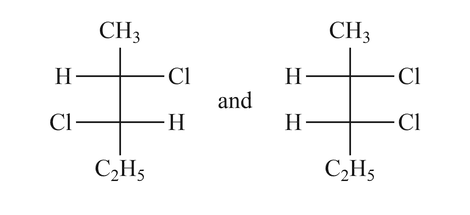
The two optical isomers given below, namely
are:
Solve with AIAnswer
(A) enantiomers
(B) geometrical isomers
- Correct
(C) diastereomers
(D) structural isomers
Answer: (C) diastereomers
Key idea: Stereoisomers with the same structure (same atoms joined in the same order) are enantiomers if they are mirror images and diastereomers if they are not. In a Fischer projection, horizontal bonds point towards the viewer and vertical bonds away.
Step 1 — Identify the compound. Both projections have at the top, at the bottom and one Cl on each of the two middle carbons, so both are 2,3-dichloropentane, . The constitution is the same, so they are not structural isomers.
Step 2 — Compare carbon 2. In both projections H is on the left and Cl on the right, so carbon 2 has the same configuration (S) in both.
Step 3 — Compare carbon 3. In the first projection Cl is on the left, in the second on the right, so carbon 3 is S in the first and R in the second (priorities Cl > C-2 > > H).
Step 4 — Decide the relationship. The first is (2S,3S) and the second (2S,3R). Mirror images would have both centres inverted (2R,3R), so these are stereoisomers that are not mirror images: diastereomers.
Why the other options are wrong:
- (A) Enantiomers need every asymmetric carbon inverted; here only carbon 3 differs.
- (B) Geometrical isomers arise about a C=C bond or a ring; these molecules have neither.
- (D) Structural isomers have different connections of atoms, but both projections show the same connections (2,3-dichloropentane).
Note: the printed answer, structural isomers, is a slip: the two projections have the same constitution and differ only at carbon 3, so they are diastereomers.
Therefore, the two isomers are diastereomers.
- 281 mark
Question 28
Cis-trans isomers generally:
Solve with AIAnswer
(A) contain an asymmetric carbon atom
(B) rotate the plane of polarized light
(C) are enantiomorphs
- Correct
(D) contain double bonded carbon atoms.
Answer: (D) contain double bonded carbon atoms
Key idea: Cis–trans (geometrical) isomerism comes from restricted rotation, which in open-chain compounds is caused by a C=C double bond with two different groups on each carbon.
Step 1 — Recall the cause. The π bond of C=C stops rotation, so groups fixed on the same side (cis) or opposite sides (trans) give two different compounds, for example cis- and trans-but-2-ene.
Step 2 — Check the other descriptions. Cis and trans isomers need no asymmetric carbon, are usually optically inactive and are not mirror images of each other, as the bullets below show. The feature they share is the restricted rotation of a C=C double bond.
Why the other options are wrong:
- (A) An asymmetric carbon is the usual cause of optical isomerism; but-2-ene shows cis–trans isomerism with no asymmetric carbon.
- (B) Most cis–trans isomers, such as the but-2-enes, are planar at the double bond and optically inactive.
- (C) Cis and trans isomers are not mirror images of each other; they are diastereomers, with different physical properties.
Therefore, cis–trans isomers generally contain doubly bonded carbon atoms.
- 291 mark
Question 29
Of the following, compound possessing optical isomerism is
Solve with AIAnswer
(A)
- Correct
(B)
(C)
(D)
Answer: (B)
Key idea: Optical isomerism needs a carbon atom bonded to four different atoms or groups.
Step 1 — Check butan-2-ol (B). In carbon 2 carries H, OH, and : four different groups, so it exists as two enantiomers.
Step 2 — Confirm that the two mirror-image forms are different. Because carbon 2 carries four different groups, butan-2-ol has no plane of symmetry, so its mirror image cannot be placed on top of it. The two forms are enantiomers, and they rotate plane-polarised light by equal angles in opposite directions.
Why the other options are wrong:
- (A) In ethanol both carbons carry at least two hydrogen atoms.
- (C) has two identical chlorine atoms on its only carbon.
- (D) has two chlorine atoms and two fluorine atoms on its carbon.
Therefore, possesses optical isomerism.
- 301 mark
Question 30
Compound whose molecules are superimposable on their mirror images even though they contain asymmetric carbon atom is called
Solve with AIAnswer
- Correct
(A) meso compound
(B) an erythro isomer
(C) a threo isomer
(D) a glycol
Answer: (A) meso compound
Key idea: A meso compound contains two (or more) asymmetric carbons but also an internal plane of symmetry, so each molecule is superimposable on its mirror image and is optically inactive.
Step 1 — Recall an example. Meso-tartaric acid has two asymmetric carbons of opposite configuration (R and S); the plane of symmetry between them makes the molecule identical to its mirror image.
Step 2 — Explain why the molecule is optically inactive. The rotation of plane-polarised light caused by one half of a meso molecule is cancelled by the equal and opposite rotation caused by its mirror-image other half (internal compensation). So a meso compound is optically inactive even though it contains asymmetric carbon atoms.
Why the other options are wrong:
- (B) "Erythro" only describes a relative arrangement (like groups on the same side of a Fischer projection); an erythro compound is meso only when its two ends are identical, and erythrose, for example, is chiral.
- (C) A threo isomer has like groups on opposite sides; threo forms such as (+)-tartaric acid are chiral.
- (D) A glycol is any compound with two –OH groups; the word says nothing about symmetry.
Therefore, such a compound is called a meso compound.
- 311 mark
Question 31
Which of the following statement is wrong?
Solve with AIAnswer
- Correct
(A) Diethyl ketone and methyl propyl ketone are position isomers.
(B) 2-Chloropentane and 1-chloropentane are position isomers.
(C) n-Butane and 2-methyl propane are chain isomers.
(D) Acetone and propionaldehyde are functional isomers.
Answer: (A) Diethyl ketone and methyl propyl ketone are position isomers.
Key idea: In this chapter, compounds with the same functional group but different alkyl groups on either side of it are called metamers. Diethyl ketone () and methyl propyl ketone () are both ketones, , with different alkyl groups on the C=O group.
Step 1 — Classify the ketone pair. The C=O group is the same, but the carbon atoms are shared as 2 + 2 in one and 1 + 3 in the other, so the chapter calls them metamers; the statement calling them position isomers is the wrong one.
Step 2 — Check the other statements. We test each of the remaining pairs against its stated type.
Why the other options are wrong:
- (B) This statement is true: both are with the same chain, differing only in the position of Cl.
- (C) This statement is true: both are , one with a straight chain and one with a branched chain.
- (D) This statement is true: both are , one a ketone and the other an aldehyde.
Note: pentan-3-one and pentan-2-one can also be described as position isomers (the C=O group sits at a different place on the same five-carbon chain); the key follows the chapter's classification of such pairs as metamers.
Therefore, statement (A) is the wrong one.
- 321 mark
Question 32
An enantiomerically pure acid is treated with racemic mixture of an alcohol having one chiral carbon. The ester formed will be
Solve with AIAnswer
- Correct
(A) optically active mixture
(B) pure enantiomer
(C) meso compound
(D) racemic mixture
Answer: (A) optically active mixture
Key idea: When a single enantiomer reacts with a racemic mixture, the products are diastereomers. Diastereomers are not mirror images, so their rotations do not cancel.
Step 1 — Write the reactants. Call the pure acid (R)-acid; the racemic alcohol is a 50 : 50 mixture of (R)-alcohol and (S)-alcohol.
Step 2 — Write the esters. The (R)-acid gives an (R)-acid–(R)-alcohol ester and an (R)-acid–(S)-alcohol ester. The acid part is the same in both, so the two esters are not mirror images of each other: they are diastereomers.
Step 3 — Decide on the optical activity. Each ester is chiral and the two have different, unrelated rotations, so the mixture rotates plane-polarised light: it is an optically active mixture.
Why the other options are wrong:
- (B) Two different esters are formed, one from each alcohol enantiomer, so the product is not a single pure compound.
- (C) A meso compound needs an internal plane of symmetry; these esters are chiral.
- (D) A racemic mixture needs equal amounts of two enantiomers; the two esters are diastereomers, not enantiomers.
Therefore, the ester formed is an optically active mixture.
- 331 mark
Question 33
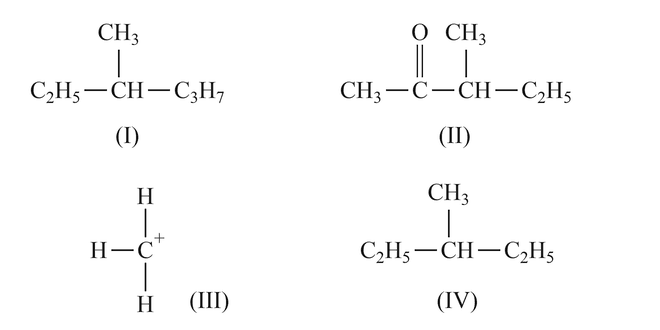
Among the following four structures I to IV
It is true that
Solve with AIAnswer
(A) all four are chiral compounds
- Correct
(B) only (I) and (II) are chiral compounds.
(C) only (III) is a chiral compound
(D) only (II) and (IV) are chiral compounds.
Answer: (B) only I and II are chiral compounds
Key idea: A compound is chiral if a carbon atom carries four different groups (and there is no plane of symmetry).
Step 1 — Check structure I. (3-methylhexane): the CH carbon carries H, , and , four different groups, so I is chiral.
Step 2 — Check structure II. (3-methylpentan-2-one): the CH carbon carries H, , and , so II is chiral.
Step 3 — Check structure III. The methyl cation, , is a flat sp² ion with three identical hydrogen atoms, so it is achiral.
Step 4 — Check structure IV. (3-methylpentane): the CH carbon carries two identical ethyl groups, so IV is achiral.
Why the other options are wrong:
- (A) III and IV are achiral, so not all four are chiral.
- (C) III is a planar ion with three identical hydrogens, so it is not chiral.
- (D) II is chiral but IV is not, because its CH carbon carries two ethyl groups.
Therefore, only I and II are chiral.
- 341 mark
Question 34
The structural isomers possible for the compounds with molecular formula is:
Solve with AIAnswer
- Correct
(A) 2
(B) 3
(C) 4
(D) 5
Answer: (A) 2
Key idea: We share the three chlorine atoms between the two carbon atoms of ethane in every possible way and count the different structures.
Step 1 — Put all three Cl on one carbon. This gives 1,1,1-trichloroethane.
Step 2 — Put two Cl on one carbon and one on the other. This gives 1,1,2-trichloroethane.
Step 3 — Count. Putting one Cl on one carbon and two on the other in the opposite order gives the same molecule, so there are only 2 structural isomers.
Why the other options are wrong:
- (B) 3 counts and separately, but they are the same molecule written from opposite ends.
- (C) 4 counts more structures than exist; with three identical atoms on two carbons there are only two arrangements.
- (D) 5 is also more than the two possible structures.
Therefore, has 2 structural isomers.
- 351 mark
Question 35
The most stable configuration of n-butane will be:
Solve with AIAnswer
(A) Skew boat
(B) Eclipsed
(C) Gauche
- Correct
(D) Staggered
Answer: (D) Staggered
Key idea: Rotation about the C2–C3 bond of butane gives different conformations. The most stable one keeps the bonds, and especially the two large methyl groups, as far apart as possible. That is the fully staggered (anti) form, with a dihedral angle of 180° between the two groups.
Step 1 — Compare the eclipsed forms. In eclipsed forms the bonds on C2 and C3 line up, so their electron pairs repel (torsional strain); the form with the two methyl groups eclipsed is the least stable.
Step 2 — Compare the staggered forms. In the gauche form the dihedral angle between the methyl groups is 60° and they crowd each other a little; in the anti form it is 180°, so this form has the lowest energy.
Why the other options are wrong:
- (A) "Skew boat" (twist boat) is a conformation of a six-membered ring such as cyclohexane, not of butane.
- (B) Eclipsed forms have the highest energy because of torsional strain and methyl–methyl crowding.
- (C) The gauche form is staggered too, but the dihedral angle between its methyl groups is only 60°, so it is a little less stable (by about 3.8 kJ mol⁻¹) than the anti form.
Therefore, the staggered (anti) conformation of n-butane is the most stable.
- 361 mark
Question 36
Tautomerism will be exhibited by:
Solve with AIAnswer
(A)
(B)
(C)
- Correct
(D)
Answer: (D)
Key idea: Tautomerism needs a mobile hydrogen atom that can move between two atoms of the molecule. In nitroalkanes this is a hydrogen on the carbon next to the nitro group (an α-hydrogen), which can move to an oxygen of the nitro group (nitro ⇌ aci-nitro tautomerism).
Step 1 — Look at . The carbon attached to carries two α-hydrogens.
Step 2 — Write the tautomers. One α-hydrogen moves to oxygen and a C=N bond forms.
Why the other options are wrong:
- (A) In the carbon next to the nitroso group carries three methyl groups and no hydrogen, so it cannot change into an oxime.
- (B) Dimethylamine has no group into which its N–H hydrogen can move to give a different stable structure.
- (C) In the α-carbon carries three R groups and no hydrogen, so the aci form cannot be reached.
Therefore, tautomerism is exhibited by .
- 371 mark
Question 37
The number of geometrical isomers of the complex is
Solve with AIAnswer
- Correct
(A) 2
(B) 3
(C) 4
(D) 0
Answer: (A) 2
Key idea: An octahedral complex of the type has two geometrical isomers. In the facial (fac) isomer the three identical ligands occupy one face of the octahedron (all mutually cis); in the meridional (mer) isomer they lie in a plane through the metal (one pair trans).
Step 1 — Identify the type. has three ligands and three ligands round an octahedral Co(III), which makes it a complex of the type .
Step 2 — Place the three nitrite ligands. Either no two of them are trans (all three on one face: fac), or one pair is trans (all three in one plane through the metal: mer). Every other placement can be turned into one of these two.
Why the other options are wrong:
- (B) A third arrangement does not exist; any other placement is the fac or the mer form turned round.
- (C) 4 counts rotated copies of the same two forms as different isomers.
- (D) 0 is wrong because the fac and mer forms cannot be turned into each other and are different compounds.
Therefore, the complex has 2 geometrical isomers (fac and mer).
- 381 mark
Question 38
Which of the following compounds is not chiral?
Solve with AIAnswer
- Correct
(A)
(B)
(C)
(D)
Answer: (A)
Key idea: A molecule is chiral when one of its carbons carries four different groups; deuterium (D) counts as different from hydrogen (H).
Step 1 — Check (A). In the three carbons carry (D, H, H), (H, H) and (H, H, Cl) besides the chain, so every carbon has two identical hydrogen atoms and none is asymmetric.
Step 2 — Check the others. Each of the remaining molecules has one carbon with four different groups, so each is chiral.
Why the other options are wrong:
- (B) Carbon 1 of carries H, D, Cl and .
- (C) Carbon 2 of carries H, D, and .
- (D) Carbon 2 of carries H, Cl, and .
Note: the book prints this question twice (also MCQ Q17).
Therefore, is not chiral.
- 391 mark
Question 39
But-2-ene exhibits cis-trans isomerism due to:
Solve with AIAnswer
(A) rotation around double bond
(B) rotation around sigma bond
(C) rotation around bond
- Correct
(D) restricted rotation around C = C bond
Answer: (D) restricted rotation around C = C bond
Key idea: The π bond of a C=C double bond is formed by side-on overlap of p orbitals. Twisting one carbon relative to the other would destroy this overlap, so rotation about the double bond is restricted.
Step 1 — Apply this to but-2-ene. Because C2 and C3 cannot rotate, the two methyl groups stay fixed either on the same side (cis) or on opposite sides (trans).
Step 2 — Conclude. These two fixed arrangements are different compounds with different properties: cis- and trans-but-2-ene.
Why the other options are wrong:
- (A) There is no free rotation about the C2=C3 double bond; it is exactly the lack of rotation that causes the isomerism.
- (B) Rotation about the C3–C4 single bond only turns the methyl group; it gives conformations, not isomers.
- (C) Rotation about the C1–C2 single bond likewise only turns the other methyl group.
Therefore, but-2-ene shows cis–trans isomerism because rotation about the C=C bond is restricted.
- 401 mark
Question 40
Among the following alkenes
1-butene (I), cis 2-butene (II), trans-2-butene (III)
The decreasing order of stability is:
Solve with AIAnswer
(A) II > I > III
- Correct
(B) III > II > I
(C) III > I > II
(D) I > II > III
Answer: (B) III > II > I
Key idea: Alkenes are more stable when (1) the double bond carries more alkyl groups, which stabilise it by hyperconjugation, and (2) large groups are on opposite sides, which avoids crowding. A lower heat of hydrogenation shows a more stable alkene.
Step 1 — Compare 1-butene with the 2-butenes. 1-Butene, , has one alkyl group on the C=C bond and only 2 α-hydrogens for hyperconjugation; each 2-butene, , has two alkyl groups and 6 α-hydrogens. So both 2-butenes are more stable than 1-butene.
Step 2 — Compare cis and trans 2-butene. In the cis form the two methyl groups are on the same side and crowd each other; in the trans form they are far apart. So trans-2-butene is more stable than cis-2-butene.
Step 3 — Check with heats of hydrogenation. They are about 127 kJ mol⁻¹ (I), 120 kJ mol⁻¹ (II) and 116 kJ mol⁻¹ (III); the smallest value belongs to the most stable alkene, which confirms III > II > I.
Why the other options are wrong:
- (A) II > I > III puts trans-2-butene last, but it is the most stable of the three.
- (C) III > I > II puts 1-butene above cis-2-butene, but 1-butene has fewer alkyl groups on its double bond and is the least stable.
- (D) I > II > III is the exact reverse of the true order.
Therefore, the decreasing order of stability is III > II > I.
- 411 mark
Question 41
The dihedral angle between two C—H bonds in the staggered conformation of ethane is:
Solve with AIAnswer
- Correct
(A) 60°
(B) 180°
(C) 0°
(D) 120°
Answer: (A) 60°
Key idea: The dihedral (torsional) angle is the angle between a bond on the front carbon and a bond on the back carbon when the molecule is viewed along the C–C bond (Newman projection). The staggered conformation is the one in which every back C–H bond lies midway between two front C–H bonds.
Step 1 — Place the bonds in the Newman projection. The three front C–H bonds are 120° apart, and in the staggered form the three back C–H bonds are also 120° apart but turned by half of that.
Step 2 — Read the dihedral angle. Each front C–H bond is therefore 60° from the nearest back C–H bond on either side. This 60° angle is the dihedral angle that defines the staggered conformation.
Why the other options are wrong:
- (B) 180° is the angle between a front C–H bond and the back C–H bond directly opposite it (the anti pair); it is present too, but the angle that describes the staggered form is the 60° between neighbouring front and back bonds.
- (C) 0° belongs to the eclipsed conformation, where each back bond hides behind a front bond.
- (D) 120° is the angle between two bonds on the same carbon in the projection; as a front–back angle it occurs in the eclipsed form, not in the staggered form.
Therefore, the dihedral angle in staggered ethane is 60°.
- 421 mark
Question 42
The (R)-and (S)- enantiomers of an optically active compound differ in:
(a) their solubility in a chiral solvents
(b) their reactivity with a chiral reagent
(c) their optical rotation of plane polarised light
(d) their melting points.
Solve with AIWritten solution
Solution:
Key idea: Enantiomers behave identically towards anything achiral, but they behave differently towards anything chiral: polarised light (which they rotate in opposite directions), chiral solvents and chiral reagents. A chiral partner forms different (diastereomeric) combinations with the R and the S molecule.
Step 1 — Judge (a). In a chiral solvent the R and S molecules form diastereomeric solute–solvent pairs with different energies, so their solubilities can differ. Statement (a) is correct.
Step 2 — Judge (b). A chiral reagent gives diastereomeric transition states with the R and the S molecule, so the two react at different rates (this is how enzymes pick one enantiomer). Statement (b) is correct.
Step 3 — Judge (c). The two enantiomers rotate plane-polarised light by equal angles in opposite directions. Statement (c) is correct.
Step 4 — Judge (d). The forces between the molecules in the pure R solid and the pure S solid are identical (mirror images), so their melting points are the same. Statement (d) is not correct.
Note: as printed, three options are correct. The likely intended wording is "achiral solvent" and "achiral reagent" (as in MCQ Q14); in an achiral solvent or with an achiral reagent the two enantiomers behave alike, and then only (c) is correct.
Therefore, as printed, the enantiomers differ in (a) solubility in a chiral solvent, (b) reactivity with a chiral reagent and (c) optical rotation, but not in (d) melting point.
- 431 mark
Question 43
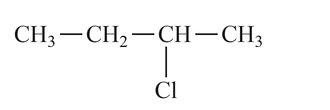
obtained by chlorination of n-butane, will be:
Solve with AIAnswer
(A) Meso form
- Correct
(B) Racemic mixture
(C) d-form
(D) l-form
Answer: (B) Racemic mixture
Key idea: Chlorination of butane at carbon 2 goes through a free radical. The carbon radical is flat (sp², or very nearly so), so the chlorine atom can attach equally well from either face.
Step 1 — Form the radical. A chlorine atom removes a hydrogen from carbon 2 of butane, giving the planar radical .
Step 2 — Add chlorine from both faces. Attack from the top face gives one enantiomer of 2-chlorobutane and attack from the bottom face gives the other; both faces are equally open, so both form at the same rate.
Step 3 — Decide the product. Equal amounts of the two enantiomers form a racemic mixture, which is optically inactive.
Why the other options are wrong:
- (A) A meso form needs at least two asymmetric carbons with an internal plane of symmetry; 2-chlorobutane has only one asymmetric carbon.
- (C) A pure d-form would need one face to be attacked preferentially, which needs a chiral influence; ordinary chlorination has none.
- (D) A pure l-form is ruled out for the same reason.
Therefore, the 2-chlorobutane obtained is a racemic mixture.
- 441 mark
Question 44
Geometrical isomers differ in:
Solve with AIAnswer
(A) position of functional group.
(B) position of atoms
- Correct
(C) spatial arrangement of atoms
(D) length of carbon chain
Answer: (C) spatial arrangement of atoms
Key idea: Geometrical isomers are stereoisomers: the atoms are joined in exactly the same order, and only their arrangement in space about the double bond (or ring) differs.
Step 1 — Compare cis- and trans-but-2-ene. Both are with the same bonds; only the side on which each methyl group lies is different.
Step 2 — Name the kind of isomerism. Because only the arrangement in space differs, geometrical isomerism is a kind of stereoisomerism. The two forms cannot change into each other at room temperature because rotation about the C=C bond is restricted.
Why the other options are wrong:
- (A) A different position of the functional group gives position isomers, a kind of structural isomerism.
- (B) The atoms are bonded in the same positions in both isomers; only their direction in space differs.
- (D) A different carbon chain gives chain isomers, again a kind of structural isomerism.
Therefore, geometrical isomers differ in the spatial arrangement of atoms.
- 451 mark
Question 45
In this reaction
an asymmetric centre is generated. The acid obtained would be
Solve with AIAnswer
- Correct
(A) 50% D + 50% L-isomer
(B) 20% D + 80% L-isomer
(C) D-isomer
(D) L-isomer
Answer: (A) 50% D + 50% L-isomer
Key idea: When a new asymmetric carbon is formed from achiral starting materials without any chiral catalyst, both configurations form in equal amounts, giving a racemic mixture.
Step 1 — Look at the addition of HCN. The carbonyl carbon of ethanal is flat (sp²), so the cyanide ion can attack it equally well from above or from below the plane.
Step 2 — See the new asymmetric centre. In the cyanohydrin, carbon 2 carries H, OH, and CN; attack from the two faces gives the two enantiomers in equal amounts.
Step 3 — Hydrolyse. Hydrolysis changes CN into COOH without touching the asymmetric carbon, so the lactic acid formed is also a 50 : 50 mixture of the D and L forms.
Why the other options are wrong:
- (B) An unequal 20 : 80 mixture would need something chiral to favour one face of the carbonyl group; none is present.
- (C) Pure D-lactic acid could be made only with a chiral catalyst such as an enzyme.
- (D) Pure L-lactic acid likewise needs a chiral influence, which this reaction lacks.
Note: the book prints this question twice (also MCQ Q76).
Therefore, the acid obtained is a racemic mixture, 50% D + 50% L, option (A).
- 461 mark
Question 46
Which of the following pairs of compounds are enantiomers?
 Solve with AI
Answer
(A) Pair (a)
(B) Pair (b)
- Correct
(C) Pair (c)
(D) Pair (d)
Answer: (C) Pair (c)
Key idea: All eight projections are butane-2,3-diol, . In a Fischer projection of this molecule, the two –OH groups on the same side give the meso form (a plane of symmetry), and the –OH groups on opposite sides give a chiral form. Enantiomers are two chiral forms that are mirror images of each other.
Step 1 — Classify each projection. We note on which side each –OH group lies.
- Pair (a): first, –OH right then left (chiral); second, both right (meso).
- Pair (b): first, –OH left then right (chiral); second, both left (meso).
- Pair (c): first, –OH right then left (chiral); second, –OH left then right (chiral).
- Pair (d): first, –OH right then left (chiral); second, both left (meso).
Step 2 — Check pair (c) for a mirror relation. Reflecting the first projection in a vertical mirror swaps left and right at both carbons, which turns "right, left" into "left, right": exactly the second projection.
Step 3 — Confirm with R/S labels. Taking priorities OH > the other CH(OH) carbon > > H, the first projection of pair (c) is (2S,3S) and the second is (2R,3R): both centres inverted, so they are enantiomers.
Why the other options are wrong:
- (A) Pair (a) is a chiral form, (2S,3S), with the meso form, (2S,3R); a chiral molecule and a meso molecule are diastereomers.
- (B) Pair (b) is (2R,3R) with the meso form; again diastereomers.
- (D) Pair (d) is (2S,3S) with the meso form, written the other way up; diastereomers.
Therefore, pair (c) is a pair of enantiomers.
- 471 mark
Question 47
The compound with molecular formula, shows optical isomerism, the compound will be
Solve with AIAnswer
- Correct
(A) 2, 3-dimethylpentane
(B) 2, 2-dimethylpentane
(C) 2-methylhexane
(D) none of these
Answer: (A) 2, 3-dimethylpentane
Key idea: An alkane shows optical isomerism when one of its carbons carries four different groups.
Step 1 — Write 2,3-dimethylpentane. The five-carbon chain carries methyl groups on carbons 2 and 3.
Step 2 — Look at carbon 3. It carries H, , and an isopropyl group : four different groups, so the molecule is chiral and shows optical isomerism.
Why the other options are wrong:
- (B) In 2,2-dimethylpentane, , carbon 2 carries three methyl groups and every other carbon carries at least two hydrogen atoms.
- (C) In 2-methylhexane, , carbon 2 carries two identical methyl groups, so no carbon is asymmetric.
- (D) "None of these" is wrong because 2,3-dimethylpentane does have an asymmetric carbon.
Therefore, the compound is 2,3-dimethylpentane.
- 481 mark
Question 48
The pair of structures given below represent
 Solve with AI
Answer
(A) Enantiomers
(B) Diastereomers
- Correct
(C) Structural isomers
(D) Two molecules of the same compound
Answer: (C) Structural isomers
Key idea: In a Newman projection the bonds meeting at the centre belong to the front carbon and the bonds starting at the circle belong to the back carbon. Reading the groups on each carbon lets us rebuild the condensed formula.
Step 1 — Read the first projection. The front carbon carries , H and H, so it is a joined to a . The back carbon carries H, Cl and . The compound is , 2-chlorobutane.
Step 2 — Read the second projection. The front carbon again carries , H and H. The back carbon carries H, H and . The compound is , 1-chlorobutane.
Step 3 — Compare. Both are , but the chlorine is on different carbon atoms, so the atoms are joined differently: they are structural (position) isomers.
Why the other options are wrong:
- (A) Enantiomers must have the same structure and be mirror images; these two have different structures.
- (B) Diastereomers also need the same structure (only the arrangement in space differing).
- (D) The two molecules cannot be the same compound, because one has Cl on carbon 2 and the other on carbon 1; no rotation about a bond can move a chlorine atom to another carbon.
Therefore, the two structures are structural isomers.
- 491 mark
Question 49
The number of isomers for the compounds with molecular formula is
Solve with AIAnswer
(A) 3
(B) 4
(C) 5
- Correct
(D) 6
Answer: (D) 6
Key idea: The formula has the same pattern as ethene, , with all four hydrogen atoms replaced by four different halogen atoms. So it is a halogenated ethene with one C=C bond, and each structure can also show geometrical (cis–trans, E/Z) isomerism.
Step 1 — Place the four halogens on the two carbon atoms. Each carbon of the C=C bond carries two atoms, so we split Br, Cl, F and I into two pairs. There are only three ways to do this:
- Br and Cl on one carbon, F and I on the other:
- Br and F on one carbon, Cl and I on the other:
- Br and I on one carbon, Cl and F on the other:
So there are 3 structural isomers.
Step 2 — Check each structure for geometrical isomerism. Geometrical isomerism needs two different groups on EACH carbon of the double bond. In every structure above, each carbon carries two different halogen atoms, so every structure exists as two geometrical isomers (E and Z).
Step 3 — Count all the isomers. Three structures, each in two geometrical forms, give the total number of isomers.
Why the other options are wrong:
- (A) 3 is the number of structural isomers only; it leaves out the E and Z forms of each structure.
- (B) 4 matches no correct way of counting: there are 3 structures, and each has exactly 2 geometrical forms.
- (C) 5 would mean one of the three structures had no geometrical isomers, but in all three both carbons carry two different halogens.
Therefore, has 6 isomers, option (D).
- 501 mark
Question 50
Which of the following compounds exhibits stereoisomerism?
Solve with AIAnswer
(A) 2-Methylbutene-1
(B) 3-Methylbutyne-1
(C) 3-Methylbutanoic acid
- Correct
(D) 2-Methylbutanoic acid
Answer: (D) 2-Methylbutanoic acid
Key idea: Stereoisomers have the same structure but a different arrangement of atoms in space. A compound shows stereoisomerism here if it has a chiral carbon (a carbon joined to four different groups, giving optical isomers) or a C=C bond with two different groups on each carbon (giving geometrical isomers).
Step 1 — Write the structure of 2-methylbutanoic acid. It is .
Step 2 — Look at carbon 2. Carbon 2 is joined to H, , and COOH: four different groups. It is a chiral carbon, so the acid exists as a pair of enantiomers (optical isomers).
Why the other options are wrong:
- (A) 2-Methylbut-1-ene, , has two H atoms on C-1, so it has no geometrical isomers, and it has no chiral carbon.
- (B) 3-Methylbut-1-yne, , has a linear triple bond (no cis–trans forms), and C-3 carries two identical methyl groups, so it is not chiral.
- (C) 3-Methylbutanoic acid, , has two methyl groups on C-3 and no C=C bond, so it has no stereoisomers.
Note: the current IUPAC names are 2-methylbut-1-ene and 3-methylbut-1-yne.
Therefore, 2-methylbutanoic acid shows stereoisomerism (optical isomerism), option (D).
- 511 mark
Question 51
A similarity between optical and geometrical isomerism is that
Solve with AIAnswer
(A) each forms equal number of isomers for a given compound
(B) if in a compound, one is present then so is the other
- Correct
(C) both are included in stereoisomerism
(D) they have no similarity
Answer: (C) both are included in stereoisomerism
Key idea: Isomers with the same structural formula but a different arrangement of atoms in space are stereoisomers. Stereoisomerism has two main kinds: geometrical (cis–trans) isomerism and optical isomerism.
Step 1 — Compare the two kinds. In both, the atoms are joined in the same order; only their arrangement in space differs. That is exactly the definition of stereoisomerism, so both belong to it.
Step 2 — Compare the causes. Geometrical isomerism arises from restricted rotation about a C=C bond (or within a ring), while optical isomerism arises when a molecule is not superimposable on its mirror image (usually because it has an asymmetric carbon). The causes differ, but in both cases the isomers differ only in the arrangement of atoms in space.
Why the other options are wrong:
- (A) The numbers differ: but-2-ene has 2 geometrical isomers, while a compound with two different chiral carbons such as 2,3-dichloropentane has 4 optical isomers.
- (B) One can occur without the other: but-2-ene has geometrical isomers but no optical isomers, and butan-2-ol has optical isomers but no geometrical isomers.
- (D) They do have a similarity: both are kinds of stereoisomerism.
Therefore, the similarity is that both are included in stereoisomerism, option (C).
- 521 mark
Question 52
Which of the following does not show geometrical isomerism?
Solve with AIAnswer
(A) 1,2-Dichloro-1-pentene
(B) 1,3-Dichloro-2-pentene
- Correct
(C) 1,1-Dichloro-1-pentene
(D) 1,4-Dichloro-2-pentene
Answer: (C) 1,1-Dichloro-1-pentene
Key idea: An alkene shows geometrical (cis–trans) isomerism only if EACH carbon of the C=C bond carries two different groups. If one carbon has two identical groups, the two "isomers" are the same molecule.
Step 1 — Write the structure of 1,1-dichloropent-1-ene. It is .
Step 2 — Look at carbon 1. Carbon 1 carries two Cl atoms, which are identical. Swapping them gives the same molecule, so there are no geometrical isomers.
Why the other options are wrong:
- (A) In , C-1 carries H and Cl, and C-2 carries Cl and propyl, so cis and trans forms exist.
- (B) In , C-2 carries H and , and C-3 carries Cl and ethyl, so cis and trans forms exist.
- (D) In , each alkene carbon carries H and a different group, so cis and trans forms exist.
Note: the current IUPAC names are 1,1-dichloropent-1-ene, 1,2-dichloropent-1-ene, 1,3-dichloropent-2-ene and 1,4-dichloropent-2-ene.
Therefore, 1,1-dichloro-1-pentene does not show geometrical isomerism, option (C).
- 531 mark
Question 53
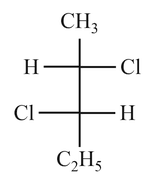
The absolute configuration of the following compound is
 Solve with AI
Answer
(A) 2S, 3R
- Correct
(B) 2S, 3S
(C) 2R, 3S
(D) 2R, 3R
Answer: (B) 2S, 3S
Key idea: In a Fischer projection the horizontal bonds point towards us and the vertical bonds point away. Rank the four groups by the CIP rules (higher atomic number first). Trace 1 → 2 → 3: clockwise means R and anticlockwise means S, but if the lowest group (H) is on a horizontal bond, the answer must be reversed.
Step 1 — Name the compound. The chain is , so this is 2,3-dichloropentane; C-2 is the upper crossing and C-3 the lower one.
Step 2 — Rank the groups on C-2. Cl has the highest atomic number, so it is 1. Next, C-3 carries (Cl, C, H), which beats the methyl carbon (H, H, H), so C-3 is 2 and is 3. H is 4.
Step 3 — Trace the sequence on C-2. Cl is on the right, C-3 is below and is above. Right → down → up runs clockwise, which reads as R. But H is on a horizontal bond (left), so we reverse it: C-2 is S.
Step 4 — Rank the groups on C-3. Cl is 1. C-2 carries (Cl, C, H), which beats the ethyl carbon (C, H, H), so C-2 is 2 and is 3. H is 4.
Step 5 — Trace the sequence on C-3. Cl is on the left, C-2 is above and is below. Left → up → down runs clockwise, which reads as R. H is again on a horizontal bond (right), so we reverse it: C-3 is S.
Why the other options are wrong:
- (A) 2S, 3R has C-3 wrong: it forgets to reverse the reading at C-3, where H is on a horizontal bond.
- (C) 2R, 3S has C-2 wrong: it forgets to reverse the reading at C-2.
- (D) 2R, 3R is what we get if we forget the reversal at both carbons; it is the mirror image of the compound drawn.
Therefore, the compound is (2S,3S)-2,3-dichloropentane, option (B).
- 541 mark
Question 54
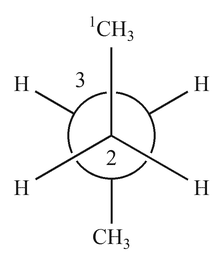
is rotated anticlockwise through 120° about . The resulting conformer is
Solve with AIAnswer
(A) Partially eclipsed
(B) Eclipsed
- Correct
(C) Gauche
(D) Staggered
Answer: (C) Gauche
Key idea: In a Newman projection of butane we look along the C-2–C-3 bond. The front carbon is the centre point, and the rear carbon is the circle. The angle between the two groups (the dihedral angle) names the conformer: 180° is anti, 60° is gauche (both staggered), 0° is fully eclipsed and 120° is partially eclipsed.
Step 1 — Read the starting conformer. The front carbon C-2 carries C-1 () pointing straight up, and the rear carbon C-3 carries its (C-4) pointing straight down. The methyl groups are 180° apart, so this is the anti (staggered) conformer.
Step 2 — Turn the front carbon. Rotating C-2 anticlockwise by 120° moves its from the top (90°) to the lower left (210°). The rear carbon does not move, so its stays at the bottom (270°).
Step 3 — Find the new dihedral angle. The angle between the two methyl groups is now
The bonds are still staggered (a 120° turn moves each front bond into the next staggered slot), and the methyl groups are 60° apart, which is the gauche conformer.

Why the other options are wrong:
- (A) A partially eclipsed form needs a turn of 60° (either way) from the anti form, so that each front bond lies over a rear bond; a 120° turn keeps every bond staggered.
- (B) The fully eclipsed form has the two methyl groups one behind the other (0°); here they are 60° apart.
- (D) "Staggered" alone is not the best answer: the new form is staggered, but the starting form was also staggered (anti); the name for the staggered form with methyls at 60° is gauche.
Therefore, the resulting conformer is gauche, option (C).
- 551 mark
Question 55
On monochloronation of 2-methylbutane, the total number of chiral compounds is
Solve with AIAnswer
(A) 2
- Correct
(B) 4
(C) 6
(D) 8
Answer: (B) 4
Key idea: The alkane 2-methylbutane, , has four kinds of hydrogen, so replacing one H by Cl gives four different structures. A structure with a chiral carbon (four different groups) is formed as a pair of enantiomers, and each enantiomer is a separate chiral compound.
Step 1 — List the four monochloro products. Write each one and look for a chiral carbon.
- (1-chloro-2-methylbutane): C-2 carries H, , and , so it is chiral.
- (2-chloro-2-methylbutane): C-2 has two groups, so it is not chiral.
- (2-chloro-3-methylbutane): the CHCl carbon carries H, Cl, and an isopropyl group, so it is chiral.
- (1-chloro-3-methylbutane): no carbon has four different groups, so it is not chiral.
Step 2 — Count the chiral compounds. Two structures are chiral, and each is formed as a pair of enantiomers (R and S), so the number of chiral compounds is
Why the other options are wrong:
- (A) 2 is the number of chiral structures; it does not count the two enantiomers of each structure separately.
- (C) 6 is the total number of monochloro compounds when enantiomers are counted (4 chiral + 2 achiral), not the number of chiral ones.
- (D) 8 would need four chiral structures, but only two of the four products have a chiral carbon.
Note: the book counts each enantiomer as a separate compound; if the question means different structures, the answer would be 2.
Therefore, 4 chiral compounds are formed, option (B).
- 561 mark
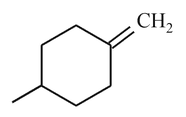
Question 56
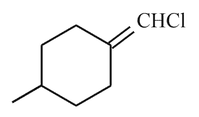
The geometrical isomerism is shown by
Solve with AIAnswer
(A)
(B)
(C)
- Correct
(D)
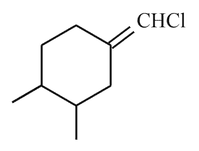
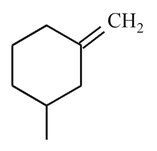
Answer: (D) the ring with a group and two methyl groups (at ring positions 3 and 4)
Key idea: A C=C bond gives geometrical isomers only if EACH of its two carbons carries two different groups. For a double bond leaving a ring, the ring carbon's two "groups" are the two ring paths around it; they differ only if the ring substituents make one path different from the other.
Step 1 — Check the outer carbon of the double bond. In (A) and (B) it is , with two identical H atoms, so these cannot show geometrical isomerism. In (C) and (D) it is , with two different atoms (H and Cl), so they pass this test.
Step 2 — Check the ring carbon in (C). Number the ring from the carbon of the double bond as C-1. In (C) the methyl group is at C-4, exactly opposite C-1. Going round the ring either way (C-2 → C-3 → C-4 or C-6 → C-5 → C-4) meets the same atoms, so the two ring paths are identical and there are no cis/trans forms.
Step 3 — Check the ring carbon in (D). In (D) there are methyl groups at C-3 and C-4. Going one way (C-2 → C-3) we meet a carbon carrying a methyl group at the second step; going the other way (C-6 → C-5) we meet a group there. The two ring paths are different, so the Cl can lie on the side of C-2 or on the side of C-6: two geometrical isomers.
Why the other options are wrong:
- (A) The outer carbon carries two H atoms (), so no geometrical isomers are possible, whatever the ring substituent.
- (B) The outer carbon is again , with two identical H atoms.
- (C) The group is fine, but the 4-methyl group makes both ring paths identical, so the ring carbon carries two identical "groups".
Note: compound (C) does have stereoisomers of another kind: like (4-methylcyclohexylidene)acetic acid, it exists as a pair of enantiomers (axial chirality), not as cis/trans isomers.
Therefore, geometrical isomerism is shown by compound (D), option (D).
- 571 mark
Question 57
Which of the following compounds is not chiral?
Solve with AIAnswer
- Correct
(A) 1-Chloropentane
(B) 2-Chloropentane
(C) 1-Chloro-2-methylpentane
(D) 3-Chloro-2-methylpentane
Answer: (A) 1-Chloropentane
Key idea: A molecule with one carbon joined to four different groups (a chiral carbon) is chiral. A molecule with no such carbon (and no other source of chirality) is achiral.
Step 1 — Look at 1-chloropentane. It is . Every carbon carries at least two H atoms, so no carbon has four different groups. The molecule is not chiral.
Step 2 — Check the other three compounds. Each of the other compounds has one carbon joined to four different groups, as the bullets below show, so each of them is chiral and only 1-chloropentane is not.
Why the other options are wrong:
- (B) In 2-chloropentane, , C-2 carries H, Cl, and propyl: it is chiral.
- (C) In 1-chloro-2-methylpentane, , C-2 carries H, , and propyl: it is chiral.
- (D) In 3-chloro-2-methylpentane, , C-3 carries H, Cl, isopropyl and ethyl: it is chiral.
Therefore, 1-chloropentane is not chiral, option (A).
- 581 mark
Question 58
Among the following compounds, the optically active alkane having lowest molecular mass is
Solve with AIAnswer
(A)
(B)
- Correct
(C)

(D)
Answer: (C) the cyclopropyl compound
Key idea: An alkane is optically active when it has a chiral carbon: a carbon joined to four different groups. Among the options we pick the alkane that has one.
Step 1 — Look at the central carbon of (C). It carries H, , and a cyclopropyl ring: four different groups. So this saturated hydrocarbon, (butan-2-yl)cyclopropane (; older name 2-cyclopropylbutane), is chiral and optically active.
Step 2 — Check that (C) is the only option that fits. Butane and 2-methylbutane have no chiral carbon, and but-1-yne is not an alkane at all. So (C) is the only optically active alkane among the options, and it is therefore the one the question asks for.
Why the other options are wrong:
- (A) In butane, , every carbon carries at least two H atoms, so there is no chiral carbon.
- (B) In 2-methylbutane, C-2 carries two groups (H, , , ), so it is not chiral.
- (D) But-1-yne is an alkyne, not an alkane, and none of its carbons carries four different groups.
Note: option (C) is printed with a group above the central carbon; that carbon would then carry two methyl groups and would not be chiral, so no option would fit. The intended structure has H in that place, as shown here.
Therefore, the optically active alkane is compound (C), option (C).
- 591 mark
Question 59
Which of the following has a meso isomer also?
- 601 mark
Question 60
The molecular formula of diphenylmethane, is
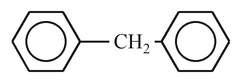
How many structural isomers are possible when one of the hydrogens is replaced by a chlorine atom
- 611 mark
Question 61
The chirality of the compound

- 621 mark
Question 62
Which type of isomerism is shown by 2,3-dichlorobutane?
- 631 mark
Question 63
Correct configuration of the following is
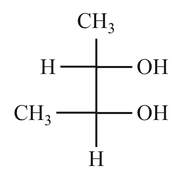
- 641 mark
Question 64
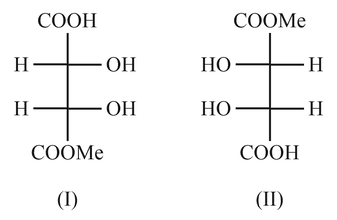
I and II are
- 651 mark
Question 65
Maximum enol content is in
- 661 mark
Question 66
Which of the following amino acid is optically inactive?
- 671 mark
Question 67
Geometrical isomerism is shown by
(a)
(b)
(c)
(d)
- 681 mark
Question 68
Which of the following will show geometrical isomerism?
- 691 mark
Question 69
Which of the following is optically active?
- 701 mark
Question 70
Which of the following is a chiral carbon?
- 711 mark
Question 71
Geometrical isomerism is found in :
- 721 mark
Question 72
Optical isomerism shown by
- 731 mark
Question 73
The total number of possible isomeric trimethyl benzene is
- 741 mark
Question 74
Which one of the following pairs represents stereoisomerism?
- 751 mark
Question 75
Which isomerism does these two show?
and
- 761 mark
Question 76
In this reaction
an asymmetric centre is generated. The acid obtained would be
- 771 mark
Question 77
Isomers of propionic acid are
- 781 mark
Question 78
Metamers of ethyl propionate are
- 791 mark
Question 79
and are the examples of
- 801 mark
Question 80
Example of geometrical isomerism is
- 811 mark
Question 81
Racemic compound has
- 821 mark
Question 82
The following compound differ in
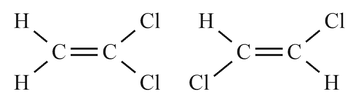
- 831 mark
Question 83
If there is no rotation of plane polarized light by a compound in a specific solvent, thought to be chiral, it may mean that:
- 841 mark
Question 84
has a chiral centre. Which one of the following represents its R configuration?
- 851 mark
Question 85
How many stereoisomers does this molecule have?
- 861 mark
Question 86
Which of the following compounds will exhibit cis-trans (geometrical) isomerism?
- 871 mark
Question 87
Which of the following molecules is expected to rotate the plane of polarized light ?
- 881 mark
Question 88
The absolute configuration of

- 891 mark
Question 89
The alkene that exhibits geometrical isomerism is
- 901 mark
Question 90
The number of stereoisomers possible for a compound of the molecular formula
is
- 911 mark
Question 91
The number of structural isomers for is:
- 921 mark
Question 92
The number of stereoisomers obtained by bromination of trans-2-butene is:
- 931 mark
Question 93
Statement-I: Molecules that are not superimposable on their mirror images are chiral.
Statement-II: All chiral molecules have chiral centres.
- 941 mark
Question 94
The correct statement(s) about the compound given below is (are)
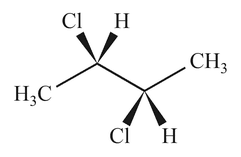
(a) the compound is optically active
(b) the compound possesses centre of symmetry
(c) the compound possesses plane of symmetry
(d) the compound possesses axis of symmetry
- 951 mark
Question 95
The correct statement (s) concerning the structures E, F and G is (are)
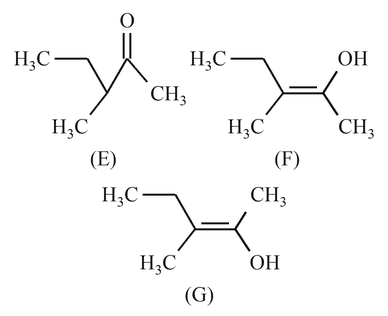
(a) E, F and G are resonance structures
(b) E, F and E, G are tautomers
(c) F and G are geometrical isomers
(d) F and G are diastereomers
- 961 mark
Question 96
The correct statement(s) about the compound (X) is (are)
(a) The total number of stereoisomers possible for X is 6
(b) The total number of diastereomers possible for X is 3
(c) If the stereochemistry about the double bond in X is trans, the number of enantiomers possible for X is 4.
(d) If the stereochemistry about the double bond in X is cis, the number of enantiomers possible for X is 2.
- 971 mark
Question 97
In Dumas' method, the nitrogen present in the organic compound is converted into ______.
- 981 mark
Question 98
Amongst , and ions, nucleophilicity decreases in the order ______.
- 991 mark
Question 99
The bond dissociation energy needed to form the benzyl radical from toluene is ______ than the energy needed for the formation of methyl radical from methane.
- 1001 mark
Question 100
An aromatic compound having as the molecular formula has ______ isomers.
- 1011 mark
Question 101
Steam distillation is used for separation and purification of those compounds which are ______ with water but ______.
- 1021 mark
Question 102
The kind of delocalization involving -bond orbitals is called ______.
- 1031 mark
Question 103
Liquids which decompose at or below their boiling points are purified by ______.
- 1041 mark
Question 104
The shape of is ______ while that of is ______.
- 1051 mark
Question 105
The correct IUPAC name for pent-4-en-1-yne is ______.
- 1061 mark
Question 106
Methyl carbanion is ______ and ______ with ammonia.
- 1071 mark
Question 107
The aryl group left after the removal of a hydrogen atom from benzene is called ______ group while that obtained from methyl group of toluene is called ______ group.
- 1081 mark
Question 108
Paper chromatography is also called ______ chromatography in which ______ constitutes the stationary phase while a ______ constitutes the mobile phase.
- 1091 mark
Question 109
Wöhler prepared urea by heating a mixture of ______ and ______ or simply by heating ______.
- 1101 mark
Question 110
In Lassaigne test for nitrogen, conc. is used to destroy ______ and ______.
- 1111 mark
Question 111
But-1-ene and cyclobutane are ______ isomers.
- 1121 mark
Question 112
The prefix and the suffix for group are ______ and ______ respectively when the carbon atom of the group is not included in the parent chain.
- 1131 mark
Question 113
Aldehydes and ketones are ______ isomers.
- 1141 mark
Question 114
Among isomeric butenes, ______ is the most stable.
- 1151 mark
Question 115
In ethyl acetoacetate, it is the ______ form which is more stable while in acetylacetone, it is the ______ form which is more stable.
- 1161 mark
Question 116
Cyclohexane is an ______ compound while benzene is an ______ compound.
- 1171 mark
Question 117
Write systematic names (IUPAC) of the following compounds:
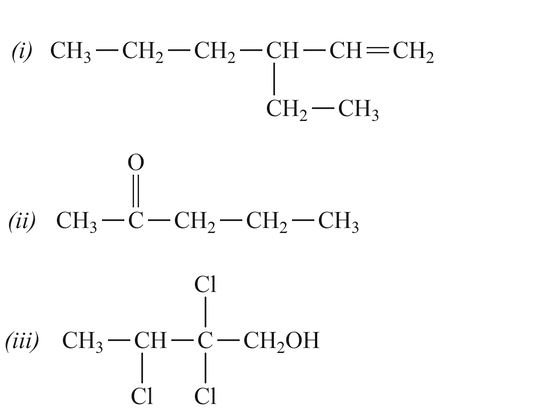
- 1181 mark
Question 118
Draw the resonance structure of the following compounds:
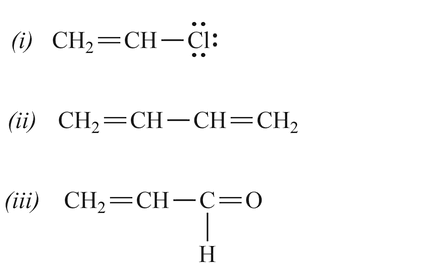
- 1191 mark
Question 119
What is wrong with the following names and why?
(a) 1, 6-Hexadiene
(b) Isopropyl amine
- 1201 mark
Question 120
Explain how is the electronegativity of carbon atoms related to their state of hybridisation in an organic compound?
- 1211 mark
Question 121
Write the structures and IUPAC names of the functional isomers having the molecular formula, .
- 1221 mark
Question 122
Why does act as an electrophile?
- 1231 mark
Question 123
Show the polarisation of carbon-magnesium bond in the following structure.
- 1241 mark
Question 124
Write structural formulae for compounds named as:
(a) 1-Bromoheptane
(b) 5-Bromoheptanoic acid
- 1251 mark
Question 125
Arrange the following:
(i) , , , , , in decreasing order of -effect.
(ii) , , , , , in increasing order of -effect.
- 1261 mark
Question 126
is more basic than . Explain why.
- 1271 mark
Question 127
What will happen if Lassaigne's extract is not boiled with dilute nitric acid before testing for halogens?
- 1282 marks
Question 128
Classify the following transformations according to the reaction type.
(a)
(b)
(c)
(d)
(e)
(f)
- 1292 marks
Question 129
Write IUPAC names of the following compounds:
(i)
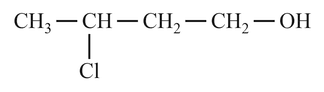
(ii)
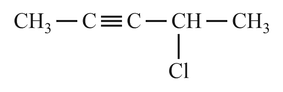
(iii)
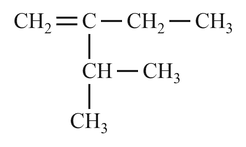
(iv)

(v)
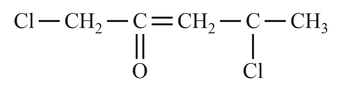
(vi)

(vii)
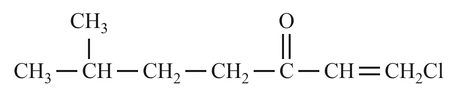
(viii)
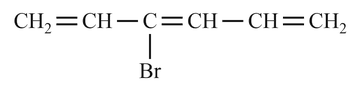
(ix)

(x)
(xi)
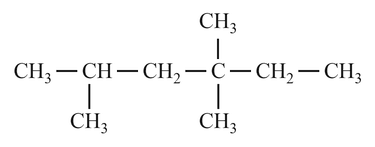
- 1302 marks
Question 130
How many isomers are possible for a disubstituted benzene? What is the relationship between them?
- 1312 marks
Question 131
Write the structures of the following compounds
(i) 3,4,4-Trimethylhex-1-yne
(ii) 1-Ethylcyclohexene
(iii) 3-Methyl-3-buten-1-ol
(iv) But-2-enoic acid
(v) 3-Bromo-3-ethyl-2-methyl-1-pentanol
(vi) But-1-en-3-yne.
- 1322 marks
Question 132
Identify the most stable species in the following set of ions giving reasons:
(i) , , ,
(ii) , , ,
- 1332 marks
Question 133
Can we use potassium in place of sodium for preparing Lassaigne's extract?
- 1342 marks
Question 134
Carbon tetrachloride does not give a white precipitate upon heating with silver nitrate solution. Is it correct?
- 1352 marks
Question 135
Lassaigne's test is not very successful for diazonium salts. Assign reason.
- 1362 marks
Question 136
Which of the following compounds will not exist as resonance hybrid. Give reason for your answer:
(i)
(ii)
(iii)
- 1372 marks
Question 137
A solution of potassium hydroxide is used to absorb evolved during the estimation of carbon in an organic compound. Explain.
- 1385 marks
Question 138
Lassaigne's extract is prepared in distilled water and not in tap water. Explain.
- 1395 marks
Question 139
Why is an organic compound fused with sodium for testing halogens, sulphur and phosphorus?
- 1405 marks
Question 140
Hydrazine does not give Lassaigne's test for nitrogen. Why?
- 1415 marks
Question 141
It is not advisable to use sulphuric acid in place of acetic acid while testing sulphur by lead acetate test. Assign reason.
- 1425 marks
Question 142
Ammonia produced when 0.75 g of a substance was kjeldahlised neutralised 30 cm³ of 0.25 N . Calculate the percentage of nitrogen in the compound.
- 1435 marks
Question 143
In Dumas method 0.206 g of an organic compound gave 18.8 cm³ of moist at 17°C and 760 mm Hg pressure. If aqueous tension at 17°C is 14.5 mm Hg, calculate the percentage of nitrogen in the given organic compound.
- 1445 marks
Question 144
An organic compound on analysis gave the following data:
(i) 0.25 g of the compound on complete combustion gave 0.37 g of and 0.2 g of water.
(ii) 0.25 g of the compound on analysis by Dumas method gave 32 mL of nitrogen at N.T.P. Calculate the percentage of C, H and N in the compound.
- 1455 marks
Question 145
In an estimation of sulphur by Carius method, 0.2175 g of a compound gave 0.5825 g of barium sulphate. Calculate the percentage of sulphur in the compound.
- 1465 marks
Question 146
0.515 g of an organic compound containing phosphorus gave 0.214 g of magnesium pyrophosphate in Carius method for the estimation of phosphorus. Calculate the percentage of phosphorus in the given organic compound.
- 1475 marks
Question 147
Write metamers of
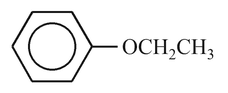
- 1485 marks
Question 148
Give three points of differences between inductive effect and resonance effect.
What Class 11 Chemistry Ch 13 covers
The sections of the chapter, in the order the book takes them. Every question above comes from one of these.
- 01Unique Nature of Carbon and Classification of Organic Compounds
- 02IUPAC Nomenclature of Organic Compounds
- 03Structural Isomerism
- 04Geometrical Isomerism
- 05Optical Isomerism and Configuration
- 06Conformations
More ways to study this chapter
The same chapter asked three other ways. Practise it, revise it, and see what the board has set on Ch 13 before.
Class 11 Chemistry Ch 13 questions students ask
How many questions are there in Class 11 Chemistry Ch 13?
148 questions. Every one is solved step by step on this page.
Are these Class 11 Chemistry solutions free?
Yes. Every question and its full working is free to read, with no account needed.
Can I download the Class 11 Chemistry Ch 13 solutions as a PDF?
There is no PDF to download. Every solution is on this page instead, which means it is searchable, always the current syllabus, and readable on a phone. Use your browser's print option if you want it on paper.