
Question 1292 marksMedium
Write IUPAC names of the following compounds:
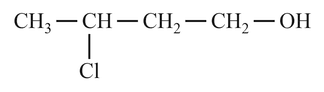
(i)
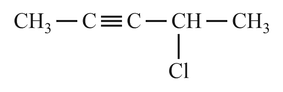
(ii)
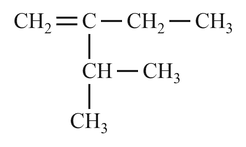
(iii)
(iv)

(v)
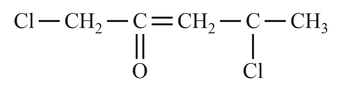
(vi)

(vii)
(viii)
(ix)

(x)
(xi)
Confirming your payment
Sign up now and get 250 free tokens.
Organic Chemistry: Some Basic Principles and Techniques · Question 129 of 148
Write IUPAC names of the following compounds:
(i)
(ii)
(iii)
(iv)
(v)
(vi)
(vii)
(viii)
(ix)
(x)
(xi)
Solution:
Key idea: To name a compound, (1) find the principal characteristic group (–COOH > C=O > –OH; halogens and alkyl groups are only prefixes), (2) choose the parent chain that contains it (and the multiple bonds), (3) number the chain so that the principal group gets the lowest locant, then the multiple bonds, then all the prefixes together, and (4) write the prefixes in alphabetical order. The small numbers written over the carbon atoms below show the numbering we use.
Step 1 — Name (i). The principal group is –OH, so the –OH carbon is C-1 of a four-carbon chain, and Cl sits on C-3.
The name is 3-chlorobutan-1-ol.
Step 2 — Name (ii). The chain has five carbons with a triple bond. Numbering from the left puts the triple bond at C-2 (from the right it would be C-3), and Cl then sits on C-4.
The name is 4-chloropent-2-yne.
Step 3 — Name (iii). Written on one line, the compound is . Under the rule taught in most school books, the parent chain must contain the double bond: the longest such chain has four carbons, numbered from the end, with an ethyl group on C-2 and a methyl group on C-3.
This gives 2-ethyl-3-methylbut-1-ene. The current (2013) IUPAC recommendations choose the longest chain first, even if it leaves out the double bond. The longest chain here has five carbons (), so the becomes a "methylidene" prefix and the 2013 name is 2-methyl-3-methylidenepentane.
Step 4 — Name (iv). The parent chain has four carbons with a C=C bond in the middle (C-2). Both Br atoms are on C-2 and C-3, and both Cl atoms on C-1 and C-4, so either end gives the same locants. Prefixes go in alphabetical order (bromo before chloro).
The name is 2,3-dibromo-1,4-dichlorobut-2-ene.
Step 5 — Name (v). As printed, the third carbon carries both =O and =CH₂ and so would have five bonds, which is impossible. The structure that fits the printed atoms is a ketone with no C=C bond: . The principal group is the ketone, which gets the lower locant (2, not 4) when we number from the left.
The name is 1,4-dichloropentan-2-one.
Step 6 — Name (vi). The longest chain runs from the next to the CHCl group through to the end of the propyl group: eight carbons. From the left the substituents sit at 2 (Cl), 3 (Br) and 5 (methyl); from the right they would sit at 4, 6 and 7. The set {2, 3, 5} is lower at the first point of difference, so we number from the left.
The name is 3-bromo-2-chloro-5-methyloctane.
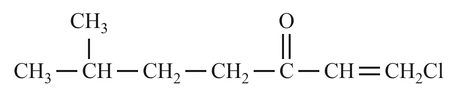
Step 7 — Name (vii). As printed, the last carbon "" carries a double bond as well and would have five bonds, so it must be =CHCl: . The ketone is the principal group. Numbering from the CHCl end gives it locant 3 (from the other end it would be 5), so the chain is a hept-1-en-3-one with Cl on C-1 and a methyl group on C-6.
The name is 1-chloro-6-methylhept-1-en-3-one.
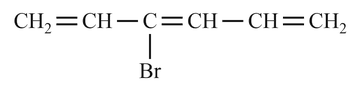
Step 8 — Name (viii). The six-carbon chain has three C=C bonds at 1, 3 and 5 from either end. The tie is broken by the Br atom, which gets locant 3 from the left (4 from the right).
The name is 3-bromohexa-1,3,5-triene.
Step 9 — Name (ix). This is the same compound as (iv), only drawn with the Br atoms above the chain. So its name is again 2,3-dibromo-1,4-dichlorobut-2-ene.
Step 10 — Name (x). The principal group is –COOH, whose carbon is C-1 of a five-carbon chain; the C=C bond starts at C-2.
The name is pent-2-enoic acid.
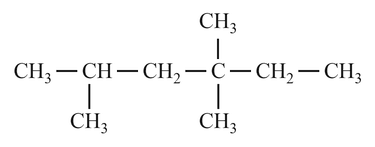
Step 11 — Name (xi). The longest chain has six carbons, with methyl groups on the CH and twice on the quaternary carbon. From the left the locants are {2, 4, 4}; from the right they would be {3, 3, 5}. The first point of difference (2 against 3) decides, so we number from the left.
The name is 2,4,4-trimethylhexane.
Watch out: Compounds (iv), (vii), (viii), (ix) and (x) each have a C=C bond whose two carbons carry two different groups, so they can exist as E and Z (cis and trans) forms; the drawings do not show which form is meant, so the names above leave out E/Z.
Note: Parts (v) and (vii) are misprinted (a carbon with five bonds); the names given are for the structures the printed atoms fit, and .
Therefore, (i) 3-chlorobutan-1-ol; (ii) 4-chloropent-2-yne; (iii) 2-ethyl-3-methylbut-1-ene (2013 IUPAC: 2-methyl-3-methylidenepentane); (iv) 2,3-dibromo-1,4-dichlorobut-2-ene; (v) 1,4-dichloropentan-2-one; (vi) 3-bromo-2-chloro-5-methyloctane; (vii) 1-chloro-6-methylhept-1-en-3-one; (viii) 3-bromohexa-1,3,5-triene; (ix) 2,3-dibromo-1,4-dichlorobut-2-ene; (x) pent-2-enoic acid; (xi) 2,4,4-trimethylhexane.