
Question 1302 marksEasy
How many isomers are possible for a disubstituted benzene? What is the relationship between them?
Confirming your payment
Sign up now and get 250 free tokens.
Organic Chemistry: Some Basic Principles and Techniques · Question 130 of 148
How many isomers are possible for a disubstituted benzene? What is the relationship between them?
Solution:
Key idea: All six carbon atoms of benzene are equivalent, so the first substituent can go on any carbon; we call that carbon C-1. The isomers differ only in where the second substituent sits relative to the first.
Step 1 — List the possible positions of the second substituent. Counting round the ring from C-1, the second group can be on C-2 (next door), C-3 (one carbon between) or C-4 (opposite). Position C-6 is the same as C-2, and C-5 is the same as C-3, because the ring can be turned over. So only three different arrangements exist.
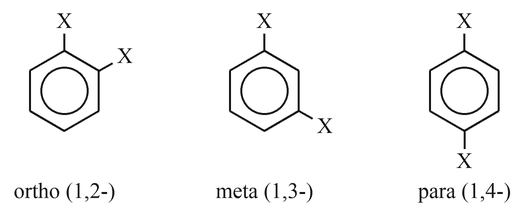
Step 2 — Name the three isomers. They are the 1,2- or ortho (o-) isomer, the 1,3- or meta (m-) isomer and the 1,4- or para (p-) isomer. For example, the three dichlorobenzenes are 1,2-, 1,3- and 1,4-dichlorobenzene. The count is also three when the two substituents are different (for example the o-, m- and p-chlorotoluenes).
Step 3 — State the relationship. The three compounds have the same molecular formula () and the same ring and functional groups; they differ only in the positions of the substituents on the ring. Such compounds are position isomers, one kind of structural isomerism.
Therefore, a disubstituted benzene has three isomers, ortho (1,2-), meta (1,3-) and para (1,4-), and they are position isomers of one another.