
Question 1312 marksMedium
Write the structures of the following compounds
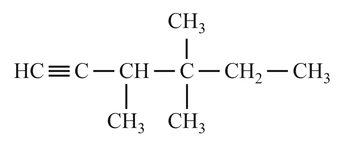
(i) 3,4,4-Trimethylhex-1-yne
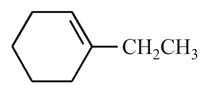
(ii) 1-Ethylcyclohexene
(iii) 3-Methyl-3-buten-1-ol
(iv) But-2-enoic acid
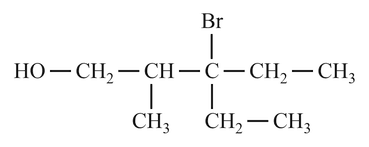
(v) 3-Bromo-3-ethyl-2-methyl-1-pentanol
(vi) But-1-en-3-yne.
Confirming your payment
Sign up now and get 250 free tokens.
Organic Chemistry: Some Basic Principles and Techniques · Question 131 of 148
Write the structures of the following compounds
(i) 3,4,4-Trimethylhex-1-yne
(ii) 1-Ethylcyclohexene
(iii) 3-Methyl-3-buten-1-ol
(iv) But-2-enoic acid
(v) 3-Bromo-3-ethyl-2-methyl-1-pentanol
(vi) But-1-en-3-yne.
Solution:
Key idea: To draw a structure from a name, first read the word root (number of carbons in the parent chain or ring), then the suffix (the principal group or multiple bond and its locant), then the prefixes (substituents and their locants). Draw the parent, number it, place each group, and finally add H atoms so that every carbon has four bonds.
Step 1 — Draw (i), 3,4,4-trimethylhex-1-yne. The parent is a six-carbon chain (hex-) with a triple bond from C-1 to C-2 (-1-yne). One methyl group goes on C-3 and two on C-4.
Step 2 — Draw (ii), 1-ethylcyclohexene. The parent is a six-membered carbon ring with one C=C bond; the double bond is always between C-1 and C-2, and the ethyl group is on C-1, one end of the double bond.
Step 3 — Draw (iii), 3-methyl-3-buten-1-ol. The parent is a four-carbon chain with –OH on C-1 and a C=C bond from C-3 to C-4; a methyl group sits on C-3. In the current style of writing this name is 3-methylbut-3-en-1-ol.

Step 4 — Draw (iv), but-2-enoic acid. The parent is a four-carbon chain whose C-1 is the –COOH carbon; the C=C bond runs from C-2 to C-3. This is crotonic acid.
Step 5 — Draw (v), 3-bromo-3-ethyl-2-methyl-1-pentanol. The parent is a five-carbon chain with –OH on C-1. A methyl group goes on C-2, and C-3 carries both a Br atom and an ethyl group. In the current style the name is written 3-bromo-3-ethyl-2-methylpentan-1-ol.
Step 6 — Draw (vi), but-1-en-3-yne. The parent is a four-carbon chain with a C=C bond from C-1 to C-2 and a C≡C bond from C-3 to C-4. When a double and a triple bond would get the same locants, the double bond is given the lower number, so the name starts "but-1-en".
Watch out: After drawing, count the bonds on every carbon. For example, C-4 in (i) is bonded to C-3, C-5 and two methyl groups, four carbon atoms in all, so it has no H atom left.
Therefore, the structures are (i) , (ii) a cyclohexene ring with an ethyl group on C-1 of the C=C bond, (iii) , (iv) , (v) and (vi) .