
Question 1181 markMedium
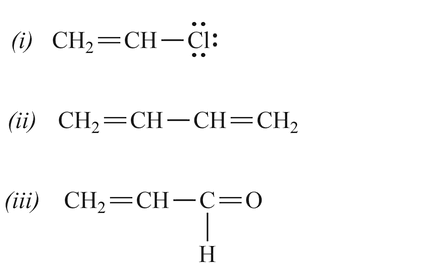
Draw the resonance structure of the following compounds:
Confirming your payment
Sign up now and get 250 free tokens.
Organic Chemistry: Some Basic Principles and Techniques · Question 118 of 148
Draw the resonance structure of the following compounds:
Solution:
Key idea: Resonance structures differ only in the positions of π electrons and lone pairs; the atoms stay in the same places. They are joined by a double-headed arrow ↔, and the real molecule is a hybrid of them.
Step 1 — Draw the structures for (i), vinyl chloride. A lone pair on chlorine moves in to form a C=Cl π bond, and at the same time the π electrons of C=C move onto the end carbon. Chlorine becomes positive and the end carbon negative:
Step 2 — Draw the structures for (ii), buta-1,3-diene. The π electrons of one C=C move to the middle bond, and the other π pair moves onto an end carbon, giving charge-separated structures in both directions:
Step 3 — Draw the structures for (iii), propenal. Oxygen is more electronegative than carbon, so the π electrons of C=O move onto oxygen, and the π electrons of C=C can then move to the middle bond, putting the positive charge on the end carbon:
Step 4 — Judge the contributions. In each case the first (uncharged) structure contributes most. The charge-separated structures contribute less, but they explain real effects: the C–Cl bond in vinyl chloride is shorter and stronger than in an alkyl chloride, the middle bond of butadiene is shorter than a normal C–C single bond, and the end carbon of propenal is attacked by nucleophiles.
Therefore, the resonance structures are those in Steps 1 to 3: for (i) the neutral structure and one with a negative end carbon and a positive chlorine; for (ii) the neutral structure and two charge-separated structures with opposite charges on the two end carbons; for (iii) the neutral structure and two structures with a negative oxygen and a positive carbon (C3 or C1).