
Question 431 markMCQMedium
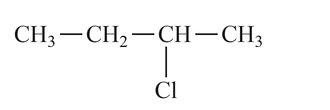
obtained by chlorination of n-butane, will be:
Confirming your payment
Sign up now and get 250 free tokens.
Organic Chemistry: Some Basic Principles and Techniques · Question 43 of 148
obtained by chlorination of n-butane, will be:
(A) Meso form
(B) Racemic mixture
(C) d-form
(D) l-form
Answer: (B) Racemic mixture
Key idea: Chlorination of butane at carbon 2 goes through a free radical. The carbon radical is flat (sp², or very nearly so), so the chlorine atom can attach equally well from either face.
Step 1 — Form the radical. A chlorine atom removes a hydrogen from carbon 2 of butane, giving the planar radical .
Step 2 — Add chlorine from both faces. Attack from the top face gives one enantiomer of 2-chlorobutane and attack from the bottom face gives the other; both faces are equally open, so both form at the same rate.
Step 3 — Decide the product. Equal amounts of the two enantiomers form a racemic mixture, which is optically inactive.
Why the other options are wrong:
Therefore, the 2-chlorobutane obtained is a racemic mixture.