
Question 561 markMCQMedium
The geometrical isomerism is shown by
Confirming your payment
Sign up now and get 250 free tokens.
Organic Chemistry: Some Basic Principles and Techniques · Question 56 of 148
The geometrical isomerism is shown by
(A) 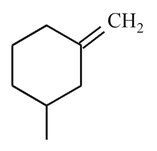
(B) 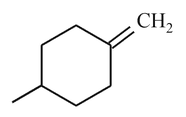
(C) 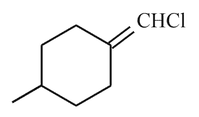
(D) 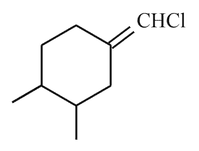
Answer: (D) the ring with a group and two methyl groups (at ring positions 3 and 4)
Key idea: A C=C bond gives geometrical isomers only if EACH of its two carbons carries two different groups. For a double bond leaving a ring, the ring carbon's two "groups" are the two ring paths around it; they differ only if the ring substituents make one path different from the other.
Step 1 — Check the outer carbon of the double bond. In (A) and (B) it is , with two identical H atoms, so these cannot show geometrical isomerism. In (C) and (D) it is , with two different atoms (H and Cl), so they pass this test.
Step 2 — Check the ring carbon in (C). Number the ring from the carbon of the double bond as C-1. In (C) the methyl group is at C-4, exactly opposite C-1. Going round the ring either way (C-2 → C-3 → C-4 or C-6 → C-5 → C-4) meets the same atoms, so the two ring paths are identical and there are no cis/trans forms.
Step 3 — Check the ring carbon in (D). In (D) there are methyl groups at C-3 and C-4. Going one way (C-2 → C-3) we meet a carbon carrying a methyl group at the second step; going the other way (C-6 → C-5) we meet a group there. The two ring paths are different, so the Cl can lie on the side of C-2 or on the side of C-6: two geometrical isomers.
Why the other options are wrong:
Note: compound (C) does have stereoisomers of another kind: like (4-methylcyclohexylidene)acetic acid, it exists as a pair of enantiomers (axial chirality), not as cis/trans isomers.
Therefore, geometrical isomerism is shown by compound (D), option (D).