
Question 531 markMCQMedium
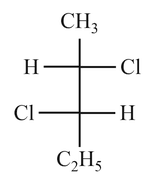
The absolute configuration of the following compound is
Confirming your payment
Sign up now and get 250 free tokens.
Organic Chemistry: Some Basic Principles and Techniques · Question 53 of 148
The absolute configuration of the following compound is
(A) 2S, 3R
(B) 2S, 3S
(C) 2R, 3S
(D) 2R, 3R
Answer: (B) 2S, 3S
Key idea: In a Fischer projection the horizontal bonds point towards us and the vertical bonds point away. Rank the four groups by the CIP rules (higher atomic number first). Trace 1 → 2 → 3: clockwise means R and anticlockwise means S, but if the lowest group (H) is on a horizontal bond, the answer must be reversed.
Step 1 — Name the compound. The chain is , so this is 2,3-dichloropentane; C-2 is the upper crossing and C-3 the lower one.
Step 2 — Rank the groups on C-2. Cl has the highest atomic number, so it is 1. Next, C-3 carries (Cl, C, H), which beats the methyl carbon (H, H, H), so C-3 is 2 and is 3. H is 4.
Step 3 — Trace the sequence on C-2. Cl is on the right, C-3 is below and is above. Right → down → up runs clockwise, which reads as R. But H is on a horizontal bond (left), so we reverse it: C-2 is S.
Step 4 — Rank the groups on C-3. Cl is 1. C-2 carries (Cl, C, H), which beats the ethyl carbon (C, H, H), so C-2 is 2 and is 3. H is 4.
Step 5 — Trace the sequence on C-3. Cl is on the left, C-2 is above and is below. Left → up → down runs clockwise, which reads as R. H is again on a horizontal bond (right), so we reverse it: C-3 is S.
Why the other options are wrong:
Therefore, the compound is (2S,3S)-2,3-dichloropentane, option (B).