
Opening your dashboard
Class 11 Chemistry Chapter 13 Organic Chemistry: Some Basic Principles and Techniques: Competency-Based Questions (CBQ)
40 questions on Chapter 13, each worked through on its own page with the AI tutor. Class 11 Chemistry, ICSE 2026-27.
40 questions
1–5 marks · Mixed difficulty
- 11 mark
Question 1
Competency: Analysis & Evaluation
A poster at a school exhibition on the history of chemistry reads: "In 1828 Friedrich Wöhler heated ammonium cyanate, , and obtained urea, , the compound found in the urine of mammals."
Assertion (A): Wöhler's preparation of urea was a serious blow to the vital force theory.
Reason (R): Wöhler made urea, an organic compound, from ammonium cyanate, an inorganic compound, without the help of any living cell.
- 23 marks
Question 2
Competency: Application
A pharmacist explains two common painkillers to trainee pharmacists. Aspirin has the condensed formula , with the two groups on neighbouring carbon atoms of the benzene ring. Paracetamol has the condensed formula , with the two groups on opposite carbon atoms of the ring (positions 1 and 4).
(a) Name the two functional groups present in each molecule.
(b) A trainee says, "Both compounds contain oxygen or nitrogen, so they are heterocyclic compounds." Classify the two compounds correctly and explain the trainee's mistake.
(c) Find the molecular formula of aspirin, and state how many of its carbon atoms are sp² hybridised and how many are sp³ hybridised.
- 31 mark
Question 3
Competency: Analysis & Evaluation
A student builds ball-and-stick models of methane, ethene and ethyne. In every model each carbon atom is joined by four bonds (a double bond counted as two and a triple bond as three).
Assertion (A): Carbon shows a valency of four in almost all of its compounds.
Reason (R): In its ground state, a carbon atom has four unpaired electrons in its valence shell.
- 43 marks
Question 4
Competency: Application
The octane number of petrol compares how smoothly it burns in an engine with a reference fuel. The reference compound given the octane number 100 is commonly called "isooctane"; its IUPAC name is 2,2,4-trimethylpentane.
(a) Write the condensed structural formula of 2,2,4-trimethylpentane, and show that it is an isomer of octane, .
(b) A student writes the name as "2,4,4-trimethylpentane". Explain, using the IUPAC numbering rule, why this name is wrong.
(c) Classify each carbon atom of 2,2,4-trimethylpentane as primary, secondary, tertiary or quaternary, and give the number of each kind.
- 51 mark
Question 5
Competency: Application
A food-flavour supplier lists "ethyl 2-methylbutanoate" as the compound that gives an apple-like aroma to a fruit drink. Which condensed formula matches this name?
- 63 marks
Question 6
Competency: Application
A quality-control laboratory receives three unlabelled bottles X, Y and Z. Each holds one of the three dimethylbenzenes (xylenes), , shown below. A small sample from each bottle is brominated so that one hydrogen atom of the ring is replaced by a bromine atom, and the different ring-monobromo products are counted by gas chromatography. (Hypothetical data.) X gives one product, Y gives two products and Z gives three products.
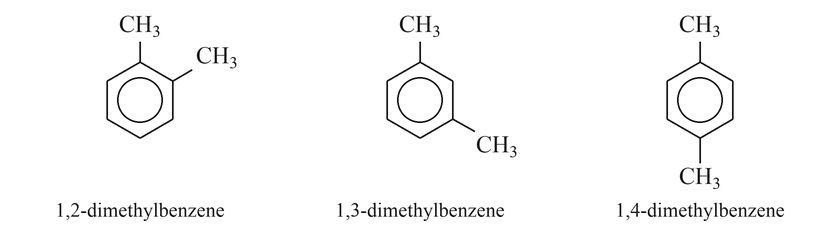
(a) Identify X, explaining your reasoning.
(b) Identify Y and Z, explaining your reasoning.
(c) Ethylbenzene, , is another aromatic compound with the formula . How many ring-monobromo products can it give? Explain why this count alone could not tell ethylbenzene apart from Z.
- 71 mark
Question 7
Competency: Application
A perfume chemist plans to test every ester with the molecular formula as a possible fruity note. How many different esters (structural isomers) have this molecular formula?
- 83 marks
Question 8
Competency: Application
Butenedioic acid, , is made in industry as two geometrical isomers, whose two possible shapes are shown below. Isomer P melts at about 135 °C and is very soluble in water; when heated to about 150 °C it loses one molecule of water and forms a cyclic anhydride, , which is used to make polyester resins. Isomer Q melts (in a sealed tube) at about 287 °C, is only slightly soluble in water, and does not form an anhydride when heated to the same temperature.
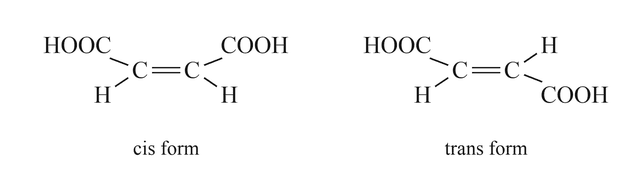
(a) Decide which isomer, P or Q, is the cis form. Explain your choice using the anhydride, and write the equation for its formation.
(b) Give the E/Z name of each isomer, showing how you ranked the groups.
(c) Suggest two reasons why Q melts at a much higher temperature than P.
- 91 mark
Question 9
Competency: Analysis & Evaluation
A student is labelling bottles of alkenes that show geometrical isomerism. On each bottle the student writes either the cis/trans name or the E/Z name, and assumes that the two systems always match.
Assertion (A): In every alkene that shows geometrical isomerism, the cis isomer is the Z isomer.
Reason (R): In the E/Z system, the two groups on each doubly bonded carbon are ranked by the Cahn–Ingold–Prelog rules, starting with the atomic number of the atom joined directly to that carbon.
- 103 marks
Question 10
Competency: Application
Carvone, , has one asymmetric carbon atom, so it exists as two enantiomers. (R)-Carvone gives spearmint its smell, while (S)-carvone gives caraway seeds their smell. Both enantiomers boil at 231 °C. Under the conditions of a laboratory polarimeter, the specific rotation of (R)-carvone is −62°. The specific rotation is defined by , where is the observed rotation, is the length of the tube in dm and is the concentration in g mL⁻¹.
(a) Explain why the two enantiomers have the same boiling point but different smells.
(b) State the specific rotation of (S)-carvone under the same conditions, and the rotation shown by a mixture containing equal amounts of the two enantiomers.
(c) A flavour chemist dissolves 3.0 g of (R)-carvone and 1.0 g of (S)-carvone in ethanol to make 100 mL of solution, and places it in a 2.0 dm polarimeter tube. (Hypothetical data.) Calculate the observed rotation.
- 111 mark
Question 11
Competency: Analysis & Evaluation
Many drug molecules are first made in the laboratory as racemic mixtures, although often only one enantiomer is wanted as the medicine. A company has a racemic mixture of a liquid chiral alcohol and wants to separate its two enantiomers.
Assertion (A): The two enantiomers in the racemic mixture can be separated by careful fractional distillation.
Reason (R): Two enantiomers have the same boiling point, because they have the same bonds and the same intermolecular forces.
- 121 mark
Question 12
Competency: Analysis & Evaluation
1,2-Dichloroethane, , is used to make vinyl chloride for PVC. Its anti and gauche conformations are shown below as Newman projections along the C–C bond. In the gas phase its measured average dipole moment is about 1.1 D near room temperature and about 1.5 D near 280 °C.
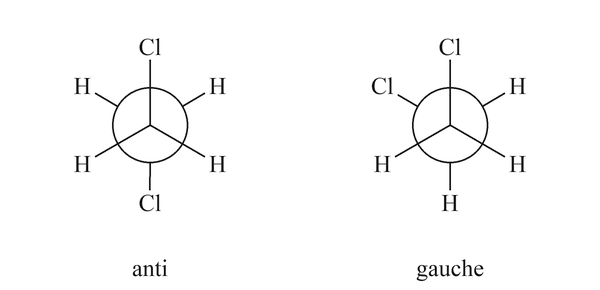
Assertion (A): The average dipole moment of 1,2-dichloroethane vapour is small and increases as the vapour is heated.
Reason (R): The anti conformation has no dipole moment while the gauche conformations are polar, and heating increases the proportion of the higher-energy gauche conformations.
- 131 mark
Question 13
Competency: Application
A student uses a molecular-modelling kit to estimate the energy barrier to rotation about the C1–C2 bond of propane, . The student takes the staggered conformation as zero energy and uses the usual approximate values: each pair of eclipsed C–H bonds (an H/H eclipsing) adds 4.0 kJ mol⁻¹, and each C– bond eclipsed with a C–H bond (a /H eclipsing) adds 6.0 kJ mol⁻¹. What barrier does the student obtain?
- 144 marks
Question 14
Competency: Application
Clove oil, used in remedies for toothache, is obtained by passing steam through crushed cloves. Its main component, eugenol (, molar mass 164 g mol⁻¹), boils at 254 °C and is almost insoluble in water. At 760 mmHg the mixture of water and eugenol boils at about 99.9 °C, where the vapour pressure of water is 757 mmHg and that of eugenol is 3 mmHg. (Hypothetical data.) In the vapour, the ratio of the numbers of moles of the two substances equals the ratio of their vapour pressures.
(a) Explain why the mixture boils below 100 °C, although eugenol on its own boils at 254 °C.
(b) Calculate the mass of eugenol that distils over with every 1000 g of water collected in the distillate.
(c) State how the eugenol can be separated from the water in the distillate.
- 151 mark
Question 15
Competency: Analysis & Evaluation
In Beilstein's test, a copper wire is heated in a Bunsen flame until it no longer colours the flame, dipped into an organic compound and heated again. A student sees a bluish-green flame and concludes at once that the compound contains a halogen.
Assertion (A): A bluish-green flame in Beilstein's test does not by itself prove that the compound contains a halogen.
Reason (R): In Beilstein's test the halogen of the compound forms a volatile copper halide, which colours the flame bluish-green.
- 161 mark
Question 16
Competency: Application
A food-safety laboratory suspects that a vegetable extract contains residues of the insecticide malathion, . A purified sample is fused with sodium to test for sulphur, and another portion is heated with sodium peroxide to test for phosphorus. If the residue is malathion, which pair of observations is expected?
- 174 marks
Question 17
Competency: Application
A dairy's quality-control laboratory estimates protein in milk powder by Kjeldahl's method, and then uses the rule: percentage of protein = percentage of nitrogen × 6.38. A 0.500 g sample of milk powder is digested with concentrated sulphuric acid, which turns its nitrogen into ammonium sulphate. The digest is made alkaline with sodium hydroxide, and the ammonia that is boiled off is absorbed in boric acid solution, where each mole of ammonia later needs one mole of hydrochloric acid in the titration. The titration needs 14.6 mL of 0.100 M hydrochloric acid. (Hypothetical data.) (N = 14)
(a) Write the equation for the release of ammonia from ammonium sulphate, and calculate the percentage of nitrogen in the milk powder.
(b) Calculate the percentage of protein in the milk powder.
(c) A dishonest supplier adds 0.50 g of urea, (molar mass 60 g mol⁻¹), to every 100 g of milk powder. Urea nitrogen is also converted to ammonium sulphate in the test. How many grams of false "protein" would the test report for the urea in each 100 g of powder?
- 181 mark
Question 18
Competency: Analysis & Evaluation
In Liebig's method for estimating carbon and hydrogen, the gases from the combustion tube pass first through a weighed U-tube of anhydrous calcium chloride and then through weighed bulbs of concentrated potassium hydroxide solution. The increase in mass of each absorber is used to find the percentages of hydrogen and carbon.
Assertion (A): The calcium chloride tube must be placed before the potassium hydroxide bulbs.
Reason (R): Anhydrous calcium chloride absorbs carbon dioxide as well as water vapour.
- 191 mark
Question 19
Competency: Application
A pharmaceutical quality-control laboratory checks a batch of paracetamol, (molar mass 151 g mol⁻¹), by Dumas' method. A 0.302 g sample gives 20.2 mL of nitrogen, corrected to STP. (Hypothetical data.) Assuming that the impurity contains no nitrogen and taking the molar volume at STP as 22.4 L mol⁻¹, what is the percentage by mass of paracetamol in the sample?
- 203 marks
Question 20
Competency: Application
Dichlorodifluoromethane, , was once widely used as a refrigerant. High in the stratosphere, ultraviolet light breaks one bond in each of its molecules, which starts the reactions below that destroy ozone. The average bond enthalpies are C–F 485 kJ mol⁻¹ and C–Cl 327 kJ mol⁻¹. (A dot, •, marks an unpaired electron.)
Reaction 1:
Reaction 2:
Reaction 3:
(a) Name the type of bond fission in reaction 1, and use the bond enthalpies to explain why a C–Cl bond breaks rather than a C–F bond.
(b) Add reactions 2 and 3 to find the overall change, and explain why one chlorine atom can destroy many thousands of ozone molecules.
(c) Explain, in terms of their electrons, why and are very reactive.
- 211 mark
Question 21
Competency: Application
In a plant that makes nitrobenzene for the dye industry, benzene is stirred at about 50–55 °C with a "mixed acid" of concentrated nitric acid and concentrated sulphuric acid. Which statement correctly gives the main role of the sulphuric acid?
- 223 marks
Question 22
Competency: Application
Chloroethene (vinyl chloride), , is the monomer from which PVC pipes are made. Some measured data for it and for chloroethane, , are given in the table.
Compound C–Cl bond length Dipole moment Chloroethane 178 pm 2.05 D Chloroethene 172 pm 1.45 D When each is warmed with an ethanolic solution of silver nitrate, chloroethane slowly gives a white precipitate, but chloroethene gives none.
(a) Write two resonance structures of chloroethene, and say which electron displacement effect of chlorine they show.
(b) Use your answer to (a) to explain why chloroethene has the shorter C–Cl bond and the smaller dipole moment.
(c) Explain why chloroethene gives no precipitate with silver nitrate.
- 231 mark
Question 23
Competency: Analysis & Evaluation
In industry, chlorobenzene is nitrated to make chloronitrobenzenes for dyes and medicines. It needs somewhat more vigorous conditions than benzene, and the products are mainly 2-chloronitrobenzene and 4-chloronitrobenzene, with very little of the 3-isomer.
Assertion (A): Chlorobenzene undergoes electrophilic substitution, such as nitration, more slowly than benzene.
Reason (R): The +R (+M) effect of chlorine increases the electron density at the ortho and para positions of the ring.
- 243 marks
Question 24
Competency: Application
Chloroethane, , is used as a cooling spray for minor sports injuries. It can be made by two routes:
Route 1:
Route 2:
The atom economy of a reaction is the mass of the wanted product divided by the total mass of all the reactants, expressed as a percentage. (C = 12, H = 1, Cl = 35.5)
(a) Classify each route as a type of reaction.
(b) Calculate the atom economy of each route.
(c) Give one other reason, based on the products formed, why route 2 is preferred in industry.
- 251 mark
Question 25
Competency: Application
A food-testing laboratory adds a dilute solution of bromine in an inert solvent to two samples. Sample 1, an edible vegetable oil, removes the bromine colour at once, even in the dark, and no hydrogen bromide is given off. Sample 2, hexane, keeps the bromine colour in the dark, but in bright sunlight the colour slowly fades and steamy fumes of hydrogen bromide are given off. Which statement correctly classifies the two reactions?
- 264 marks
Question 26
Draw Newman projections of the three staggered conformations of 2-methylbutane, , viewed along the C2–C3 bond (C2 in front). Count the gauche / interactions in each, and identify the most stable and least stable staggered conformations. (Take each gauche / interaction as about 3.8 kJ mol⁻¹.)
- 274 marks
Question 27
Consider ethanol, phenol, 3-nitrophenol and 4-nitrophenol.
(a) Arrange them in increasing order of acid strength.
(b) Explain why phenol is a much stronger acid than ethanol.
(c) Explain why 4-nitrophenol is a stronger acid than phenol.
(d) Explain why 3-nitrophenol lies between phenol and 4-nitrophenol.
- 284 marks
Question 28
2-Chloro-2-methylpropane is hydrolysed by water by the mechanism.
(a) Describe the two steps of the mechanism in words, stating which step is slow.
(b) Write the rate expression and explain why the reaction is first order.
(c) Give two reasons why this tertiary halide reacts by rather than .
(d) If an optically active tertiary chloride such as 3-chloro-3-methylhexane were hydrolysed in the same way, what would you expect for the optical activity of the alcohol formed? Explain.
- 291 mark
Question 29
Competency: Application
The label on a can of lacquer thinner lists the solvent "diacetone alcohol", whose condensed formula is . The paint company wants to print the IUPAC name of this solvent on its safety data sheet. Which name should it print?
- 301 mark
Question 30
Competency: Analysis
A college storeroom has an unlabelled bottle of a colourless liquid. The stock register shows that it must be one of the four chlorinated solvents listed in the options. A 0.294 g sample of the liquid is heated with fuming nitric acid and silver nitrate in a Carius tube, and 0.574 g of dry silver chloride is obtained. (Hypothetical data.) (C = 12, H = 1, Cl = 35.5, Ag = 108)
Which solvent is in the bottle?
- 311 mark
Question 31
Competency: Evaluation
In a school laboratory, 2-bromo-2-methylpropane, , is dissolved in two solvents. Its solution in aqueous ethanol slowly becomes able to conduct electricity and gives a cream precipitate of silver bromide when silver nitrate solution is added. Its solution in dry hexane does not conduct electricity, however long it is kept.
Assertion (A): The C–Br bond of 2-bromo-2-methylpropane breaks much more readily in aqueous ethanol than in hexane.
Reason (R): Water molecules make the C–Br bond break homolytically, and the free radicals formed are stabilised by hydrogen bonding with water.
- 321 mark
Question 32
Competency: Analysis
Nitromethane, , is used as a fuel in model-aircraft engines and drag-racing cars. A chemist notes that nitromethane reacts with aqueous sodium hydroxide: a proton is removed from its carbon atom and a sodium salt is formed. Methane does not react with aqueous sodium hydroxide at all.
Assertion (A): The hydrogen atoms on the carbon atom of nitromethane are far more acidic than the hydrogen atoms of methane.
Reason (R): In the anion , the −R (−M) effect of the nitro group spreads the negative charge from the carbon atom onto the oxygen atoms.
- 331 mark
Question 33
Competency: Evaluation
A pharmaceutical laboratory must purify 10.0 g of a crude solid drug intermediate P by recrystallisation. P melts at 105 °C. When a solid is heated in a solvent that boils above the solid's melting point, the solid tends to melt and separate as an oily layer that traps impurities, instead of dissolving and later forming crystals. The table gives the solubility of P (in g per 100 mL of solvent) in four solvents that do not react with it. (Hypothetical data.)
Solvent Boiling point (°C) Solubility of P at 20 °C Solubility of P near the boiling point Water 100 0.1 0.4 Propanone 56 30 45 Ethanol 78 1.2 28 Toluene 111 0.8 40 Which solvent should the laboratory choose?
- 342 marks
Question 34
Competency: Analysis
For a project on solvents and fuels, a student collects the boiling points of four straight-chain alcohols at 1 atm.
Alcohol Condensed formula Boiling point (°C) Methanol 65 Ethanol 78 Propan-1-ol 97 Butan-1-ol 118 (a) Show, using the formulae and the molar masses, that these alcohols belong to one homologous series, and write the general formula of the series. (C = 12, H = 1, O = 16)
(b) Use the trend in the table to predict the boiling point of the next member, pentan-1-ol, and explain why the boiling point rises along the series.
- 352 marks
Question 35
Competency: Analysis
A perfume company must purify a liquid ester Z. At 760 mmHg, Z boils at 290 °C, but it begins to decompose above about 200 °C. The table gives the vapour pressure of Z at different temperatures. (Hypothetical data.) A liquid boils when its vapour pressure becomes equal to the pressure above it.
Temperature (°C) 120 140 160 180 200 Vapour pressure of Z (mmHg) 3 7 16 34 66 (a) The laboratory's vacuum pump keeps the pressure in the apparatus at 20 mmHg. Estimate the temperature at which Z distils, and state whether Z can be purified safely in this way.
(b) A trainee suggests using a weaker pump that keeps the pressure at 100 mmHg, "to make the distillation quicker". Evaluate this suggestion.
- 362 marks
Question 36
Competency: Analysis
A student compares the strength of ethanoic (acetic) acid with three of its monohalogen derivatives, using data for water at 25 °C. A lower pKa means a stronger acid, and .
Acid Formula pKa Ethanoic acid 4.76 Iodoethanoic acid 3.18 Chloroethanoic acid 2.87 Fluoroethanoic acid 2.59 (a) Use the data to arrange F, Cl and I in order of their −I effect, and explain this order.
(b) Calculate the ratio of the Ka of fluoroethanoic acid to the Ka of ethanoic acid. Predict, with a reason, whether the pKa of dichloroethanoic acid, , is greater or less than 2.87.
- 373 marks
Question 37
Competency: Creativity
Ibuprofen, a common painkiller, is a carboxylic acid with one asymmetric carbon atom. Most tablets contain its racemic mixture, although the (S)-enantiomer is the more active form. A college chemistry club wants to obtain (S)-ibuprofen from racemic ibuprofen. It has a pure optically active base, (S)-1-phenylethan-1-amine, which reacts with a carboxylic acid to form a salt. In the club's solvent, the salt of (S)-ibuprofen with this base is much less soluble than the salt of (R)-ibuprofen. Pure (S)-ibuprofen has a specific rotation of +57° under the club's conditions, and the specific rotation of a mixture of the two enantiomers equals (fraction of S − fraction of R) × 57°. (Hypothetical data.)
(a) Explain why the two enantiomers of ibuprofen cannot be separated by crystallisation as they are, but their two salts with the (S)-base can.
(b) Design, in steps, a method to obtain (S)-ibuprofen from the racemic mixture.
(c) The club's final product has a specific rotation of +51.3°. Calculate the percentage of (S)-ibuprofen in it, assuming that the only impurity is (R)-ibuprofen.
- 383 marks
Question 38
Competency: Application
A teacher plans to make 2-chloro-2-methylpropane for a class experiment by passing chlorine into 2-methylpropane, , in sunlight and keeping only the monochloro products. At room temperature, a chlorine atom removes a tertiary hydrogen atom about 5 times as fast as a primary hydrogen atom.
(a) Write the condensed formulae and IUPAC names of the two monochloro products, and name the type of isomerism between them.
(b) Calculate the expected percentage of each monochloro product.
(c) Explain why a tertiary hydrogen atom is removed faster than a primary one, and comment on the teacher's plan.
- 395 marks
Question 39
Competency: Analysis
Caffeine, (molar mass 194 g mol⁻¹), is added with paracetamol to some headache tablets. A quality-control laboratory receives a batch of caffeine powder and analyses two 0.194 g portions. In Liebig's method the first portion gives 0.3344 g of carbon dioxide and 0.0855 g of water. In Dumas' method the second portion gives 42.6 mL of nitrogen, corrected to STP. (Hypothetical data.) Two analysts disagree about the result. Analyst 1 says the powder is pure caffeine, but some carbon dioxide escaped from the absorber. Analyst 2 says the powder contains an inert filler with no carbon, hydrogen or nitrogen. (C = 12, H = 1, N = 14, O = 16; molar volume at STP = 22.4 L mol⁻¹)
(a) Write the balanced equation for the complete combustion of caffeine to carbon dioxide, water and nitrogen, and calculate the masses of carbon dioxide and water that 0.194 g of pure caffeine should give.
(b) Calculate the volume of nitrogen at STP that 0.194 g of pure caffeine should give in Dumas' method.
(c) Use all three measurements to decide which analyst is right, and find the percentage of caffeine in the powder.
- 404 marks
Question 40
Competency: Evaluation
Vanaspati is made by partly hydrogenating vegetable oils. During partial hydrogenation, some of the cis double bonds in the fatty-acid chains are turned into trans double bonds. These "trans fats" raise the level of harmful LDL cholesterol in the blood and the risk of heart disease, and since 2022 Indian food rules have limited trans fat in oils and fats to 2 % of the total fat. Oleic acid and elaidic acid both have the condensed formula , with the double bond between C9 and C10 (C1 is the –COOH carbon). Stearic acid, , has no double bond.
Fatty acid Arrangement at the C9=C10 bond Melting point (°C) Oleic acid cis 13 Elaidic acid trans 45 Stearic acid no double bond 69 (a) Explain why oleic acid and elaidic acid are geometrical isomers, and give the E/Z name of each.
(b) Using the table, state which of the three acids are solids at 25 °C and at body temperature (37 °C), and explain the order of their melting points in terms of the shapes of the molecules.
(c) A food laboratory isolates a fatty acid of formula that melts at 44–45 °C and decolourises bromine solution; other tests show that its only C=C bond lies between C9 and C10. A trainee reports it as oleic acid "because it is unsaturated". Evaluate the report.