
Competency: Application
Butenedioic acid, , is made in industry as two geometrical isomers, whose two possible shapes are shown below. Isomer P melts at about 135 °C and is very soluble in water; when heated to about 150 °C it loses one molecule of water and forms a cyclic anhydride, , which is used to make polyester resins. Isomer Q melts (in a sealed tube) at about 287 °C, is only slightly soluble in water, and does not form an anhydride when heated to the same temperature.
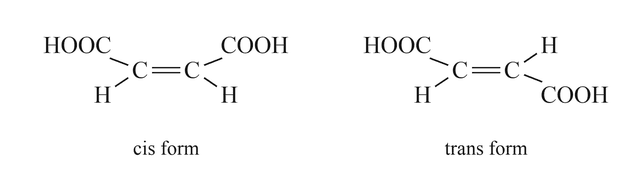
(a) Decide which isomer, P or Q, is the cis form. Explain your choice using the anhydride, and write the equation for its formation.
(b) Give the E/Z name of each isomer, showing how you ranked the groups.
(c) Suggest two reasons why Q melts at a much higher temperature than P.