
Question 271 markMCQMedium
The two optical isomers given below, namely
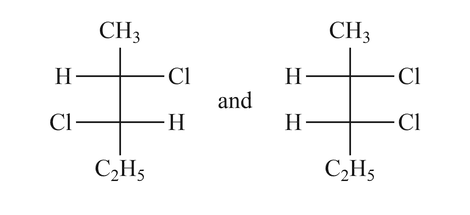
are:
Confirming your payment
Sign up now and get 250 free tokens.
Organic Chemistry: Some Basic Principles and Techniques · Question 27 of 148
The two optical isomers given below, namely
are:
(A) enantiomers
(B) geometrical isomers
(C) diastereomers
(D) structural isomers
Answer: (C) diastereomers
Key idea: Stereoisomers with the same structure (same atoms joined in the same order) are enantiomers if they are mirror images and diastereomers if they are not. In a Fischer projection, horizontal bonds point towards the viewer and vertical bonds away.
Step 1 — Identify the compound. Both projections have at the top, at the bottom and one Cl on each of the two middle carbons, so both are 2,3-dichloropentane, . The constitution is the same, so they are not structural isomers.
Step 2 — Compare carbon 2. In both projections H is on the left and Cl on the right, so carbon 2 has the same configuration (S) in both.
Step 3 — Compare carbon 3. In the first projection Cl is on the left, in the second on the right, so carbon 3 is S in the first and R in the second (priorities Cl > C-2 > > H).
Step 4 — Decide the relationship. The first is (2S,3S) and the second (2S,3R). Mirror images would have both centres inverted (2R,3R), so these are stereoisomers that are not mirror images: diastereomers.
Why the other options are wrong:
Note: the printed answer, structural isomers, is a slip: the two projections have the same constitution and differ only at carbon 3, so they are diastereomers.
Therefore, the two isomers are diastereomers.