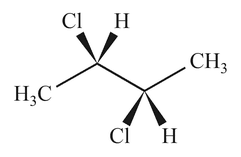
Solution:
Key idea: The compound is 2,3-dichlorobutane, CH3−CHCl−CHCl−CH3, with two alike chiral carbons. If the two centres have the same descriptor, (R,R) or (S,S), the molecule is chiral and has only a two-fold axis (C2) of symmetry. If they differ (R,S), it is the meso form, which has a mirror plane or a centre of symmetry. A molecule with a mirror plane or a centre of symmetry can never be optically active.
Step 1 — Read the drawing. The carbon chain lies in the plane of the paper. At each chiral carbon, Cl and H point out of the plane on opposite sides; we read the drawing in the usual way, with Cl towards us and H away from us at both carbons (reading it the other way round at both carbons gives the mirror image, with the same answers).
Step 2 — Assign the upper carbon (C-2). Priorities: Cl (1), C-3 carrying (Cl, C, H) (2), CH3 (3), H (4). With H away from us, Cl (upper left) → C-3 (lower right) → CH3 (lower left) runs clockwise: C-2 is R.
Step 3 — Assign the lower carbon (C-3). Priorities: Cl (1), C-2 (2), CH3 (3), H (4). With H away from us, Cl (lower left) → C-2 (upper left) → CH3 (upper right) runs clockwise: C-3 is R.
Step 4 — Decide the symmetry. The compound is (2R,3R)-2,3-dichlorobutane. It is chiral, so choice (a) is correct. Turning it through 180° about an axis through the midpoint of the C-2–C-3 bond, at right angles to it, brings the molecule onto itself, so it has a C2 axis of symmetry: choice (d) is correct. It has no mirror plane and no centre of symmetry (either one would make it achiral), so choices (b) and (c) are wrong.
Note: this item has more than one correct choice. The printed answer pairs "optically active" with "centre of symmetry", but these cannot both be true: a molecule with a centre of symmetry is superimposable on its mirror image and cannot be optically active. The drawn (R,R) compound is optically active and has a two-fold axis.
Therefore, the correct statements are (a) and (d).