
Opening your dashboard
Class 11 Chemistry Chapter 13 Organic Chemistry: Some Basic Principles and Techniques: Practice Questions
149 questions on Chapter 13, each worked through on its own page with the AI tutor. Class 11 Chemistry, ICSE 2026-27.
149 questions
1–4 marks · Mixed difficulty
- 11 mark
Question 1
Which one of the following is a heterocyclic aromatic compound?
- 22 marks
Question 2
The average bond enthalpies (kJ mol⁻¹) of some bonds are: C–C 348, Si–Si 226 and Si–O 452. Use these values to explain why carbon forms very long, stable chains of its own atoms in millions of compounds, whereas silicon forms only short Si–Si chains and occurs in nature mostly bonded to oxygen.
- 33 marks
Question 3
Acrylonitrile, , is used to make acrylic fibres.
(a) State the hybridisation of each of the three carbon atoms (number them C1, C2, C3 from the end).
(b) Find the number of σ bonds and π bonds in one molecule.
(c) State the approximate C1–C2–C3 and C2–C3–N bond angles.
- 41 mark
Question 4
Propanal, , belongs to the homologous series of aldehydes. Which compound is its next higher homologue?
- 51 mark
Question 5
The IUPAC name of is
- 63 marks
Question 6
Give the IUPAC name of , explaining how you chose the principal functional group, the numbering and the prefixes.
- 71 mark
Question 7
Which one of the following names is correct according to IUPAC rules?
- 83 marks
Question 8
Give the IUPAC name of the alkane , showing how you chose the parent chain and how you named the branched substituent.
- 91 mark
Question 9
Which pair of compounds, all with the formula , are chain isomers of each other?
- 104 marks
Question 10
A dichloro derivative of propane has the formula . Show, by placing the two chlorine atoms in every possible way, that exactly four structural isomers exist; give each its IUPAC name, and pick out the isomer in which all six hydrogen atoms are equivalent.
- 113 marks
Question 11
Butanone, , shows keto–enol tautomerism.
(a) Write the condensed formulae and IUPAC names of the two enol forms of butanone.
(b) Explain why the keto form is present in far greater amount than either enol form at equilibrium.
- 121 mark
Question 12
Which one of the following is not an isomer of cyclopentane?
- 131 mark
Question 13
Which is the correct IUPAC name, including the E/Z descriptor, of the alkene shown below?
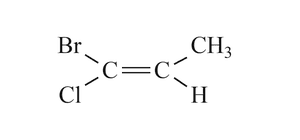
- 143 marks
Question 14
Hexa-2,4-diene, , has two double bonds, each of which can show geometrical isomerism. How many geometrical isomers does it have? Name each one with E/Z descriptors and explain why the number is not four.
- 152 marks
Question 15
The two geometrical isomers of 1,2-dichloroethene are shown below. The cis isomer boils at about 60 °C and melts at about −81 °C; the trans isomer boils at about 48 °C and melts at about −50 °C.
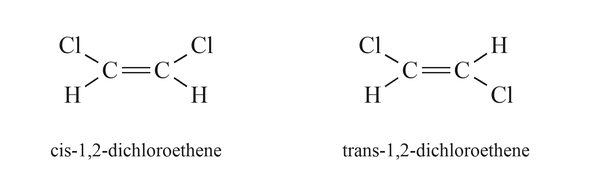
(a) Explain why the cis isomer has the higher boiling point.
(b) Explain why the trans isomer has the higher melting point.
- 161 mark
Question 16
The cis and trans forms of but-2-ene can be separated and stored at room temperature, but the staggered and eclipsed forms of ethane cannot be separated. The main reason is that
- 173 marks
Question 17
A student dissolves 10.0 g of sucrose in water to make 100 mL of solution and places it in a polarimeter tube 2.00 dm long. (Hypothetical data.) The plane of polarised light is rotated by +13.3°.
(a) Calculate the specific rotation of sucrose.
(b) Predict the observed rotation when 4.00 g of sucrose is made up to 50.0 mL of solution and placed in a 1.00 dm tube at the same temperature and wavelength.
- 181 mark
Question 18
Isoleucine, , is an amino acid. How many stereoisomers are possible for this structure?
- 193 marks
Question 19
The Fischer projection of one enantiomer of 2-chlorobutanoic acid is shown below. Assign the R or S configuration to its asymmetric carbon, showing the priority order and every step.
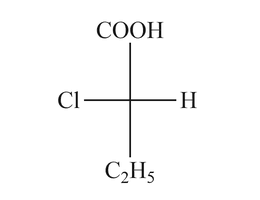
- 203 marks
Question 20
Pentane-2,4-diol, , has two asymmetric carbon atoms. State the number of its stereoisomers, assign R/S to each centre, and explain which stereoisomer is optically inactive and why.
- 211 mark
Question 21
A model of (R)-2-bromobutane, , is built with balls and sticks. Which change to the model turns it into a model of (S)-2-bromobutane?
- 223 marks
Question 22
Sketch a graph of the potential energy of ethane against the dihedral angle between a C–H bond on the front carbon and a C–H bond on the back carbon, as the back group rotates through 360° starting from an eclipsed conformation (dihedral angle 0°). Take the energy difference between the eclipsed and staggered conformations as 12.5 kJ mol⁻¹. Mark the dihedral angles of the energy maxima and minima, and name the conformation at each.
- 231 mark
Question 23
When butane is viewed along its C2–C3 bond, which dihedral angle between the two groups gives a staggered conformation that is less stable than the most stable conformation?
- 242 marks
Question 24
In butane the anti conformation (the two groups at 180°) is more stable than the gauche conformation (60°). For isolated molecules of ethane-1,2-diol, , however, the gauche conformation (the two –OH groups at 60°) is more stable than the anti conformation. Explain this difference.
- 251 mark
Question 25
A plant extract leaves an organic compound X dissolved in water. (Hypothetical data.) X decomposes if it is heated above 60 °C, it is not volatile in steam, and it is about twenty times more soluble in diethyl ether than in water; ether and water do not mix. Which method is best for recovering X from the water?
- 263 marks
Question 26
A compound contains both nitrogen and sulphur. When its sodium fusion (Lassaigne's) extract is treated with iron(III) chloride solution, a blood-red colour appears, but the usual Prussian blue test for nitrogen gives no blue colour.
(a) Explain, with equations, why the blood-red colour appears.
(b) State how the sodium fusion should be changed so that nitrogen and sulphur can be detected by their usual separate tests, and give the equation for the change.
- 271 mark
Question 27
The sodium fusion extract of an organic compound is tested as follows. (Hypothetical data.) (1) Boiled with iron(II) sulphate, then iron(III) chloride is added and the mixture acidified: no blue, green or red colour appears. (2) Sodium nitroprusside is added to a fresh portion: a violet colour appears. (3) Another portion is boiled with dilute nitric acid, cooled, and silver nitrate is added: a pale yellow precipitate forms that dissolves only sparingly in concentrated ammonia solution. Which elements does the compound contain, besides carbon and hydrogen?
- 283 marks
Question 28
A dye mixture M and three pure dyes P, Q and R were spotted side by side on the base line of a sheet of chromatography paper and run together in the same solvent. (Hypothetical data.) The chromatogram is shown below, and the distances measured from the base line are given in the table.
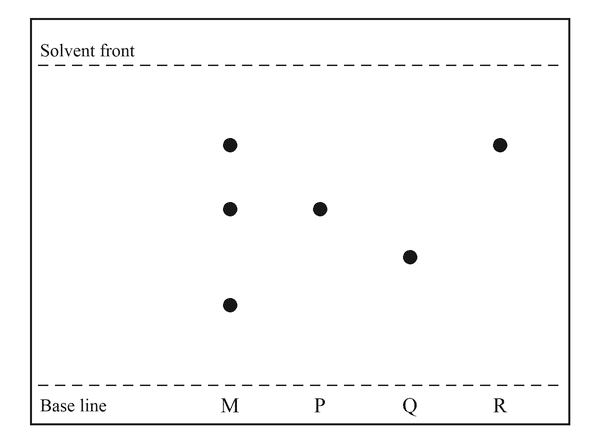
Spot Distance from base line (cm) Solvent front 8.0 M 2.0, 4.4 and 6.0 P 4.4 Q 3.2 R 6.0 (a) Which of the pure dyes P, Q and R are present in M?
(b) Does M contain any dye other than P, Q and R? Give the evidence.
(c) In paper chromatography, which component of M is held most strongly by the stationary phase? Explain.
- 293 marks
Question 29
A sample of crude acetanilide contains 4.0 g of acetanilide mixed with a little coloured impurity and some sand. (Hypothetical data.) Acetanilide dissolves in water to the extent of about 0.5 g per 100 mL at 25 °C and about 5 g per 100 mL near 100 °C. The sample is dissolved in 80 mL of boiling water and purified by crystallisation.
(a) Why is water a suitable solvent here, and what is the greatest mass of acetanilide that can crystallise when the solution is cooled to 25 °C?
(b) Why is a little activated charcoal added, and why is the solution filtered while it is still hot?
(c) How can the purity of the dried crystals be checked?
- 301 mark
Question 30
A 0.314 g sample of bromobenzene, , is heated with fuming nitric acid and silver nitrate in a Carius tube. (Hypothetical data.) Assuming all the bromine is converted into silver bromide, what mass of silver bromide is expected? (C = 12, H = 1, Br = 80, Ag = 108)
- 314 marks
Question 31
An organic compound contains only carbon, hydrogen and oxygen. On complete combustion, 0.1800 g of it gave 0.2640 g of carbon dioxide and 0.1080 g of water. (Hypothetical data.) Its vapour density is 30.
(a) Calculate the percentage of carbon.
(b) Calculate the percentages of hydrogen and oxygen.
(c) Find its empirical formula.
(d) Find its molecular formula. (C = 12, H = 1, O = 16)
- 323 marks
Question 32
In a Kjeldahl estimation, the ammonia from 0.500 g of an organic compound was passed into 50.0 mL of 0.100 M sulphuric acid. (Hypothetical data.) The acid left over after absorbing the ammonia needed 30.0 mL of 0.200 M sodium hydroxide for neutralisation. Calculate the percentage of nitrogen in the compound. (N = 14)
- 331 mark
Question 33
In Dumas' method, the vapours from the combustion tube are passed over a heated copper gauze before the gas is collected in the nitrometer. What is the purpose of the heated copper gauze?
- 343 marks
Question 34
An organic compound contains only carbon, hydrogen and sulphur, and its molar mass is 122 g mol⁻¹. When 0.244 g of it was oxidised in a Carius tube, all its sulphur was precipitated as 0.932 g of barium sulphate. (Hypothetical data.)
(a) Using moles, find how many sulphur atoms one molecule contains.
(b) A molecule of the compound contains 10 hydrogen atoms. Find its molecular formula. (C = 12, H = 1, S = 32, Ba = 137, O = 16)
- 351 mark
Question 35
In ethyllithium, , carbon (electronegativity 2.55) is bonded to lithium (electronegativity 0.98). If the C–Li bond breaks heterolytically, which pair of species is formed?
- 363 marks
Question 36
For each molecule below, identify the electrophilic centre or the nucleophilic centre named, and explain your choice in terms of bond polarity or lone pairs.
(a) Ethanal, : the electrophilic centre and the nucleophilic centre.
(b) Chloromethane, : the electrophilic centre.
(c) Methanamine, : the nucleophilic centre.
- 373 marks
Question 37
The bond dissociation enthalpy of Cl–Cl is 242 kJ mol⁻¹, and that of a C–H bond in methane is 439 kJ mol⁻¹. (h = 6.626 × 10⁻³⁴ J s, c = 3.00 × 10⁸ m s⁻¹, N_A = 6.022 × 10²³ mol⁻¹)
(a) Name the type of bond fission that occurs when a chlorine molecule absorbs light, and write the products.
(b) Calculate the longest wavelength of light that can break one Cl–Cl bond.
(c) Explain why light of this wavelength can start the chlorination of methane but cannot break the C–H bonds of methane directly.
- 381 mark
Question 38
Bromoethane reacts with ammonia as shown:
Which statement correctly describes the roles of the species in this reaction?
- 394 marks
Question 39
For each bond below, state whether it undergoes homolytic or heterolytic fission under the conditions given, write the species formed, and give a reason.
(a) The C–C bond of ethane, , when ethane gas is heated very strongly (above 1000 K).
(b) The C–Cl bond of triphenylmethyl chloride, , dissolved in a highly polar solvent.
(c) The O–O bond of dimethyl peroxide, , when it is warmed.
(d) The C–O bond of protonated 2-methylpropan-2-ol, , in acid solution.
- 401 mark
Question 40
Which of the following shows the correct order of acid strength (strongest first) of butanoic acid and its three monochloro derivatives?
- 412 marks
Question 41
The electromeric effect is described as +E or −E according to where the shared π electrons move relative to the attacking reagent. For each reaction below, describe the electron shift that occurs as the reagent attacks and classify it as +E or −E.
(a) A proton, , attacks the C=C bond of ethene.
(b) A cyanide ion, , attacks the C=O bond of propanone.
- 421 mark
Question 42
How many C–H bonds can take part in hyperconjugation with the positive carbon in the 3-methylpentan-3-yl cation, ?
- 432 marks
Question 43
In phenol, , the oxygen atom is more electronegative than carbon.
(a) Explain why the –OH group nevertheless makes the benzene ring more reactive towards electrophiles, especially at the ortho and para positions.
(b) Explain why the C–O bond in phenol (about 136 pm) is shorter than the C–O bond in methanol (about 142 pm).
- 441 mark
Question 44
The chlorination of methane in light is a free-radical chain reaction. Which of the following steps is a chain-propagation step?
- 453 marks
Question 45
2-Bromo-2-methylbutane, , is heated with alcoholic potassium hydroxide.
(a) Name the type of reaction and write the structures of the two alkenes that can form.
(b) Use Saytzeff's rule to state which alkene is the major product, and explain the rule in terms of hyperconjugation.
- 461 mark
Question 46
Which reaction is correctly matched with its type?
- 473 marks
Question 47
Propan-1-ol is converted into propan-2-ol by the three steps below.
Step I:
Step II:
Step III:
(a) Classify each step as substitution, addition or elimination.
(b) Name the type of reagent (electrophile or nucleophile) that first attacks the organic molecule in Step II and in Step III.
(c) State the relationship between propan-1-ol and propan-2-ol.
- 481 mark
Question 48
The correct order of increasing basicity of the given conjugate bases () is
- 491 mark
Question 49
Which of the following cannot be represented by resonance structures?
- 501 mark
Question 50
The IUPAC name of the compound
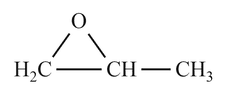
is
- 511 mark
Question 51
The IUPAC name of the following compound is
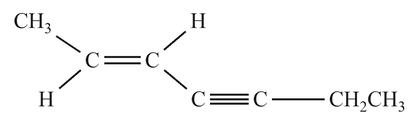
- 521 mark
Question 52
Dipole moment is shown by
- 531 mark
Question 53
How many cyclic structures are possible for ?
- 541 mark
Question 54
A solution of (–)-1-chloro-1-phenylethane in toluene racemises slowly in the presence of a small amount of , due to the formation of:
- 551 mark
Question 55
The order of stability of the following carbocations:
I: ; II: ; III:

is :
- 561 mark
Question 56
Which one of the following is most stable?

- 571 mark
Question 57
Given
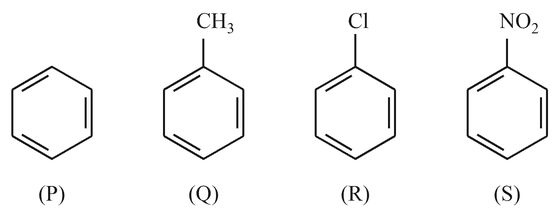
In the above compounds, correct order of reactivity in electrophilic substitution reactions will be:
- 581 mark
Question 58
In nucleophilic substitution reaction, order of halogens as incoming (attacking) nucleophile is:
The order of halogens as departing nucleophile should be:
- 591 mark
Question 59
In allene (), the type(s) of hybridization of the carbon atoms is (are):
- 601 mark
Question 60
For which of the following molecule significant ?
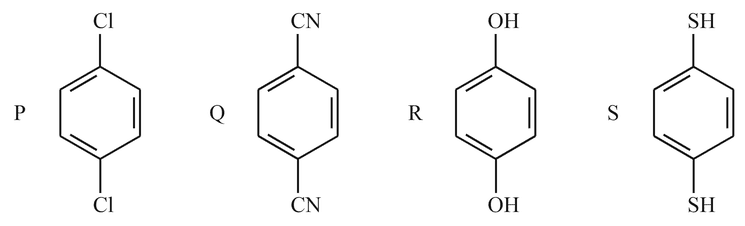
- 611 mark
Question 61
In which of the following pairs, X is more stable than Y?
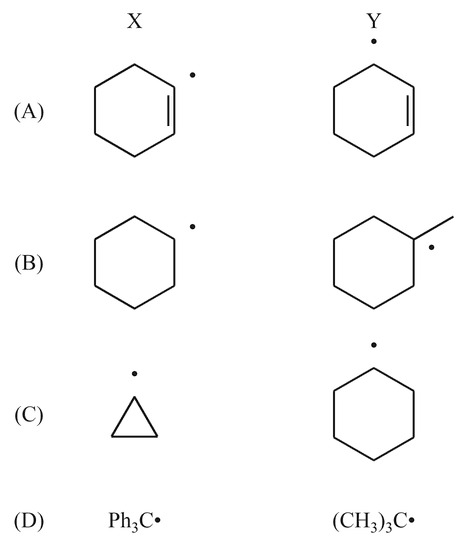
- 621 mark
Question 62
The number of structural isomers for is:
- 631 mark
Question 63
Which of the following pairs of compounds are positional isomers?
- 641 mark
Question 64
The hydrocarbon with seven carbon atoms containing a neopentyl and a vinyl group is:
- 651 mark
Question 65
The IUPAC name of the following compound is:
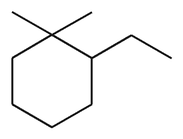
- 661 mark
Question 66
Which of the following statements is not true about partition chromatography?
- 671 mark
Question 67
The increasing order of the boiling points for the following compounds is:
(I), (II), (III), (IV)
- 681 mark
Question 68
The increasing order of basicity of the following compounds is
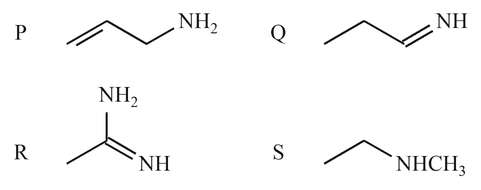
- 691 mark
Question 69
Which of the following molecules is least resonance stabilized?
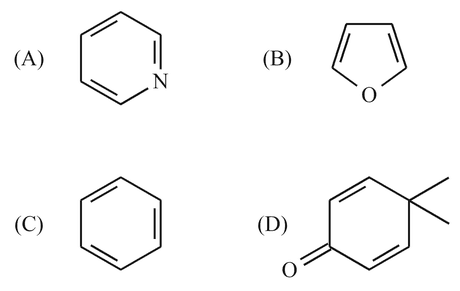
- 701 mark
Question 70
The IUPAC name of the following compound is:
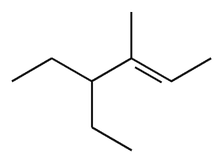
- 711 mark
Question 71
The most polar compound among the following is:
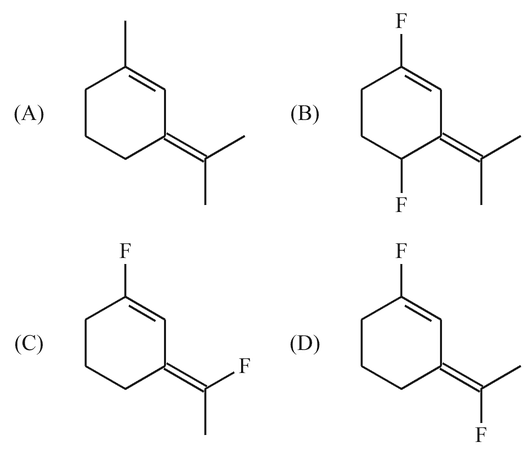
- 721 mark
Question 72
On the treatment of the following compound with a strong acid, the most susceptible site for bond cleavage is:
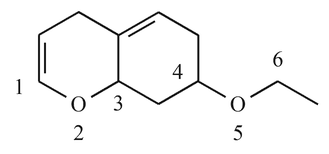
- 731 mark
Question 73
Two compounds I and II are eluted by column chromatography (adsorption of I > II). Which one of the following is a correct statement?
- 741 mark
Question 74
The IUPAC name for the following compound is:

- 751 mark
Question 75
The correct IUPAC name of the following compound is:
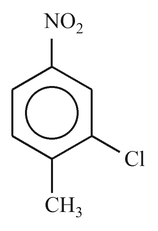
- 761 mark
Question 76
The IUPAC name of the following compound is:
- 771 mark
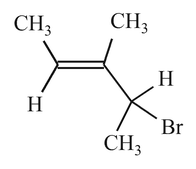
Question 77
What is the IUPAC name of the following compound?
- 781 mark
Question 78
The increasing order of nucleophilicity of the following nucleophiles is:
P:
Q:
R:
S:
- 791 mark
Question 79
The IUPAC name of the following compound is:
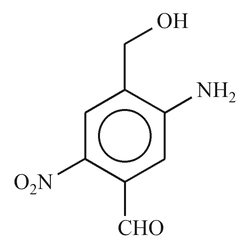
- 801 mark
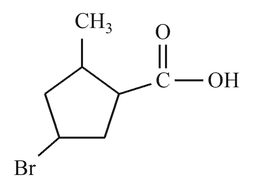
Question 80
The IUPAC name of the following compound is:
- 811 mark
Question 81
The IUPAC name for the following compound is:

- 821 mark
Question 82
Which one of the following compounds possesses the most acidic hydrogen?
- 831 mark
Question 83
Glycerol is separated in soap industries by:
- 841 mark
Question 84
The increasing order of basicity for the following intermediates is (from weak to strong)
(i) (ii) (iii) (iv) (v)
- 851 mark
Question 85
A flask contains a mixture of isohexane and 3-methylpentane. One of the liquids boils at 63 °C while the other boils at 60 °C. What is the best way to separate the two liquids and which one will be distilled out first?
- 861 mark
Question 86
The correct order of stability for the following alkoxides is:
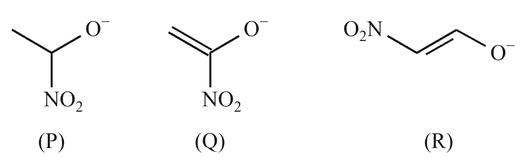
- 871 mark
Question 87
Choose the correct name for compound given below:

- 881 mark
Question 88
Mesityl oxide is a common name of
- 891 mark
Question 89
The number of acyclic structural isomers (including geometrical isomers) for pentene are ______.
- 901 mark
Question 90
Compound with molecular formula can show
- 911 mark
Question 91

The correct order of stability of given carbocation is:
- 921 mark
Question 92
Which purification technique is used for high boiling liquid compound (decomposes near its boiling point)?
- 931 mark
Question 93
Which of the following compounds does not exhibit resonance?
- 941 mark
Question 94

Among the given species, the resonance stabilised carbocations are:
- 951 mark
Question 95
In the following molecule,
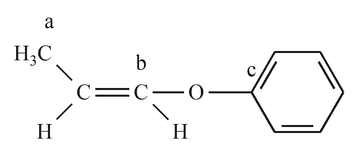
Hybridisation of carbon , and respectively are:
- 961 mark
Question 96
In chromatography technique, the purification of compound is independent of
- 971 mark
Question 97
Using the provided information in the following paper chromatogram:

Paper chromatography for compounds A and B. The calculated value of A ______ .
- 981 mark
Question 98
Match List-I with List-II.
List-I

List-II
(I) Spiro compound
(II) Aromatic compound
(III) Non-planar Heterocyclic compound
(IV) Bicyclo compound
Choose the correct answer from the options given below:
- 991 mark
Question 99
The correct decreasing order of priority of functional groups in naming an organic compound as per IUPAC system of nomenclature is:
- 1001 mark
Question 100
The correct IUPAC name of the following compound is:

- 1011 mark
Question 101
The IUPAC name of ethylidene chloride is:
- 1021 mark
Question 102
Total number of possible stereoisomers of dimethyl cyclopentane is ______.
- 1031 mark
Question 103
Given below are two statements : One is labelled as Assertion A and the other is labelled as Reason R.
Assertion A: Thin layer chromatography is an adsorption chromatography.
Reason R: A thin layer of silica gel is spread over a glass plate of suitable size in thin layer chromatography which acts as an adsorbent.
In the light of the above statements, choose the correct answer from the options given below:
- 1041 mark
Question 104
Match List-I with List-II
List-I (Mixture)
(P) Chloroform and Aniline
(Q) Benzoic acid and Naphthalene
(R) Water and Aniline
(S) Naphthalene and Sodium chloride
List-II (Purification Process)
(I) Steam distillation
(II) Sublimation
(III) Distillation
(IV) Crystallisation
- 1051 mark
Question 105
Which technique among the following, is most appropriate in separation of a mixture of 100 mg of p-nitrophenol and picric acid?
- 1061 mark
Question 106
The number of hybridised carbons in an acyclic neutral compound with molecular formula is ______.
- 1071 mark
Question 107
The separation of two coloured substances was done by paper chromatography. The distances travelled by solvent front, substance A and substance B from the base line are 3.25 cm, 2.08 cm and 1.05 cm respectively. The ratio of values of A to B is ______.
- 1081 mark
Question 108
TLC analysis of a mixture having 3 components (A, B, C) using silica gel as the stationary phase gave following values; for A = 0.72, B = 0.48, C = 0.20.
Regarding the above observations, which one of the following statements is not correct for column chromatography of the mixture?
- 1091 mark
Question 109
Which of the following carbocations is most stable:
- 1101 mark
Question 110
Which of the following is most stable?
- 1111 mark
Question 111
The correct order of nucleophilicity is
- 1121 mark
Question 112
Arrange the following carbocations in decreasing order of stability.
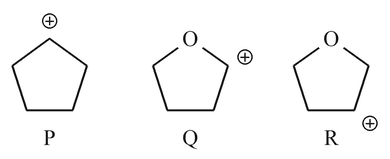
(a) P > R > Q
(b) P > Q > R
(c) R > Q > P
(d) R > P > Q
- 1131 mark
Question 113
Which of the following species is not electrophilic in nature?
- 1141 mark
Question 114
The correct IUPAC name of the compound
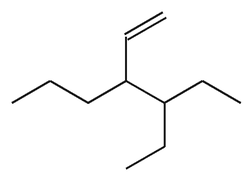
- 1151 mark
Question 115
The IUPAC name of the following compound is
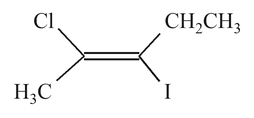
- 1161 mark
Question 116
The correct order of increasing bond length of C — H, C — O, C — C and C=C is:
- 1171 mark
Question 117
In Duma's method of estimation of nitrogen 0.35 g of an organic compound gave 55 mL of nitrogen collected at 300 K temperature and 715 mm pressure. The percentage composition of nitrogen in the compound would be : (Aqueous tension at 300 K = 15 mm)
- 1181 mark
Question 118
The Lassaigne's extract is boiled with conc. while testing for halogens. By doing so it
- 1191 mark
Question 119
Which nomenclature is not according to IUPAC system?
- 1201 mark
Question 120
Structure of the compound whose IUPAC name is 3-ethyl-2-hydroxy-4-methylhex-3-en-5-ynoic acid is:
- 1211 mark
Question 121
The structure of isobutyl group in an organic compound is:
- 1221 mark
Question 122
Arrange the following in increasing order of stability
(P) (Q) (R) (S) (T)
- 1231 mark
Question 123
Homolytic fission of the following alkanes forms free radicals , , , . Increasing order of stability of the radicals is
- 1241 mark
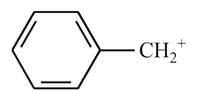
Question 124
What is the hybridisation state of benzyl carbonium ion
- 1251 mark
Question 125
Nitrogen detection in an organic compound is carried out by Lassaigne's test. The blue colour formed corresponds to which of the following formulae?
- 1261 mark
Question 126
In the Kjeldahl's method for estimation of nitrogen present in a soil sample, ammonia evolved from 0.75 g of sample neutralized 10 mL of 1 M . The percentage of nitrogen in the soil is:
- 1271 mark
Question 127
Given

Which of the given compounds can exhibit tautomerism?
- 1281 mark
Question 128
Which of the following statements is not correct for a nucleophile?
- 1291 mark
Question 129
Consider the following compounds
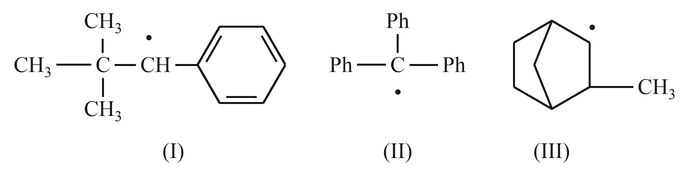
Hyperconjugation occurs in:
- 1301 mark
Question 130
Which of the following is the most correct electron displacement for a nucleophilic reaction to take place?
- 1311 mark
Question 131
In which of the following compounds, the C—Cl bond ionisation shall give most stable carbonium ion?
- 1321 mark
Question 132
In Duma's method for estimation of nitrogen 0.25 g of an organic compound gave 40 mL of nitrogen collected at 300 K temperature and 725 mm pressure. If the aqueous tension at 300 K is 25 mm, the percentage of nitrogen in compound is:
- 1331 mark
Question 133
In which of the following molecules, all atoms are coplanar?
- 1341 mark
Question 134
For the following reactions:
(1)
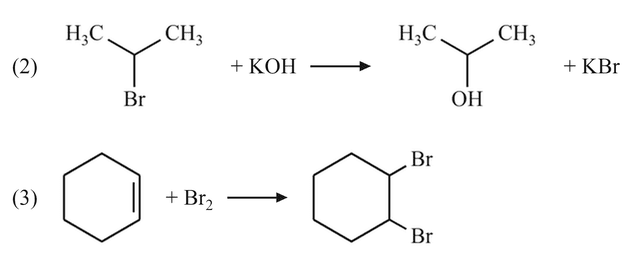
Which of the following statements is correct?
- 1351 mark
Question 135
The pair of electron in the given carbanion, , is present in which of the following orbitals?
- 1361 mark
Question 136
The IUPAC name of the compound is:
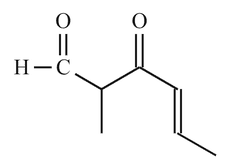
- 1371 mark
Question 137
The most suitable method of separation of 1 : 1 mixture of ortho and para-nitrophenols is:
- 1381 mark
Question 138
The correct statement regarding electrophile is:
- 1391 mark
Question 139
Which of the following carbocation is expected to be most stable?
- 1401 mark
Question 140
Which of the following is correct with respect to –I effect of the substituents? (R = alkyl)
(a)
(b)
(c)
(d)
- 1411 mark
Question 141
The most stable carbocation, among the following, is
- 1421 mark
Question 142
Among the following, the reaction that proceeds through an electrophilic substitution, is:
- 1431 mark
Question 143
A tertiary butyl carbocation is more stable than a secondary butyl carbocation because of which of the following?
- 1441 mark
Question 144
Which of the following is a free radical substitution reaction?
- 1451 mark
Question 145
Paper chromatography is an example of
- 1461 mark
Question 146
The correct structure of 2,6-dimethyl-dec-4-ene is
- 1471 mark
Question 147
The compound which shows metamerism is:
- 1481 mark
Question 148
The correct IUPAC name of the following compound is:
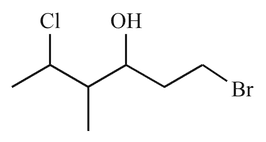
- 1491 mark
Question 149
The Kjeldahl's method for the estimation of nitrogen can be used to estimate the amount to nitrogen in which one of the following compounds?