
Opening your dashboard
Class 10 Maths Chapter 6: Solving (simple) Problems Solutions
88 textbook questions with step-by-step answers, free to read, for ICSE 2026-27.
Get talked through Ch 6, not just shown the answer
Reading a finished solution is not the same as being able to do it. The AI tutor takes one question at a time and works it with you, in your own words, until you can.
- Ask it out loud, in your own words
- It gives you the next step, not the answer
- Stuck on part (ii)? Start there
88 questions with solutions
1–3 marks · Mixed difficulty
The first 16 solutions are on this page. This chapter is a long one, so the rest open on their own page to keep this one quick to load.
- 11 mark
Question 1
The sum of two natural numbers is 5 and the sum of their reciprocals is , the numbers are :
Solve with AIAnswer
(A) 2 and 5
(B) 4 and 2
- Correct
(C) 2 and 3
(D) 3 and 4
Answer: (C) 2 and 3
Concept: Let one number be . The two numbers add up to 5, so the other is . The reciprocal of a number is ; adding the two reciprocals and clearing the fractions gives a quadratic equation in .
Step 1 — Name the numbers.
Let one number be . Since the two numbers add up to 5, the other number is .
Step 2 — Form the equation.
The sum of the reciprocals of the two numbers is .
Step 3 — Clear the fractions.
We multiply every term by , the L.C.M. of the denominators, and then open the brackets.
Every term is divisible by 5, so we divide by 5 to make the numbers smaller.
Step 4 — Solve the equation.
We split the middle term. We need two numbers whose product is 6 and whose sum is −5. They are −3 and −2, so we write −5x as −3x − 2x.
A product is zero only when one of its factors is zero, so we set each bracket equal to zero.
If , the other number is , which is 3. If , the other number is 2. Either way the two numbers are 2 and 3.
Check: 2 + 3 is 5, and the reciprocals add up to 5/6.
Watch out: Add fractions with the L.C.M. of the denominators. is not ; never add the denominators.
Why the other options are wrong:
- (A) 2 and 5: 2 + 5 is 7, not 5, so these numbers do not have the right sum.
- (B) 4 and 2: 4 + 2 is 6, not 5. Also 1/4 + 1/2 is 3/4, not 5/6.
- (D) 3 and 4: 3 + 4 is 7, not 5. Also 1/3 + 1/4 is 7/12, not 5/6.
Therefore, the numbers are 2 and 3, option (C).
- 21 mark
Question 2
The product of two consecutive even whole numbers is 24, the numbers are :
Solve with AIAnswer
(A) −8 and −3
(B) 3 and 8
(C) −4 and −6
- Correct
(D) 4 and 6
Answer: (D) 4 and 6
Concept: Consecutive even numbers differ by 2, so we call them and . Whole numbers are 0, 1, 2, 3, …, so a negative root must be rejected.
Step 1 — Name the numbers.
Let the smaller even number be . The next even number is 2 more than , so we write it as .
Step 2 — Form the equation.
The product of the two numbers is 24. We open the bracket and bring every term to the left side.
Step 3 — Solve the equation.
We split the middle term. We need two numbers whose product is −24 and whose sum is 2. They are 6 and −4, so we write 2x as 6x − 4x.
A product is zero only when one of its factors is zero, so we set each bracket equal to zero.
Whole numbers cannot be negative, so we reject and keep . The numbers are 4 and , that is, 4 and 6.
Check: 4 and 6 are consecutive even whole numbers, and their product is 24.
Watch out: −6 and −4 also have product 24 and are consecutive even integers, but negative numbers are not whole numbers.
Why the other options are wrong:
- (A) −8 and −3: −8 and −3 are negative, so they are not whole numbers, and −3 is not even.
- (B) 3 and 8: 3 × 8 is 24, but 3 is odd, and 3 and 8 are not consecutive even numbers.
- (C) −4 and −6: their product is 24 and they are consecutive even integers, but negative numbers are not whole numbers.
Therefore, the numbers are 4 and 6, option (D).
- 31 mark
Question 3
The sum of the squares of two consecutive integers is 41. The integers are :
Solve with AIAnswer
(A) 4 and −5 or −4 and 5
- Correct
(B) 4 and 5 or −4 and −5
(C) 3 and 4 or −4 and −3
(D) 6 and 3 or −6 and −3
Answer: (B) 4 and 5 or −4 and −5
Concept: Consecutive integers differ by 1, so we call them and . Integers may be negative, so both roots of the equation can give an answer.
Step 1 — Name the integers.
Let the smaller integer be . The next integer is .
Step 2 — Form the equation.
The sum of their squares is 41. We expand and collect the terms.
Every term is divisible by 2, so we divide by 2 to make the numbers smaller.
Step 3 — Solve the equation.
We split the middle term. We need two numbers whose product is −20 and whose sum is 1. They are 5 and −4, so we write x as 5x − 4x.
A product is zero only when one of its factors is zero, so we set each bracket equal to zero.
Both roots are integers, so both are allowed. If , the integers are 4 and 5. If , they are −5 and −4.
Check: Both pairs give 41.
Watch out: Integers include negative numbers. Do not reject the root ; it gives the second pair, −5 and −4.
Why the other options are wrong:
- (A) 4 and −5 or −4 and 5: 4 and −5 are 9 apart, so they are not consecutive, even though 16 + 25 is 41.
- (C) 3 and 4 or −4 and −3: 3² + 4² is only 25, not 41.
- (D) 6 and 3 or −6 and −3: 6 and 3 are not consecutive, and 6² + 3² is 45, not 41.
Therefore, the integers are 4 and 5 or −4 and −5, option (B).
- 41 mark
Question 4
The sum of a number and its reciprocal is 5·2. The number is :
Solve with AIAnswer
- Correct
(A) 5 or
(B) 2 or
(C) 4 or
(D) −2 or
Answer: (A) 5 or
Concept: Let the number be ; its reciprocal is . Multiplying by clears the fraction and gives a quadratic equation. Writing the decimal 5·2 as a fraction keeps the numbers whole.
Step 1 — Write the decimal as a fraction.
The book's 5·2 is the decimal 5.2. We write it as a fraction in its lowest terms.
Step 2 — Form the equation.
The number plus its reciprocal is .
Step 3 — Clear the fractions.
We multiply every term by and bring every term to the left side.
Step 4 — Solve the equation.
We split the middle term. We need two numbers whose product is 5 × 5, that is 25, and whose sum is −26. They are −25 and −1, so we write −26x as −25x − x.
A product is zero only when one of its factors is zero, so we set each bracket equal to zero.
Both roots work: 5 and are reciprocals of each other, so either one can be the number.
Check: 5 plus its reciprocal is 5.2.
Watch out: 5·2 is the decimal 5.2 (the book writes the decimal point as a raised dot), not 5 × 2.
Why the other options are wrong:
- (B) 2 or : 2 + 1/2 is 2.5, not 5.2.
- (C) 4 or : 4 + 1/4 is 4.25, not 5.2.
- (D) −2 or : −2 + (−1/2) is −2.5, a negative sum, not 5.2.
Therefore, the number is 5 or 1/5, option (A).
- 51 mark
Question 5
Two integers differ by 2 and sum of their squares is 52. The integers are :
Solve with AIAnswer
(A) 4 and 6
(B) 4 or 6
(C) −4 or 6
- Correct
(D) −4 and −6 or 6 and 4
Answer: (D) −4 and −6 or 6 and 4
Concept: Let the smaller integer be ; the other is . Integers may be negative, so both roots of the equation can give a pair.
Step 1 — Name the integers.
Let the smaller integer be . The integers differ by 2, so the other is .
Step 2 — Form the equation.
The sum of their squares is 52. We expand and collect the terms.
Every term is divisible by 2, so we divide by 2 to make the numbers smaller.
Step 3 — Solve the equation.
We split the middle term. We need two numbers whose product is −24 and whose sum is 2. They are 6 and −4, so we write 2x as 6x − 4x.
A product is zero only when one of its factors is zero, so we set each bracket equal to zero.
Both roots are integers, so both give an answer. If , the integers are 4 and 6. If , they are −6 and −4.
Check: Both pairs give 52.
Watch out: Integers can be negative. Keep the root ; it gives the second pair.
Why the other options are wrong:
- (A) 4 and 6: this pair is correct, but it is only half the answer: −6 and −4 also differ by 2 and their squares add up to 52.
- (B) 4 or 6: an answer must name a pair of integers; “4 or 6” gives single numbers, not a pair.
- (C) −4 or 6: these are single numbers, not a pair, and −4 and 6 differ by 10, not 2.
Therefore, the integers are −4 and −6 or 6 and 4, option (D).
- 63 marks
Question 6
Divide 15 into two parts such that the sum of their reciprocals is .
Solve with AIWritten solution
Solution:
Concept: When a number is divided into two parts, call one part ; the other part is then the number minus . The condition on the reciprocals gives an equation with fractions, which becomes a quadratic equation once the fractions are cleared.
Given: The two parts add up to 15; the sum of their reciprocals is .
Step 1 — Name the parts.
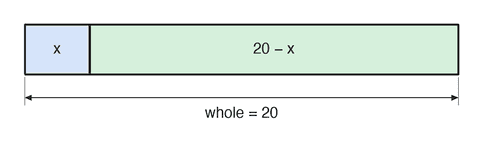
Let one part be . The two parts together make 15, so the other part is . The figure shows the whole 15 split into these two parts.

Step 2 — Form the equation.
The reciprocal of is , and the reciprocal of is . Their sum is .
Step 3 — Clear the fractions.
We multiply every term by , the L.C.M. of the denominators, open the brackets and bring every term to one side.
Every term is divisible by 3, so we divide by 3 to make the numbers smaller.
Step 4 — Solve the equation.
We split the middle term. We need two numbers whose product is 50 and whose sum is −15. They are −10 and −5, so we write −15x as −10x − 5x.
A product is zero only when one of its factors is zero, so we set each bracket equal to zero.
Both roots are positive and less than 15, so both are allowed. If , the other part is , which is 10. If , the other part is 5. Either way the parts are 5 and 10.
Check: The parts add up to 15, and their reciprocals add up to 3/10.
Watch out: The two roots do not give two different answers. Both lead to the same pair of parts, 5 and 10.
Therefore, the two parts are 5 and 10.
- 73 marks
Question 7
The sum of the squares of two positive integers is 208. If the square of the larger number is 18 times the smaller number, find the numbers.
Solve with AIWritten solution
Solution:
Concept: When one condition gives the square of one number in terms of the other, substitute it into the other condition. This gives a quadratic equation in one unknown.
Given: The sum of the squares of two positive integers is 208; the square of the larger number is 18 times the smaller number.
Step 1 — Name the numbers.
Let the smaller number be and the larger number be . The second condition says that the square of the larger number is 18 times the smaller number.
Step 2 — Form the equation.
The sum of the squares is 208. We replace by and bring every term to the left side.
Step 3 — Solve the equation.
We split the middle term. We need two numbers whose product is −208 and whose sum is 18. They are 26 and −8, so we write 18x as 26x − 8x.
A product is zero only when one of its factors is zero, so we set each bracket equal to zero.
The numbers are positive integers, so we reject and keep .
Step 4 — Find the larger number.
We put 8 in place of in and take the positive square root, because the numbers are positive.
Check: Both conditions hold for 8 and 12.
Watch out: 144 is the square of the larger number, not the larger number itself. Take its square root.
Therefore, the numbers are 8 and 12.
- 83 marks
Question 8
Find two consecutive positive odd numbers, the sum of whose squares is 74.
Solve with AIWritten solution
Solution:
Concept: Consecutive odd numbers differ by 2 (for example 5 and 7), so we call them and . Their squares give a quadratic equation in .
Given: Two consecutive positive odd numbers; the sum of their squares is 74.
Step 1 — Name the numbers.
Let the smaller odd number be . The next odd number is 2 more than , so we write it as .
Step 2 — Form the equation.
The sum of their squares is 74. We expand and collect the terms.
Every term is divisible by 2, so we divide by 2 to make the numbers smaller.
Step 3 — Solve the equation.
We split the middle term. We need two numbers whose product is −35 and whose sum is 2. They are 7 and −5, so we write 2x as 7x − 5x.
A product is zero only when one of its factors is zero, so we set each bracket equal to zero.
The numbers must be positive, so we reject and keep . The numbers are 5 and , that is, 5 and 7.
Check: 5 and 7 are consecutive odd numbers, and their squares add up to 74.
Watch out: Consecutive odd numbers differ by 2, not 1. Writing x and x + 1 would make one of them even.
Therefore, the two consecutive positive odd numbers are 5 and 7.
- 93 marks
Question 9
Divide 20 into two parts such that three times the square of one part exceeds the other part by 10.
Solve with AIWritten solution
Solution:
Concept: Let one part be ; the other part is . “A exceeds B by 10” means .
Given: 20 is divided into two parts; three times the square of one part is 10 more than the other part.
Step 1 — Name the parts.
Let the part that is squared be . The two parts make 20, so the other part is .
Step 2 — Form the equation.
Three times the square of , minus the other part, equals 10. The minus sign in front of the bracket changes the sign of each term inside.
Step 3 — Solve the equation.
We split the middle term. We need two numbers whose product is 3 × (−30), that is −90, and whose sum is 1. They are 10 and −9, so we write x as 10x − 9x.
A product is zero only when one of its factors is zero, so we set each bracket equal to zero.
A part of 20 cannot be negative, so we reject and keep . The other part is , which is 17.
Check: Three times the square of 3 is 27, and 27 is 10 more than 17.
Watch out: It does not matter which part we call . If the squared part is called instead, the equation has the root 17, which gives the same two parts.
Therefore, the two parts are 3 and 17.
- 103 marks
Question 10
Three consecutive natural numbers are such that the square of the middle number exceeds the difference of the squares of the other two by 60. Assume the middle number to be and form a quadratic equation satisfying the above statement. Hence; find the three numbers.
Solve with AIWritten solution
Solution:
Concept: Three consecutive natural numbers can be written , and , with the middle one. The difference of the squares of the other two is (larger)² − (smaller)², and “exceeds … by 60” means we subtract and set the result equal to 60.
Given: Three consecutive natural numbers; (middle number)² is 60 more than the difference of the squares of the other two.
Step 1 — Name the numbers.
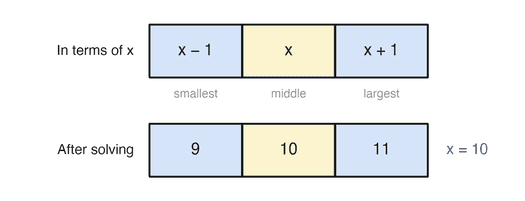
As the question says, let the middle number be . The numbers are then , and .
Step 2 — Find the difference of the squares of the other two.
We expand with and , then subtract.
Step 3 — Form the quadratic equation.
The square of the middle number exceeds this difference by 60.
This is the required quadratic equation.
Step 4 — Solve the equation.
We split the middle term. We need two numbers whose product is −60 and whose sum is −4. They are −10 and 6, so we write −4x as −10x + 6x.
A product is zero only when one of its factors is zero, so we set each bracket equal to zero.
Natural numbers are positive, so we reject and keep . The three numbers are , and , that is, 9, 10 and 11.
Check: The difference of the squares of 11 and 9 is 40, and 10² exceeds 40 by 60.
Watch out: The difference of the squares of the other two is the larger square minus the smaller square, . Taking it the other way round gives and a different equation.
Therefore, the quadratic equation is , and the three numbers are 9, 10 and 11.
- 113 marks
Question 11
Out of three consecutive positive integers, the middle number is . If three times the square of the largest is greater than the sum of the squares of the other two numbers by 67; calculate the value of .
Solve with AIWritten solution
Solution:
Concept: Three consecutive positive integers with middle number are , and ; the largest is . “Greater than … by 67” means we subtract and set the result equal to 67.
Given: Three consecutive positive integers with middle number ; three times the square of the largest is 67 more than the sum of the squares of the other two.
Step 1 — Name the numbers.
The middle number is , so the numbers are , and .

Step 2 — Expand the two sides.
First we write three times the square of the largest number without brackets.
Next we add the squares of the other two numbers.
Step 3 — Form the equation.
The first expression is 67 more than the second. The minus sign in front of the bracket changes the sign of each term inside.
Step 4 — Solve the equation.
We split the middle term. We need two numbers whose product is −65 and whose sum is 8. They are 13 and −5, so we write 8p as 13p − 5p.
A product is zero only when one of its factors is zero, so we set each bracket equal to zero.
The integers are positive, so we reject and keep . The numbers are 4, 5 and 6.
Check: 3 × 6² is 108, the other two squares add up to 41, and 108 is 67 more than 41.
Watch out: The minus sign in front of the bracket changes the sign of every term inside: is .
Therefore, the value of is 5 (the three integers are 4, 5 and 6).
- 123 marks
Question 12
A positive number is divided into two parts such that the sum of the squares of the two parts is 20. The square of the larger part is 8 times the smaller part. Taking as the smaller part of the two parts, find the sum of both the parts.
Solve with AIWritten solution
Solution:
Concept: When one condition gives the square of one part in terms of the other, substitute it into the other condition. This gives a quadratic equation in one unknown.
Given: A positive number is divided into two parts; the sum of their squares is 20; the square of the larger part is 8 times the smaller part.
Step 1 — Name the parts.
As the question says, let the smaller part be , and let the larger part be . The square of the larger part is 8 times the smaller part.
Step 2 — Form the equation.
The sum of the squares is 20. We replace by and bring every term to the left side.
Step 3 — Solve the equation.
We split the middle term. We need two numbers whose product is −20 and whose sum is 8. They are 10 and −2, so we write 8x as 10x − 2x.
A product is zero only when one of its factors is zero, so we set each bracket equal to zero.
A part of a positive number cannot be negative, so we reject and keep .
Step 4 — Find the larger part.
We put 2 in place of in and take the positive square root.
Step 5 — Find the sum of the parts.
The sum of the two parts is the number that was divided.
Check: The squares of 2 and 4 add up to 20, and 4² is 8 times 2.
Watch out: The question asks for the sum of both the parts (the original number), not just the smaller part.
Therefore, the smaller part is 2, the larger part is 4, and the sum of both the parts is 6.
- 133 marks
Question 13
The difference between two natural numbers is 5 and the difference of their reciprocals is . Find the numbers.
Solve with AIWritten solution
Solution:
Concept: Let the smaller number be ; the larger is . The smaller number has the bigger reciprocal, so the difference of the reciprocals is .
Given: Two natural numbers differ by 5; the difference of their reciprocals is .
Step 1 — Name the numbers.
Let the smaller number be . The numbers differ by 5, so the larger number is .
Step 2 — Form the equation.
The reciprocal of the smaller number minus the reciprocal of the larger number is .
Step 3 — Clear the fractions.
We multiply every term by , the L.C.M. of the denominators, and simplify.
Step 4 — Solve the equation.
We split the middle term. We need two numbers whose product is −50 and whose sum is 5. They are 10 and −5, so we write 5x as 10x − 5x.
A product is zero only when one of its factors is zero, so we set each bracket equal to zero.
Natural numbers are positive, so we reject and keep . The larger number is , which is 10.
Check: 10 − 5 is 5, and the reciprocals differ by 1/10.
Watch out: The smaller number has the larger reciprocal, so subtract from . The other order gives a negative difference.
Therefore, the numbers are 5 and 10.
- 143 marks
Question 14
The sum of the squares of two consecutive odd natural numbers is 514. Find the numbers.
Solve with AIWritten solution
Solution:
Concept: Consecutive odd numbers differ by 2 (for example 15 and 17), so we call them and . Their squares give a quadratic equation in .
Given: Two consecutive odd natural numbers; the sum of their squares is 514.
Step 1 — Name the numbers.
Let the smaller odd number be . The next odd number is .
Step 2 — Form the equation.
The sum of their squares is 514. We expand and collect the terms.
Every term is divisible by 2, so we divide by 2 to make the numbers smaller.
Step 3 — Solve the equation.
We split the middle term. We need two numbers whose product is −255 and whose sum is 2. They are 17 and −15, so we write 2x as 17x − 15x.
A product is zero only when one of its factors is zero, so we set each bracket equal to zero.
Natural numbers are positive, so we reject and keep . The numbers are 15 and , that is, 15 and 17.
Check: 15 and 17 are consecutive odd numbers, and their squares add up to 514.
Watch out: Consecutive odd numbers differ by 2, not 1. Writing x and x + 1 would make one of them even.
Therefore, the numbers are 15 and 17.
- 153 marks
Question 15
The sum of the squares of two consecutive multiples of 7 is 637. Taking the bigger number a positive number, find the smaller of these two numbers.
Solve with AIWritten solution
Solution:
Concept: Consecutive multiples of 7 differ by 7 (for example 14 and 21). The question takes the bigger number as , so the smaller one is .
Given: The sum of the squares of two consecutive multiples of 7 is 637; the bigger number is positive.
Step 1 — Name the numbers.
As the question says, let the bigger number be . The smaller multiple of 7 is .
Step 2 — Form the equation.
The sum of their squares is 637. We expand and collect the terms.
Every term is divisible by 2, so we divide by 2 to make the numbers smaller.
Step 3 — Solve the equation.
We split the middle term. We need two numbers whose product is −294 and whose sum is −7. They are −21 and 14, so we write −7x as −21x + 14x.
A product is zero only when one of its factors is zero, so we set each bracket equal to zero.
The question says is positive, so we reject and keep . The smaller number is , which is 14.
Check: 14 and 21 are consecutive multiples of 7, and their squares add up to 637.
Watch out: Consecutive multiples of 7 differ by 7, not by 1.
Therefore, the smaller number is 14 (the two numbers are 14 and 21).
- 163 marks
Question 16
Two positive numbers differ by 5. Three times the square of the larger number exceeds twice the square of smaller number by 270, find the larger of these two numbers.
Solve with AIWritten solution
Solution:
Concept: Let the larger number be ; the smaller is . “A exceeds B by 270” means . When a quadratic equation does not factorise, we use the quadratic formula .
Given: Two positive numbers differ by 5; three times the square of the larger is 270 more than twice the square of the smaller.
Step 1 — Name the numbers.
Let the larger number be . The numbers differ by 5, so the smaller number is .
Step 2 — Form the equation.
Three times the square of the larger, minus twice the square of the smaller, is 270. We expand , open the bracket and collect the terms.
Step 3 — Decide how to solve it.
To factorise we would need two whole numbers with product −320 and sum 20. No such pair exists (for example 32 and −10 give 22, and 16 and −20 give −4), so we use the quadratic formula. Comparing with , we have , and .
Step 4 — Find the discriminant.
The number under the square root is .
Since , we can take 16 out of the square root as 4.
Step 5 — Use the formula.
We put the values into the formula and divide each term of the numerator by 2.
Step 6 — Choose the root that fits.
The root is negative, so it is rejected. Taking :
The smaller number is then about , which is about 5.49; both numbers are positive.
Check: Adding 10 to the root gives , whose square is 420, so satisfies .
Watch out: “exceeds twice the square of the smaller” means , not . Only the bracket is squared.
Note: The printed numbers give an irrational answer, which is unusual for this exercise. If the two numbers differed by 3 instead of 5, the larger number would be the whole number 12, since .
Therefore, the larger number is , which is about 10.49.
- 171 mark
Question 17
The sum of the numerator and the denominator is 8 and their product is 15. Then the fraction is :
- 181 mark
Question 18
The sum of the digits of a two digit number is 9 and the product of the digits is 20. If the unit digit is greater than the tens digit, the number is :
- 191 mark
Question 19
Two whole numbers are in the ratio 3 : 2. If the sum of their squares is 52; the numbers are:
- 201 mark
Question 20
A two digit number is 5 times the sum of its digits. The number is :
- 211 mark
Question 21
Three positive numbers are in the ratio 4 : 3 : 2. If the difference between the squares of the largest and the smallest numbers is 48, the numbers are :
- 223 marks
Question 22
The numerator of a fraction is 3 less than its denominator. If one is added to the denominator, the fraction is decreased by . Find the fraction.
- 233 marks
Question 23
The denominator of a fraction is 3 more than its numerator. The sum of the fraction and its reciprocal is . Find the fraction.
- 243 marks
Question 24
The product of the digits of a two digit number is 24. If its unit's digit exceeds twice its ten's digit by 2; find the number.
- 253 marks
Question 25
A two-digit number is such that the product of its digits is 18. When 63 is subtracted from the number, the digits are reversed. Find the number.
- 263 marks
Question 26
The ratio between two positive numbers is . If the sum of the squares of the numbers is 666, find the numbers.
- 273 marks
Question 27
The ratio between three positive numbers is . When the square of the middle number is subtracted from the sum of the squares of the other, the result is 725. Find the numbers.
- 283 marks
Question 28
The numerator of a fraction is 3 less than its denominator. If 2 is added to both the numerator and the denominator, the sum of the new fraction and the original fraction is . Find the new fraction.
- 293 marks
Question 29
A two digit number is 4 times the sum of its digits and twice the product of its digits. Find the number.
- 303 marks
Question 30
27 is divided into two parts such that the sum of their reciprocals is . Find the ratio between the numbers.
- 311 mark
Question 31
A and B together can do a piece of work in 6 days. Whereas A alone can do the same work in 9 days. Then B alone will do same work in:
- 321 mark
Question 32
A can do a piece of work in 5 days and B can do the same work in days. The total number of days taken by A and B, working together, is . The value of is:
- 331 mark
Question 33
An article is bought for ₹ and is sold at the profit of . If its selling price is ₹ 56, the cost price is :
- 341 mark
Question 34
An empty tank is filled by a pipe in 2 hours, whereas an another pipe empties the full tank in 3 hours. If the tank is empty and both the pipes are opened together the tank will be filled in :
- 353 marks
Question 35
A can do a piece of work in '' days and B can do the same work in days. If both working together can do it in 15 days; calculate ''.
- 363 marks
Question 36
One pipe can fill a cistern in 3 hours less than the other. The two pipes together can fill the cistern in 6 hours 40 minutes. Find the time that each pipe will take to fill the cistern.
- 373 marks
Question 37
A trader bought an article for ₹ and sold it for ₹ 52, thereby making a profit of percent on his outlay. Calculate the cost price.
- 383 marks
Question 38
The C.P. of an article is ₹ which is sold for ₹ 27 at a loss of percent; find the value of .
- 393 marks
Question 39
The C.P. of an article is ₹ which is sold for ₹ 152 at a profit of . Find the value of .
- 403 marks
Question 40
Two pipes running together can fill an empty cistern in min. If one pipe takes 5 minutes more than the other takes to fill the empty cistern. Find the time in which each pipe would fill the cistern.
- 413 marks
Question 41
In order to fill an empty swimming pool completely, a pipe of larger diameter alone takes 10 hours less than the time taken by the pipe of smaller diameter alone. If the pipe of larger diameter is used for 4 hours and the pipe of smaller diameter is used for 9 hours, half of the pool is filled. In how many hours will the pipe of larger diameter alone fill the pool.
- 421 mark
Question 42
Two years ago the ages of Radha and Meena were in the ratio 5 : 2. If the sum of their present ages is 39 years, their ages, 2 years ago, were :
- 431 mark
Question 43
The perimeter of a rectangular field is 28 m and its area is 40 sq. m. Its sides are :
- 441 mark
Question 44
The perimeter of a square is numerically equal to its area. The perimeter of the square is :
- 451 mark
Question 45
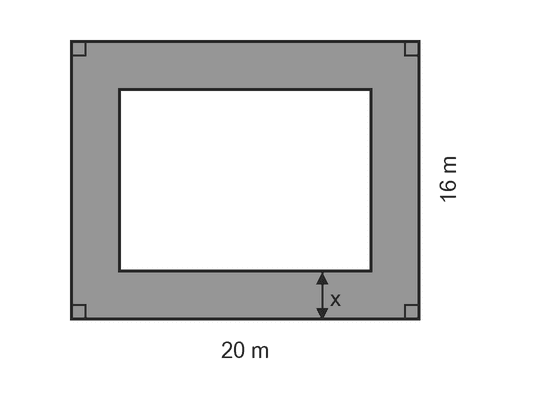
If the width of the uniform shaded portion is m; its area in terms of is :
- 461 mark
Question 46
The speed of a boat in still water is 32 km/h. If the speed of stream is 8 km/h, the speed of boat upstream is :
- 471 mark
Question 47
The speed of train A is km/h and speed of train B is km/h. How much time will each train take to cover 400 km ?
- 483 marks
Question 48
A boy is twice as old as her sister. Four year hence, the product of their ages (in years) will be 160. Find their present ages.
- 493 marks
Question 49
Seven years ago Rohit's age was five times the square of Geeta's age. 3 years hence, Geeta's age will be two fifths of Rohit's age. Find their ages.
- 503 marks
Question 50
The sum of the reciprocals of Joseph's age 3 years ago and five years from now is . Find his present age.
- 513 marks
Question 51
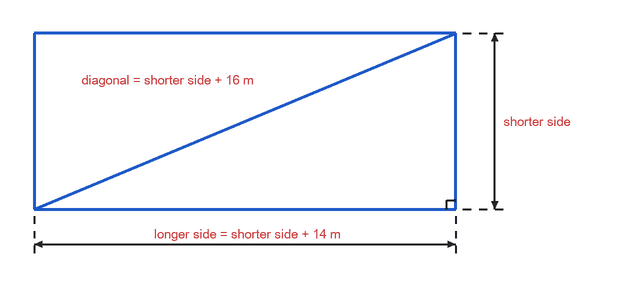
The diagonal of a rectangular field is 16 m more than the shorter side. If the longer side is 14 m more than the shorter side, find the length and the breadth of the rectangular field.
- 523 marks
Question 52
Sum of the areas of two squares is 260 m. If the difference of their perimeters is 24 m, find the sides of the two squares.
- 533 marks
Question 53
A man walks 1 km/hr faster than his usual speed and covers a distance of 3 km in 15 minutes less time. Find his usual speed.
- 543 marks
Question 54
A bus travels at a certain speed for a distance of 75 km and then travels a distance of 90 km at a speed of 10 km/hr more than the first speed. If it takes 3 hours to complete the journey, find the original speed.
- 553 marks
Question 55
The speed of an ordinary train is km per hr and that of an express train is km per hr.
(i) Find the time taken by each train to cover 300 km.
(ii) If the ordinary train takes 2 hrs more than the express train; calculate the speed of the express train.
- 563 marks
Question 56
A goods train leaves a station at 6 p.m., followed by an express train which leaves at 8 p.m. and travels 20 km/hour faster than the goods train. The express train arrives at a station, 1040 km away, 36 minutes before the goods train. Assuming that the speeds of both the trains remain constant between the two stations; calculate their speeds.
- 571 mark
Question 57
The product of two whole numbers, each greater than 4, is 35; the numbers are :
- 581 mark
Question 58
The difference between the digits of a two-digit number is 2 and the product of digits is 24. If tens digit is bigger, the number is:
- 591 mark
Question 59
If 18 is added to a two-digit number, its digits are reversed. If the product of the digits of the number is 24, the number is :
- 601 mark
Question 60
Three years hence, the ages of Radha and Meena will be in the ratio 5 : 2. If the sum of their present ages is 62 years, their ages, 2 years ago, were :
- 611 mark
Question 61
₹ 320 were divided equally among 8 children. If 2 more children join them, each will get, how many rupees more or less?
- 623 marks
Question 62
The product of the digits of a two digit number is 24. If its unit's digit exceeds twice its ten's digit by 2; find the number.
- 633 marks
Question 63
The ages of two sisters are 11 years and 14 years. In how many years time will the product of their ages be 304 ?
- 643 marks
Question 64
One year ago, a man was 8 times as old as his son. Now his age is equal to the square of his son's age. Find their present ages.
- 653 marks
Question 65
The age of a father is twice the square of the age of his son. Eight years hence, the age of the father will be 4 years more than three times the age of the son. Find their present ages.
- 663 marks
Question 66
Mr. Mehra sends his servant to the market to buy oranges worth ₹ 15. The servant having eaten three oranges on the way, Mr. Mehra pays 25 paise per orange more than the market price. Taking to be the number of oranges which Mr. Mehra receives, form a quadratic equation in . Hence, find the value of .
- 673 marks
Question 67
₹ 250 is divided equally among a certain number of children. If there were 25 children more, each would have received 50 paise less. Find the number of children.
- 683 marks
Question 68
An employer finds that if he increases the weekly wages of each worker by ₹ 5 and employs five workers less, he increases his weekly wage bill from ₹ 3,150 to ₹ 3,250. Taking the original weekly wage of each worker as ₹ ; obtain an equation in and then solve it to find the weekly wages of each worker.
- 693 marks
Question 69
A trader bought a number of articles for ₹ 1,200. Ten were damaged and he sold each of the remaining articles at ₹ 2 more than what he paid for it, thus getting a profit of ₹ 60 on the whole transaction ? Taking the number of articles he bought as , form an equation in and solve it.
- 703 marks
Question 70
The total cost price of a certain number of identical articles is ₹ 4,800. By selling the articles at ₹ 100 each, a profit equal to the cost price of 15 articles is made. Find the number of articles bought.
- 711 mark
Question 71
The sum of a number and its reciprocal is 4·25; the number is :
- 721 mark
Question 72
The sum of two whole numbers is 18 and their product is 45, the numbers are :
- 731 mark
Question 73
The length of a rectangle is 3m more than its width. If its area is 180 m; the length of the rectangle is :
- 741 mark
Question 74
The speed of a boat in still water is 15 km/h and speed of stream is 5 km/h. The boat goes km downstream and then returns back to the point of start in :
- 751 mark
Question 75
One pipe can fill an empty cistern in 3 hrs less than the another pipe. When both the pipes are opened together, the empty cistern is filled in 2 hrs. The second pipe will fill the empty cistern in :
- 761 mark
Question 76
The sum of the ages of Rohan and his father is 35 years, whereas the product of their ages is 150.
Assertion (A) : Rohan's age is 5 years.
Reason (R) : If Rohan's age is years then
- 771 mark
Question 77
The speed of a boat downstream is 20 km/h and upstream is 16 km/h.
Assertion (A) : The speed of boat in still water km/h.
Reason (R) : If speed of boat in still water is km/h and speed of stream is km/h, the speed downstream km/h and speed upstream km/h
- 781 mark
Question 78
Two consecutive natural numbers each of which is a multiple of 3 and with their product = 108.
Statement (1) : The required natural numbers are 9 and 12.
Statement (2) : If two natural numbers are and ; .
- 791 mark
Question 79
The selling price of an article is ₹ 24. If cost price is ₹ and loss is .
Statement (1) : of ₹ 24.
Statement (2) : of .
- 803 marks
Question 80
The distance by road between two towns A and B is 216 km, and by rail it is 208 km. A car travels at a speed of km/hr and the train travels at a speed which is 16 km/hr faster than the car. Calculate :
(i) the time taken by the car to reach town B from A, in terms of ;
(ii) the time taken by the train, to reach town B from A, in terms of .
(iii) If the train takes 2 hours less than the car, to reach town B, obtain an equation in , and solve it.
(iv) Hence, find the speed of the train.
- 813 marks
Question 81
A trader buys articles for a total cost of ₹ 600.
(i) Write down the cost of one article in terms of .
If the cost per article were ₹ 5 more, the number of articles that can be bought for ₹ 600 would be four less.
(ii) Write down the equation in for the above situation and solve it for .
- 823 marks
Question 82
A hotel bill for a number of people for overnight stay is ₹ 4,800. If there were 4 people more, the bill each person had to pay, would have reduced by ₹ 200. Find the number of people staying overnight.
- 833 marks
Question 83
An aeroplane travelled a distance of 400 km at an average speed of km/hr. On the return journey, the speed was increased by 40 km/hr. Write down an expression for the time taken for:
(i) the onward journey; (ii) the return journey.
If the return journey took 30 minutes less than the onward journey, write down an equation in and find its value.
- 843 marks
Question 84
A plane left 30 minutes later than the scheduled time and in order to reach its destination 1500 km away in time, it has to increase its speed by 250 km/hr from its usual speed. Find its usual speed.
- 853 marks
Question 85
In an auditorium, seats were arranged in rows and columns. The number of rows was equal to the number of seats in each row. When the number of rows was doubled and the number of seats in each row was reduced by 10, the total number of seats increased by 300. Find :
(i) the number of rows in the original arrangement.
(ii) the number of seats in the auditorium after re-arrangement.
- 863 marks
Question 86
In a certain positive fraction, the denominator is greater than the numerator by 3. If 1 is subtracted from the numerator and the denominator both, the fraction reduces by . Find the fraction.
- 873 marks
Question 87
In a two digit number, the ten's digit is bigger. The product of the digits is 27 and the difference between the two digits is 6. Find the number.
- 883 marks
Question 88
₹ 480 is divided equally among '' children. If the number of children were 20 more then each would have got ₹ 12 less. Find ''.
What Class 10 Maths Ch 6 covers
The sections of the chapter, in the order the book takes them. Every question above comes from one of these.
- 01Problems Based on Numbers and Two Digit Numbers
- 02Problems Based on Fractions
- 03Problems Based on Ratio
- 04Problems Based on Time and Work, Pipes and Cistern
- 05Problems Based on S.P. and C.P.
- 06Problems Based on Ages
More ways to study this chapter
The same chapter asked three other ways. Practise it, revise it, and see what the board has set on Ch 6 before.
- Competency-Based Questions (CBQ)Case study questions: a situation, and the part of the chapter that answers it.40questionsOpen
- Previous Year QuestionsQuestions that have actually appeared in board papers, each tagged with its year.15questionsOpen
- Practice QuestionsExtra questions per chapter, for when one attempt at a method is not enough.40questionsOpen
Ch 6 in past ICSE papers
The same chapter as the board has actually asked it. These are worded differently from the textbook exercise, which is the point of reading them.
- 13 marks
Board paper question 1
A bus covers a distance of 240 km at a uniform speed. Due to heavy rain its speed gets reduced by 10 km/h and as such it takes two hrs longer to cover the total distance. Assuming the uniform speed to be 'x' km/h, form an equation and solve it to evaluate 'x'.
Solve with AIWritten solution
Solution:
Concept: For a journey, . Write both times in terms of the unknown speed, use the given difference of the times to form an equation, clear the fractions to get a quadratic equation, solve it, and reject any value that cannot be a speed.
Given: Distance 240 km; in the rain the speed is 10 km/h less and the journey takes 2 hours longer.
Step 1 — Write the two speeds.
Let the uniform speed be km/h, as the question says. In the rain the speed is 10 km/h less, so it becomes km/h.
Step 2 — Form the equation.
The time at the usual speed is hours and the time in the rain is hours. The slower journey takes 2 hours longer, so we subtract the shorter time from the longer one.
Step 3 — Combine the two fractions.
The L.C.M. of the denominators is , so we write both fractions over it. In the numerator the terms cancel.
Step 4 — Clear the fraction and write the quadratic equation.
We multiply both sides by , divide both sides by 2, open the bracket and bring every term to one side.
Step 5 — Factorise by splitting the middle term.
To factorise we split the middle term. We need two numbers whose product is (here ) and whose sum is (here ). They are and .
Writing the middle term as these two parts and taking out the common factor of each pair of terms:
Step 6 — Use the Zero Product Rule.
A product is zero only when at least one of its factors is zero, so we set each factor equal to zero and solve.
Step 7 — Keep the root that makes sense.
is rejected, because a speed cannot be negative. So .
Check: At 40 km/h the bus takes , or 6 hours; at 30 km/h it takes , or 8 hours. That is 2 hours longer, as given.
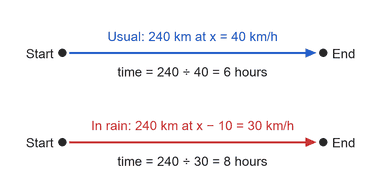
Watch out: The slower speed gives the longer time, so the equation is , not the other way round.
Therefore, the uniform speed is km/h.
- 24 marks
Board paper question 2
The sum of the ages of Vivek and his younger brother Amit is 47 years. The product of their ages in years is 550. Find their ages.
Solve with AIWritten solution
Solution:
Concept: Use one letter for one unknown and write the other unknown in terms of it using the sum. The product then gives a quadratic equation. Both roots may be positive, so use the other facts in the question to choose.
Given: The sum of the ages of Vivek and his younger brother Amit is 47 years, and the product of their ages is 550.
Step 1 — Choose the unknown.
Let Vivek's age be years. Since the two ages add up to 47, Amit's age is years.
Step 2 — Form the equation.
The product of their ages is 550. We open the bracket and bring every term to one side, making the term positive.
Step 3 — Factorise by splitting the middle term.
To factorise we split the middle term. We need two numbers whose product is (here ) and whose sum is (here ). They are and .
Writing the middle term as these two parts and taking out the common factor of each pair of terms:
Step 4 — Use the Zero Product Rule.
A product is zero only when at least one of its factors is zero, so we set each factor equal to zero and solve.
Step 5 — Choose the right root.
Both roots are positive, so both look possible. But Amit is the younger brother, so Vivek is older. If , Amit would be years old, older than Vivek, which is wrong. So , and Amit is years old.
Check: The ages add up to and multiply to .
Watch out: Both roots are positive here, so read the question again (“younger brother”) to decide which root is Vivek's age.
Therefore, Vivek is 25 years old and Amit is 22 years old.
- 33 marks
Board paper question 3
₹ 7500 were divided equally among a certain number of children. Had there been 20 less children, each would have received ₹ 100 more. Find the original number of children.
Solve with AIWritten solution
Solution:
Concept: When an amount is shared equally, . Write both shares in terms of the unknown number, use the given difference of the shares to form an equation, and solve it.
Given: ₹ 7500 is divided equally; with 20 fewer children, each child would get ₹ 100 more.
Step 1 — Choose the unknown.
Let the original number of children be . Then each child gets rupees. With 20 fewer children there are children, and each gets rupees.
Step 2 — Form the equation.
With fewer children each share is bigger by ₹ 100, so the bigger share minus the smaller share is 100.
Step 3 — Combine the two fractions.
The L.C.M. of the denominators is , so we write both fractions over it. In the numerator the terms cancel.
Step 4 — Clear the fraction and write the quadratic equation.
We multiply both sides by , divide both sides by 100, open the bracket and bring every term to one side.
Step 5 — Factorise by splitting the middle term.
To factorise we split the middle term. We need two numbers whose product is (here ) and whose sum is (here ). They are and .
Writing the middle term as these two parts and taking out the common factor of each pair of terms:
Step 6 — Use the Zero Product Rule.
A product is zero only when at least one of its factors is zero, so we set each factor equal to zero and solve.
Step 7 — Keep the root that makes sense.
is rejected, because the number of children cannot be negative. So .
Check: 50 children get ₹ 7500 ÷ 50, which is ₹ 150 each; 30 children would get ₹ 7500 ÷ 30, which is ₹ 250 each. That is ₹ 100 more, as given.
Watch out: With fewer children each share is larger, so comes first in the subtraction.
Therefore, the original number of children is 50.
- 43 marks
Board paper question 4
The product of two consecutive natural numbers which are multiples of 3 is equal to 810. Find the two numbers.
Solve with AIWritten solution
Solution:
Concept: Consecutive multiples of 3 differ by 3 (for example 12, 15, 18). So if one is , the next one is . Their product gives a quadratic equation.
Given: Two consecutive natural numbers that are multiples of 3 have product 810.
Step 1 — Choose the unknown.
Let the smaller multiple of 3 be . The next multiple of 3 is , not .
Step 2 — Form the equation.
Their product is 810. We open the bracket and bring every term to one side.
Step 3 — Factorise by splitting the middle term.
To factorise we split the middle term. We need two numbers whose product is (here ) and whose sum is (here ). They are and .
Writing the middle term as these two parts and taking out the common factor of each pair of terms:
Step 4 — Use the Zero Product Rule.
A product is zero only when at least one of its factors is zero, so we set each factor equal to zero and solve.
Step 4 — Keep the root that makes sense.
is rejected, because a natural number is positive. So .
Step 6 — Write both numbers.
The smaller number is 27 and the next multiple of 3 is .
Check: is 810, and both are multiples of 3, since 27 is and 30 is .
Watch out: Consecutive multiples of 3 are and ; writing and answers a different question.
Therefore, the two numbers are 27 and 30.
- 53 marks
Board paper question 5
The difference of two natural numbers is 7 and their product is 450.
Find the numbers.
Solve with AIWritten solution
Solution:
Concept: If two numbers differ by 7, the larger is 7 more than the smaller. So call the smaller number and the larger ; their product gives a quadratic equation.
Given: The difference of two natural numbers is 7 and their product is 450.
Step 1 — Choose the unknown.
Let the smaller number be . Then the larger number is .
Step 2 — Form the equation.
Their product is 450. We open the bracket and bring every term to one side.
Step 3 — Factorise by splitting the middle term.
To factorise we split the middle term. We need two numbers whose product is (here ) and whose sum is (here ). They are and .
Writing the middle term as these two parts and taking out the common factor of each pair of terms:
Step 4 — Use the Zero Product Rule.
A product is zero only when at least one of its factors is zero, so we set each factor equal to zero and solve.
Step 4 — Keep the root that makes sense.
is rejected, because a natural number is positive. So .
Step 6 — Write both numbers.
The smaller number is 18 and the larger is .
Check: is 7 and is 450.
Watch out: Check that the factor pair has the right signs: is and is , matching the equation.
Therefore, the numbers are 18 and 25.
- 61 mark
Board paper question 6
Two cars X and Y use 1 litre of diesel to travel km and km respectively. If both the cars covered a distance of 72 km, then:
(i) The number of litres of diesel used by car X is
Solve with AIAnswer
(A) litres
(B) litres
- Correct
(C) litres
(D) litres
Answer: (C) litres
Concept: If a car travels km on 1 litre, then for a distance km it needs litres ().
Step 1 — Note what car X does on 1 litre.
Car X travels km on 1 litre of diesel, and it has to cover 72 km.
Step 2 — Divide the distance by the km per litre.
Each litre takes the car km, so the number of litres is the number of times km fits into 72 km.
For example, if were 8, car X would use litres.
Watch out: Divide the distance by the km per litre; would be upside down.
Why the other options are wrong:
- (A) litres: it uses km per litre, which belongs to neither car.
- (B) litres: this is the diesel used by car Y, which travels km per litre.
- (D) litres: it uses 12 km instead of the 72 km travelled.
Therefore, car X uses litres, option (C).
All 15 board paper questions for this chapter, solved the same way.
Class 10 Maths Ch 6 questions students ask
How many questions are there in Class 10 Maths Ch 6?
88 questions. Every one is solved step by step on this page.
Are these Class 10 Maths solutions free?
Yes. Every question and its full working is free to read, with no account needed.
Can I download the Class 10 Maths Ch 6 solutions as a PDF?
There is no PDF to download. Every solution is on this page instead, which means it is searchable, always the current syllabus, and readable on a phone. Use your browser's print option if you want it on paper.