
Question 513 marksMedium
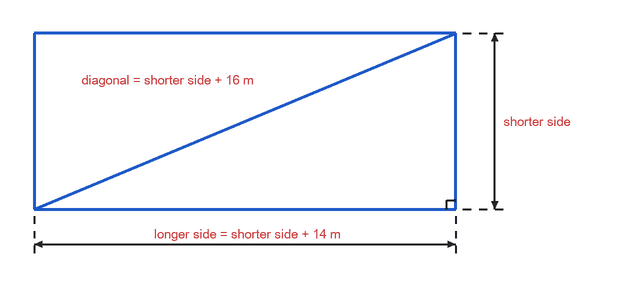
The diagonal of a rectangular field is 16 m more than the shorter side. If the longer side is 14 m more than the shorter side, find the length and the breadth of the rectangular field.
Confirming your payment
Sign up now and get 250 free tokens.
Solving (simple) Problems · Question 51 of 88
The diagonal of a rectangular field is 16 m more than the shorter side. If the longer side is 14 m more than the shorter side, find the length and the breadth of the rectangular field.
Solution:
Concept: The diagonal of a rectangle divides it into two right-angled triangles, so by Pythagoras' theorem (diagonal)² = (length)² + (breadth)².
Given: Diagonal = shorter side + 16 m; longer side = shorter side + 14 m.
Step 1 — Name the sides.
Let the shorter side (the breadth) be m. Then the longer side is m and the diagonal is m.

Step 2 — Form the equation.
The diagonal is the hypotenuse of a right-angled triangle whose other sides are the length and the breadth. We expand both squares and bring every term to one side.
Step 3 — Solve the equation.
We split the middle term. We need two numbers whose product is −60 and whose sum is −4. They are −10 and 6, so we write −4x as −10x + 6x.
A product is zero only when one of its factors is zero, so we set each bracket equal to zero.
A length cannot be negative, so we reject and keep . Now we find the length and the diagonal.
Check: Pythagoras' theorem holds for 10, 24 and 26.
Watch out: The diagonal is the hypotenuse, so its square goes on its own side of the equation.
Therefore, the length of the field is 24 m and the breadth is 10 m.