Answer: (B) A is false, R is true.
Concept: If a boat moves at x km/h in still water and the stream flows at y km/h, the stream helps the boat downstream and holds it back upstream: speed downstream =(x+y) km/h and speed upstream =(x−y) km/h. Adding the two speeds removes the stream's speed and leaves twice the boat's speed.
Step 1 — Check the Reason (R).
R gives the standard rule: with the boat's speed x km/h and the stream's speed y km/h, the speed downstream is (x+y) km/h and the speed upstream is (x−y) km/h. R is true.
Step 2 — Use R with the given speeds.
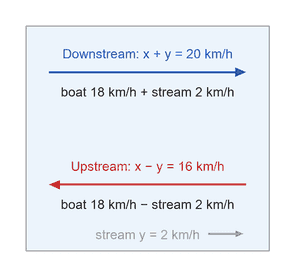
The speed downstream is 20 km/h and the speed upstream is 16 km/h. We add the two equations, so y cancels.
x+y=20
x−y=16
2xx=36=18
So the speed of the boat in still water is 18 km/h (and the stream flows at 2 km/h).
Step 3 — Check the Assertion (A).
As printed, A gives the speed in still water as 220−18 km/h.
220−18=1
This is 1 km/h, but the correct speed is 18 km/h. A is false.
Note: If A had been printed as 220+16 km/h, which is 18 km/h, A would be true and R its correct reason. As printed, A is false.
Watch out: The speed in still water is half the sum of the downstream and upstream speeds; half their difference is the stream's speed.
Why the other options are wrong:
- (A) A is true, R is false: it is the other way round: A is false and R is true.
- (C) Both A and R are true and R is the correct reason for A: A is false as printed: (20 − 18)/2 is 1 km/h, not 18 km/h.
- (D) Both A and R are true and R is the incorrect reason for A: A is false, so “both A and R are true” cannot hold.
Therefore, A is false and R is true, option (B).
