Solution:
Concept: For a journey, time=speeddistance. Write both times in terms of the unknown speed, use the given difference of the times to form an equation, clear the fractions to get a quadratic equation, solve it, and reject any value that cannot be a speed.
Given: Distance 240 km; in the rain the speed is 10 km/h less and the journey takes 2 hours longer.
Step 1 — Write the two speeds.
Let the uniform speed be x km/h, as the question says. In the rain the speed is 10 km/h less, so it becomes (x−10) km/h.
Step 2 — Form the equation.
The time at the usual speed is x240 hours and the time in the rain is x−10240 hours. The slower journey takes 2 hours longer, so we subtract the shorter time from the longer one.
x−10240−x240=2
Step 3 — Combine the two fractions.
The L.C.M. of the denominators is x(x−10), so we write both fractions over it. In the numerator the x terms cancel.
x−10240−x240x(x−10)240x−240(x−10)x(x−10)2400=2=2=2
Step 4 — Clear the fraction and write the quadratic equation.
We multiply both sides by x(x−10), divide both sides by 2, open the bracket and bring every term to one side.
240012001200x2−10x−1200=2x(x−10)=x(x−10)=x2−10x=0
Step 5 — Factorise by splitting the middle term.
To factorise x2−10x−1200 we split the middle term. We need two numbers whose product is a×c (here 1×(−1200)=−1200) and whose sum is b (here −10). They are 30 and −40.
Writing the middle term as these two parts and taking out the common factor of each pair of terms:
x2+30x−40x−1200x(x+30)−40(x+30)(x−40)(x+30)=0=0=0
Step 6 — Use the Zero Product Rule.
A product is zero only when at least one of its factors is zero, so we set each factor equal to zero and solve.
x−40=0orx+30=0
x=40orx=−30
Step 7 — Keep the root that makes sense.
x=−30 is rejected, because a speed cannot be negative. So x=40.
Check: At 40 km/h the bus takes 40240, or 6 hours; at 30 km/h it takes 30240, or 8 hours. That is 2 hours longer, as given.
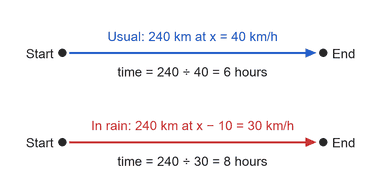
Watch out: The slower speed gives the longer time, so the equation is x−10240−x240=2, not the other way round.
Therefore, the uniform speed is x=40 km/h.
