
Opening your dashboard
Class 10 Maths Chapter 6 Solving (simple) Problems: Previous Year Questions
15 questions on Chapter 6, each solved step by step. Class 10 Maths, ICSE 2026-27.
15 questions with solutions
1–4 marks · Mixed difficulty
The first 13 solutions are on this page. This chapter is a long one, so the rest open on their own page to keep this one quick to load.
- 13 marks
Question 1
A bus covers a distance of 240 km at a uniform speed. Due to heavy rain its speed gets reduced by 10 km/h and as such it takes two hrs longer to cover the total distance. Assuming the uniform speed to be 'x' km/h, form an equation and solve it to evaluate 'x'.
Solve with AIWritten solution
Solution:
Concept: For a journey, . Write both times in terms of the unknown speed, use the given difference of the times to form an equation, clear the fractions to get a quadratic equation, solve it, and reject any value that cannot be a speed.
Given: Distance 240 km; in the rain the speed is 10 km/h less and the journey takes 2 hours longer.
Step 1 — Write the two speeds.
Let the uniform speed be km/h, as the question says. In the rain the speed is 10 km/h less, so it becomes km/h.
Step 2 — Form the equation.
The time at the usual speed is hours and the time in the rain is hours. The slower journey takes 2 hours longer, so we subtract the shorter time from the longer one.
Step 3 — Combine the two fractions.
The L.C.M. of the denominators is , so we write both fractions over it. In the numerator the terms cancel.
Step 4 — Clear the fraction and write the quadratic equation.
We multiply both sides by , divide both sides by 2, open the bracket and bring every term to one side.
Step 5 — Factorise by splitting the middle term.
To factorise we split the middle term. We need two numbers whose product is (here ) and whose sum is (here ). They are and .
Writing the middle term as these two parts and taking out the common factor of each pair of terms:
Step 6 — Use the Zero Product Rule.
A product is zero only when at least one of its factors is zero, so we set each factor equal to zero and solve.
Step 7 — Keep the root that makes sense.
is rejected, because a speed cannot be negative. So .
Check: At 40 km/h the bus takes , or 6 hours; at 30 km/h it takes , or 8 hours. That is 2 hours longer, as given.
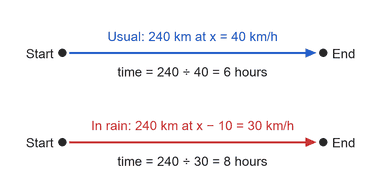
Watch out: The slower speed gives the longer time, so the equation is , not the other way round.
Therefore, the uniform speed is km/h.
- 24 marks
Question 2
The sum of the ages of Vivek and his younger brother Amit is 47 years. The product of their ages in years is 550. Find their ages.
Solve with AIWritten solution
Solution:
Concept: Use one letter for one unknown and write the other unknown in terms of it using the sum. The product then gives a quadratic equation. Both roots may be positive, so use the other facts in the question to choose.
Given: The sum of the ages of Vivek and his younger brother Amit is 47 years, and the product of their ages is 550.
Step 1 — Choose the unknown.
Let Vivek's age be years. Since the two ages add up to 47, Amit's age is years.
Step 2 — Form the equation.
The product of their ages is 550. We open the bracket and bring every term to one side, making the term positive.
Step 3 — Factorise by splitting the middle term.
To factorise we split the middle term. We need two numbers whose product is (here ) and whose sum is (here ). They are and .
Writing the middle term as these two parts and taking out the common factor of each pair of terms:
Step 4 — Use the Zero Product Rule.
A product is zero only when at least one of its factors is zero, so we set each factor equal to zero and solve.
Step 5 — Choose the right root.
Both roots are positive, so both look possible. But Amit is the younger brother, so Vivek is older. If , Amit would be years old, older than Vivek, which is wrong. So , and Amit is years old.
Check: The ages add up to and multiply to .
Watch out: Both roots are positive here, so read the question again (“younger brother”) to decide which root is Vivek's age.
Therefore, Vivek is 25 years old and Amit is 22 years old.
- 33 marks
Question 3
₹ 7500 were divided equally among a certain number of children. Had there been 20 less children, each would have received ₹ 100 more. Find the original number of children.
Solve with AIWritten solution
Solution:
Concept: When an amount is shared equally, . Write both shares in terms of the unknown number, use the given difference of the shares to form an equation, and solve it.
Given: ₹ 7500 is divided equally; with 20 fewer children, each child would get ₹ 100 more.
Step 1 — Choose the unknown.
Let the original number of children be . Then each child gets rupees. With 20 fewer children there are children, and each gets rupees.
Step 2 — Form the equation.
With fewer children each share is bigger by ₹ 100, so the bigger share minus the smaller share is 100.
Step 3 — Combine the two fractions.
The L.C.M. of the denominators is , so we write both fractions over it. In the numerator the terms cancel.
Step 4 — Clear the fraction and write the quadratic equation.
We multiply both sides by , divide both sides by 100, open the bracket and bring every term to one side.
Step 5 — Factorise by splitting the middle term.
To factorise we split the middle term. We need two numbers whose product is (here ) and whose sum is (here ). They are and .
Writing the middle term as these two parts and taking out the common factor of each pair of terms:
Step 6 — Use the Zero Product Rule.
A product is zero only when at least one of its factors is zero, so we set each factor equal to zero and solve.
Step 7 — Keep the root that makes sense.
is rejected, because the number of children cannot be negative. So .
Check: 50 children get ₹ 7500 ÷ 50, which is ₹ 150 each; 30 children would get ₹ 7500 ÷ 30, which is ₹ 250 each. That is ₹ 100 more, as given.
Watch out: With fewer children each share is larger, so comes first in the subtraction.
Therefore, the original number of children is 50.
- 43 marks
Question 4
The product of two consecutive natural numbers which are multiples of 3 is equal to 810. Find the two numbers.
Solve with AIWritten solution
Solution:
Concept: Consecutive multiples of 3 differ by 3 (for example 12, 15, 18). So if one is , the next one is . Their product gives a quadratic equation.
Given: Two consecutive natural numbers that are multiples of 3 have product 810.
Step 1 — Choose the unknown.
Let the smaller multiple of 3 be . The next multiple of 3 is , not .
Step 2 — Form the equation.
Their product is 810. We open the bracket and bring every term to one side.
Step 3 — Factorise by splitting the middle term.
To factorise we split the middle term. We need two numbers whose product is (here ) and whose sum is (here ). They are and .
Writing the middle term as these two parts and taking out the common factor of each pair of terms:
Step 4 — Use the Zero Product Rule.
A product is zero only when at least one of its factors is zero, so we set each factor equal to zero and solve.
Step 4 — Keep the root that makes sense.
is rejected, because a natural number is positive. So .
Step 6 — Write both numbers.
The smaller number is 27 and the next multiple of 3 is .
Check: is 810, and both are multiples of 3, since 27 is and 30 is .
Watch out: Consecutive multiples of 3 are and ; writing and answers a different question.
Therefore, the two numbers are 27 and 30.
- 53 marks
Question 5
The difference of two natural numbers is 7 and their product is 450.
Find the numbers.
Solve with AIWritten solution
Solution:
Concept: If two numbers differ by 7, the larger is 7 more than the smaller. So call the smaller number and the larger ; their product gives a quadratic equation.
Given: The difference of two natural numbers is 7 and their product is 450.
Step 1 — Choose the unknown.
Let the smaller number be . Then the larger number is .
Step 2 — Form the equation.
Their product is 450. We open the bracket and bring every term to one side.
Step 3 — Factorise by splitting the middle term.
To factorise we split the middle term. We need two numbers whose product is (here ) and whose sum is (here ). They are and .
Writing the middle term as these two parts and taking out the common factor of each pair of terms:
Step 4 — Use the Zero Product Rule.
A product is zero only when at least one of its factors is zero, so we set each factor equal to zero and solve.
Step 4 — Keep the root that makes sense.
is rejected, because a natural number is positive. So .
Step 6 — Write both numbers.
The smaller number is 18 and the larger is .
Check: is 7 and is 450.
Watch out: Check that the factor pair has the right signs: is and is , matching the equation.
Therefore, the numbers are 18 and 25.
- 61 mark
Question 6
Two cars X and Y use 1 litre of diesel to travel km and km respectively. If both the cars covered a distance of 72 km, then:
(i) The number of litres of diesel used by car X is
Solve with AIAnswer
(A) litres
(B) litres
- Correct
(C) litres
(D) litres
Answer: (C) litres
Concept: If a car travels km on 1 litre, then for a distance km it needs litres ().
Step 1 — Note what car X does on 1 litre.
Car X travels km on 1 litre of diesel, and it has to cover 72 km.
Step 2 — Divide the distance by the km per litre.
Each litre takes the car km, so the number of litres is the number of times km fits into 72 km.
For example, if were 8, car X would use litres.
Watch out: Divide the distance by the km per litre; would be upside down.
Why the other options are wrong:
- (A) litres: it uses km per litre, which belongs to neither car.
- (B) litres: this is the diesel used by car Y, which travels km per litre.
- (D) litres: it uses 12 km instead of the 72 km travelled.
Therefore, car X uses litres, option (C).
- 71 mark
Question 7
Two cars X and Y use 1 litre of diesel to travel km and km respectively. If both the cars covered a distance of 72 km, then:
(ii) The number of litres of diesel used by car Y is
Solve with AIAnswer
(A) litres
- Correct
(B) litres
(C) litres
(D) litres
Answer: (B) litres
Concept: If a car travels km on 1 litre, then for a distance km it needs litres ().
Step 1 — Note what car Y does on 1 litre.
Car Y travels km on 1 litre of diesel, and it also covers 72 km.
Step 2 — Divide the distance by the km per litre.
As for car X, the number of litres is the distance divided by the km per litre.
Car Y goes 3 km further on each litre, so it uses less diesel than car X for the same 72 km.
Watch out: Car Y's km per litre is , so the whole of goes in the denominator.
Why the other options are wrong:
- (A) litres: it uses km per litre, which belongs to neither car.
- (C) litres: this is the diesel used by car X, which travels km per litre.
- (D) litres: it uses 12 km instead of the 72 km travelled.
Therefore, car Y uses litres, option (B).
- 81 mark
Question 8
Two cars X and Y use 1 litre of diesel to travel km and km respectively. If both the cars covered a distance of 72 km, then:
(iii) If car X used 4 litres of diesel more than car Y in the journey, then
Solve with AIAnswer
(A)
(B)
- Correct
(C)
(D)
Answer: (C)
Concept: If a car travels km on 1 litre, then for a distance km it needs litres (). “X used 4 litres more than Y” means: diesel of X minus diesel of Y equals 4.
Step 1 — Write the diesel used by each car.
From the first two parts of this question, car X uses litres and car Y uses litres.
Step 2 — Form the equation.
Car X uses more diesel, so we subtract Y's amount from X's amount and set the difference equal to 4.
Watch out: Subtract in the right order: the larger amount (car X) minus the smaller amount (car Y) gives .
Why the other options are wrong:
- (A) : both expressions are wrong: km per litre belongs to neither car, and uses 12 km in place of 72 km.
- (B) : it subtracts the other way round (Y minus X). Since X uses more diesel, that difference is , not 4.
- (D) : it uses km per litre for car X instead of km.
Therefore, the equation is , option (C).
- 91 mark
Question 9
Two cars X and Y use 1 litre of diesel to travel km and km respectively. If both the cars covered a distance of 72 km, then:
(iv) The amount of diesel used by the car X is
Solve with AIAnswer
(A) 6 litres
- Correct
(B) 12 litres
(C) 18 litres
(D) 24 litres
Answer: (B) 12 litres
Concept: If a car travels km on 1 litre, then for a distance km it needs litres (). Solve the equation from the previous part for , then find car X's diesel, litres.
Step 1 — Start from the equation of the previous part.
Car X uses 4 litres more than car Y.
Step 2 — Combine the two fractions.
The L.C.M. of the denominators is , so we write both fractions over it. In the numerator the terms cancel.
Step 3 — Clear the fraction and write the quadratic equation.
We multiply both sides by , divide both sides by 4, open the bracket and bring every term to one side.
Step 4 — Factorise by splitting the middle term.
To factorise we split the middle term. We need two numbers whose product is (here ) and whose sum is (here ). They are and .
Writing the middle term as these two parts and taking out the common factor of each pair of terms:
Step 5 — Use the Zero Product Rule.
A product is zero only when at least one of its factors is zero, so we set each factor equal to zero and solve.
Step 6 — Keep the root that makes sense.
is rejected, because a distance per litre cannot be negative. So .
Step 7 — Find the diesel used by car X.
Car X travels 6 km per litre, so for 72 km it needs:
Car Y travels 9 km per litre and needs litres, which is 4 litres less, as given.

Watch out: The question asks for the diesel used by car X (12 litres), not the value of (6 km per litre), which is option (A)'s number.
Why the other options are wrong:
- (A) 6 litres: 6 is the value of (km per litre), not the diesel. If X used 6 litres, would be 12, Y would use , that is 4.8 litres, and the difference would be 1.2 litres, not 4.
- (C) 18 litres: if X used 18 litres, would be 4 and Y would use litres; the difference would be litres, not 4.
- (D) 24 litres: if X used 24 litres, would be 3 and Y would use , that is 12 litres; the difference would be 12 litres, not 4.
Therefore, car X uses 12 litres of diesel, option (B).
- 103 marks
Question 10
A man covers a distance of 100 km, travelling with a uniform speed of km/hr. Had the speed been 5 km/hr more it would have taken 1 hour less. Find the original speed.
Solve with AIWritten solution
Solution:
Concept: For a journey, . Write both times in terms of the unknown speed, use the given difference of the times to form an equation, clear the fractions to get a quadratic equation, solve it, and reject any value that cannot be a speed.
Given: Distance 100 km at km/hr; at 5 km/hr more the journey would take 1 hour less.
Step 1 — Write the two speeds.
The original speed is km/hr. The faster speed is 5 km/hr more, so it is written km/hr.
Step 2 — Form the equation.
The original time is hours and the faster time is hours. The faster journey takes 1 hour less, so the original time minus the faster time is 1.
Step 3 — Combine the two fractions.
The L.C.M. of the denominators is , so we write both fractions over it. In the numerator the terms cancel.
Step 4 — Clear the fraction and write the quadratic equation.
We multiply both sides by , open the bracket and bring every term to one side.
Step 5 — Factorise by splitting the middle term.
To factorise we split the middle term. We need two numbers whose product is (here ) and whose sum is (here ). They are and .
Writing the middle term as these two parts and taking out the common factor of each pair of terms:
Step 6 — Use the Zero Product Rule.
A product is zero only when at least one of its factors is zero, so we set each factor equal to zero and solve.
Step 7 — Keep the root that makes sense.
is rejected, because a speed cannot be negative. So .
Check: At 20 km/hr the man takes , or 5 hours; at 25 km/hr he takes , or 4 hours. That is 1 hour less, as given.
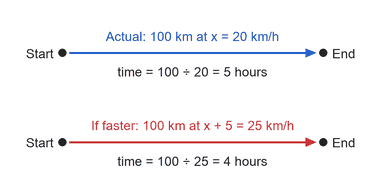
Watch out: The faster speed gives the shorter time, so comes first in the subtraction.
Therefore, the original speed is km/hr.
- 114 marks
Question 11
Mr. and Mrs. Das were travelling by car from Delhi to Kasauli for a holiday. Distance between Delhi and Kasauli is approximately 350 km (via NH 152D). Due to heavy rain they had to slow down. The average speed of the car was reduced by 20 km/h and time of the journey increased by 2 hours. Find:
(a) the original speed of the car.
(b) with the reduced speed, the number of hours they took to reach their destination.
Solve with AIWritten solution
Solution:
Concept: For a journey, . Write both times in terms of the unknown speed, use the given difference of the times to form an equation, clear the fractions to get a quadratic equation, solve it, and reject any value that cannot be a speed.
Given: Distance about 350 km; the average speed was reduced by 20 km/h and the journey took 2 hours more.
Step 1 — Write the two speeds.
Let the original average speed be km/h. The reduced speed is 20 km/h less, so it becomes km/h.
Step 2 — Form the equation.
The original time is hours and the time at the reduced speed is hours. The slower journey takes 2 hours more, so the longer time minus the shorter time is 2.
Step 3 — Combine the two fractions.
The L.C.M. of the denominators is , so we write both fractions over it. In the numerator the terms cancel.
Step 4 — Clear the fraction and write the quadratic equation.
We multiply both sides by , divide both sides by 2, open the bracket and bring every term to one side.
Step 5 — Factorise by splitting the middle term.
To factorise we split the middle term. We need two numbers whose product is (here ) and whose sum is (here ). They are and .
Writing the middle term as these two parts and taking out the common factor of each pair of terms:
Step 6 — Use the Zero Product Rule.
A product is zero only when at least one of its factors is zero, so we set each factor equal to zero and solve.
Step 7 — Keep the root that makes sense.
is rejected, because a speed cannot be negative. So .
Step 8 — Answer part (a).
The original speed of the car was 70 km/h.
Step 9 — Answer part (b).
The reduced speed is km/h, so the time taken at the reduced speed is:
Check: At the original speed the time is , or 5 hours, and 7 hours is 2 hours more, as given.
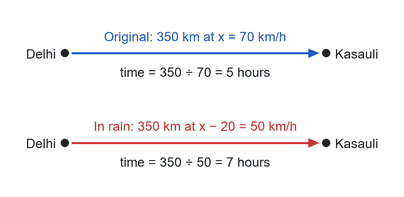
Watch out: Part (b) asks for the time at the reduced speed (50 km/h), not at the original speed.
Therefore, (a) the original speed of the car was 70 km/h; (b) at the reduced speed they took 7 hours.
- 123 marks
Question 12
The sum of two numbers is 2 and the sum of their reciprocals is 2.25. Find the numbers.
Solve with AIWritten solution
Solution:
Concept: Write the second number in terms of the first using the sum, then use the sum of the reciprocals to form an equation. The reciprocal of a number is .
Given: The sum of two numbers is 2 and the sum of their reciprocals is 2.25.
Step 1 — Choose the unknown.
Let one number be . Since the two numbers add up to 2, the other number is .
Step 2 — Write 2.25 as a fraction.
Fractions are easier to work with here.
Step 3 — Form the equation and combine the fractions.
The sum of the reciprocals is . The L.C.M. of the denominators is ; in the numerator the terms cancel.
Step 4 — Cross-multiply and write the quadratic equation.
We cross-multiply, open the bracket and bring every term to one side, keeping the term positive.
Step 5 — Factorise by splitting the middle term.
To factorise we split the middle term. We need two numbers whose product is (here ) and whose sum is (here ). They are and .
Writing the middle term as these two parts and taking out the common factor of each pair of terms:
Step 6 — Use the Zero Product Rule.
A product is zero only when at least one of its factors is zero, so we set each factor equal to zero and solve.
Step 7 — Find the other number.
If , the other number is , which works out to . If , the other number is . Both roots give the same pair of numbers.
Check: , and the reciprocals and add up to .
Watch out: The reciprocal of a sum is not the sum of the reciprocals; add and as two fractions.
Therefore, the numbers are and .
- 134 marks
Question 13
Divide 20 into two parts such that the sum of their squares is 272. The larger of two parts is square of the other. Assuming the smaller part to be '', form an equation and solve it to find the two parts.
Solve with AIWritten solution
Solution:
Concept: Call the smaller part . The question says the larger part is the square of the smaller, so it is written , and the two parts add up to 20. This gives a quadratic equation. The sum of the squares (272) is then used as a check.
Given: 20 is divided into two parts; the larger part is the square of the smaller, and the sum of their squares is 272.
Step 1 — Write both parts.
Let the smaller part be , as the question says. The larger part is the square of the smaller, so we write it as .
Step 2 — Form the equation.
The two parts together make 20. We bring every term to one side.
Step 3 — Factorise by splitting the middle term.
To factorise we split the middle term. We need two numbers whose product is (here ) and whose sum is (here ). They are and .
Writing the middle term as these two parts and taking out the common factor of each pair of terms:
Step 4 — Use the Zero Product Rule.
A product is zero only when at least one of its factors is zero, so we set each factor equal to zero and solve.
Step 4 — Keep the root that makes sense.
is rejected, because a part of 20 here must be positive. So .
Step 6 — Write both parts.
The smaller part is 4 and the larger part is .
Check: is 20, and the sum of the squares is , which works out to 272, as given.
Watch out: The larger part is (the square of the smaller), not or .
Therefore, the two parts are 4 and 16.
- 144 marks
Question 14
The difference of two natural numbers is 5 and sum of their reciprocals is . Find the two numbers.
- 154 marks
Question 15
A car covers a distance of 400 km at a certain speed. Had the speed been 12 km/h more, the time taken for the journey would have been 1 hour 40 minutes less. Find the:
(a) original speed of the car.
(b) time taken with the increased speed.