Solution:
Concept: For a journey, time=speeddistance. Write both times in terms of the unknown speed, use the given difference of the times to form an equation, clear the fractions to get a quadratic equation, solve it, and reject any value that cannot be a speed.
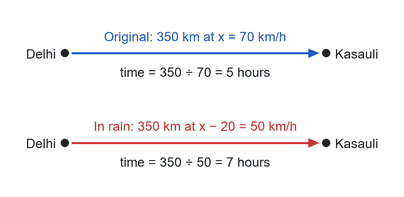
Given: Distance about 350 km; the average speed was reduced by 20 km/h and the journey took 2 hours more.
Step 1 — Write the two speeds.
Let the original average speed be x km/h. The reduced speed is 20 km/h less, so it becomes (x−20) km/h.
Step 2 — Form the equation.
The original time is x350 hours and the time at the reduced speed is x−20350 hours. The slower journey takes 2 hours more, so the longer time minus the shorter time is 2.
x−20350−x350=2
Step 3 — Combine the two fractions.
The L.C.M. of the denominators is x(x−20), so we write both fractions over it. In the numerator the x terms cancel.
x−20350−x350x(x−20)350x−350(x−20)x(x−20)7000=2=2=2
Step 4 — Clear the fraction and write the quadratic equation.
We multiply both sides by x(x−20), divide both sides by 2, open the bracket and bring every term to one side.
700035003500x2−20x−3500=2x(x−20)=x(x−20)=x2−20x=0
Step 5 — Factorise by splitting the middle term.
To factorise x2−20x−3500 we split the middle term. We need two numbers whose product is a×c (here 1×(−3500)=−3500) and whose sum is b (here −20). They are 50 and −70.
Writing the middle term as these two parts and taking out the common factor of each pair of terms:
x2+50x−70x−3500x(x+50)−70(x+50)(x−70)(x+50)=0=0=0
Step 6 — Use the Zero Product Rule.
A product is zero only when at least one of its factors is zero, so we set each factor equal to zero and solve.
x−70=0orx+50=0
x=70orx=−50
Step 7 — Keep the root that makes sense.
x=−50 is rejected, because a speed cannot be negative. So x=70.
Step 8 — Answer part (a).
The original speed of the car was 70 km/h.
Step 9 — Answer part (b).
The reduced speed is 70−20=50 km/h, so the time taken at the reduced speed is:
time=50350 hours=7 hours
Check: At the original speed the time is 70350, or 5 hours, and 7 hours is 2 hours more, as given.
Watch out: Part (b) asks for the time at the reduced speed (50 km/h), not at the original speed.
Therefore, (a) the original speed of the car was 70 km/h; (b) at the reduced speed they took 7 hours.
