Solution:
Concept: Number of seats = number of rows × number of seats in each row.
Given: Rows = seats per row at first; when the rows are doubled and each row loses 10 seats, the total increases by 300.
Step 1 — Name the original arrangement.
Let there be x rows with x seats in each row, so there are x2 seats.
Step 2 — Write the new arrangement.
Doubling the rows gives 2x rows, and each row now has (x−10) seats, so there are 2x(x−10) seats.
Step 3 — Form the equation.
The new total is 300 more than the old total. We open the bracket and bring every term to one side.
2x(x−10)2x2−20xx2−20x−300=x2+300=x2+300=0
Step 4 — Solve the equation.
We split the middle term. We need two numbers whose product is −300 and whose sum is −20. They are −30 and 10, so we write −20x as −30x + 10x.
x2−30x+10x−300x(x−30)+10(x−30)(x−30)(x+10)=0=0=0
A product is zero only when one of its factors is zero, so we set each bracket equal to zero.
x−30=0orx+10=0
x=30orx=−10
A number of rows cannot be negative, so we reject x=−10 and keep x=30.
Step 5 — Part (ii): seats after re-arrangement.
There are now 60 rows of 20 seats.
60×20=1,200
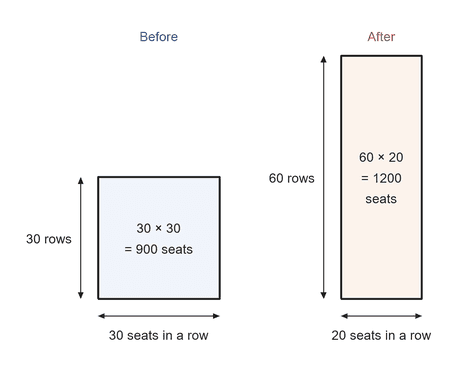
Check: At first there were 900 seats, and 1,200 is 300 more.
30×30=900
1,200−900=300
Watch out: Part (ii) asks for the seats after re-arrangement, 2x(x−10), not the original x2.
Therefore, (i) there were 30 rows in the original arrangement; (ii) after re-arrangement the auditorium has 1,200 seats.
