
Question 373 marksEasy
A trader bought an article for ₹ and sold it for ₹ 52, thereby making a profit of percent on his outlay. Calculate the cost price.
Confirming your payment
Sign up now and get 250 free tokens.
Solving (simple) Problems · Question 37 of 88
A trader bought an article for ₹ and sold it for ₹ 52, thereby making a profit of percent on his outlay. Calculate the cost price.
Solution:
Concept: Profit and loss per cent are always worked out on the cost price (C.P.). So S.P. = C.P. + profit, and a profit of on a C.P. of ₹ is .
Given: C.P. = ₹ ; S.P. = ₹ 52; profit = of the C.P.
Step 1 — Write the profit.
The profit is of the cost price ₹ .
Step 2 — Form the equation.
The C.P. plus the profit is the S.P., ₹ 52. We multiply every term by 100 and bring every term to one side.
Step 3 — Solve the equation.
We split the middle term. We need two numbers whose product is −5,200 and whose sum is 90. They are 130 and −40, so we write 90x as 130x − 40x.
A product is zero only when one of its factors is zero, so we set each bracket equal to zero.
A price cannot be negative, so we reject and keep .
Check: The profit is 40 − 10, that is 30% of ₹ 40, which is ₹ 12, and ₹ 40 + ₹ 12 is ₹ 52.
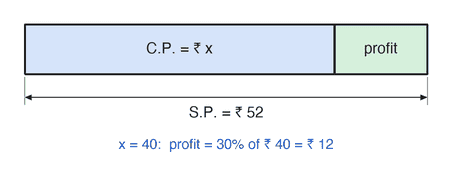
Watch out: The profit per cent is taken on the cost price ₹ , not on the selling price ₹ 52.
Therefore, the cost price is ₹ 40.