
Opening your dashboard
Class 10 Maths Chapter 6 Solving (simple) Problems: Competency-Based Questions (CBQ)
40 questions on Chapter 6, each worked through on its own page with the AI tutor. Class 10 Maths, ICSE 2026-27.
40 questions
1–5 marks · Mixed difficulty
- 11 mark
Question 1
Competency: Understanding
Every morning a cyclist rides 30 km to a lake at a uniform speed of km/h. On the way back a headwind cuts his speed by 3 km/h, and the return ride takes 30 minutes longer. Which equation gives ?
- 21 mark
Question 2
Competency: Application
Amit writes a puzzle on his sister's birthday card : "I am 3 years older than you. Multiply our ages and you get 180." Amit's age is :
- 31 mark
Question 3
Competency: Analysis
A farmer makes a rectangular pen for his goats against a long straight wall. He uses 40 m of wire for the other three sides, and the wall serves as the fourth side. He wants the area of the pen to be exactly 200 m².
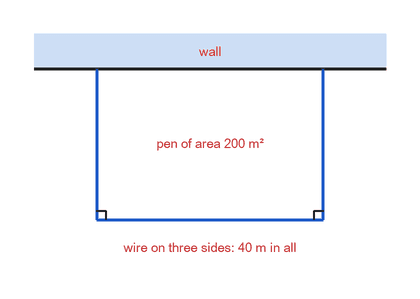
Which statement is correct?
- 41 mark
Question 4
Competency: Analysis
Sahil is hunting for a positive real number which is exactly 1 less than its own reciprocal.
Assertion (A) : Sahil's hunt must fail, because a number of this kind cannot exist.
Reason (R) : One root of is positive and its other root is negative.
- 51 mark
Question 5
Competency: Evaluation
In a problem on a two-digit number, Rohit takes the tens digit as . He correctly forms the equation and correctly gets or . What should he conclude?
- 61 mark
Question 6
Competency: Application
A school orders a flag whose length and width are in the ratio 3 : 2. The cloth used for the flag has an area of 96 dm². The flag measures :
- 72 marks
Question 7
Competency: Application & Analysis
A wire 36 cm long is cut into two pieces. Each piece is bent to form a square. The two squares together have an area of 45 cm². Find the lengths of the two pieces. Why do both roots of your equation lead to the same answer?
- 82 marks
Question 8
Competency: Application
Zara circles a date on a calendar and also the date exactly one week after it, in the same month. The product of the two dates is 120. Find the two dates.
- 92 marks
Question 9
Competency: Understanding & Evaluation
Rita is 5 years older than her brother. Five years ago, the product of their ages was 84. Rita says, "Each of us is 5 years older now. So the product of our ages today is ." Find their present ages and say whether Rita is right.
- 102 marks
Question 10
Competency: Application
On Van Mahotsav day, a school plants 300 saplings in straight rows. The number of saplings in each row is 5 more than the number of rows. Find the number of rows and the number of saplings in each row.
- 113 marks
Question 11
Competency: Analysis
An office has an old printer and a new printer. To print the same set of question papers, the new printer takes 6 minutes less than the old one. When both work together, the set is printed in 4 minutes.
(a) Taking the time of the old printer alone as minutes, form a quadratic equation and solve it.
(b) Both roots are positive. Explain which root must be rejected and why.
(c) State the time each printer takes alone.
- 123 marks
Question 12
Competency: Application & Analysis
Two friends start cycling from the same crossing at the same time. Arnav rides due north at a uniform speed and Bela rides due east, 7 km/h faster than Arnav. After 2 hours they are 26 km apart, measured in a straight line.

Find the speed of each.
- 133 marks
Question 13
Competency: Creativity
A teacher wants a word problem on a rectangular playground whose answer is "length 24 m, breadth 10 m". The problem must use the diagonal of the playground and must lead to a quadratic equation.
Frame such a problem. Then solve it to show that it gives this answer, and say why the other root is rejected.
- 145 marks
Question 14
Competency: Analysis & Evaluation
Case study: A school canteen tried four different prices for a plate of idli, one in each week, and noted the average number of plates sold in a day.
Price of a plate ₹ 10 ₹ 12 ₹ 14 ₹ 16 Plates sold in a day 200 180 160 140 (a) Find the money received in a day at each price. What happens to the number of plates sold for every ₹ 1 rise in the price?
(b) Assume this pattern continues. If the price is ₹ , write the number of plates sold in terms of . Form a quadratic equation for the money received to be ₹ 2,240 and solve it. Do your answers agree with the table?
(c) The canteen manager says, "With the right price we can receive ₹ 2,300 in a day." Use the discriminant to test this claim. Then show that ₹ 2,250 can be received at exactly one price, and state that price.
- 154 marks
Question 15
Competency: Application & Evaluation
Case study: A delivery rider covers the same 60 km route every day at a uniform speed. On a rainy day he has to ride 5 km/h slower than usual, and the route takes him 1 hour longer.
(a) Taking his usual speed as km/h, form a quadratic equation and solve it.
(b) Find the time he takes on a usual day and on a rainy day.
(c) The rider says, "Going 5 km/h slower costs me an hour. So going 5 km/h faster than usual will save me an hour." Is he right? Find the time he would actually save.
- 161 mark
Question 16
Competency: Application
In a maths game, Tara hides a fraction. She says: "The numerator and the denominator are positive whole numbers. The denominator is 1 more than the square of the numerator. If I add 1 to the numerator, the fraction becomes ." Which fraction did Tara hide?
- 171 mark
Question 17
Competency: Analysis
A shopkeeper buys an article for ₹ and sells it at a loss of of the cost price. Which of these can NOT be the selling price of the article?
- 181 mark
Question 18
Competency: Application
On a 60 km charity cycle ride, Kiran rode at a uniform speed. Her speed in km/h was 7 more than the number of hours the ride took. Kiran's speed was :
- 191 mark
Question 19
Competency: Analysis
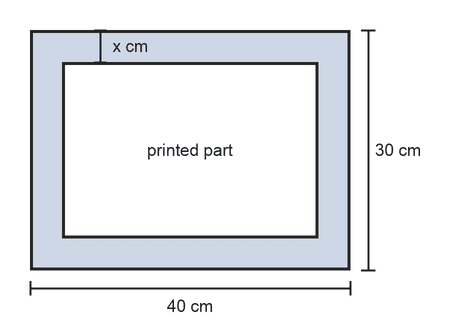
A rectangular poster is 40 cm long and 30 cm wide. A blank margin of the same width cm is left on all four sides, as shown. The printed part inside has an area of 600 cm. The width of the margin is :
- 201 mark
Question 20
Competency: Analysis
Isha looks for a two-digit number whose digits differ by 3 and whose digits have a product of 20.
Assertion (A) : No two-digit number has both these properties.
Reason (R) : If the smaller digit is , the equation has no whole-number root.
- 211 mark
Question 21
Competency: Application
Nisha says, "In 6 years' time my age will be the square of what my age was 6 years ago." Taking her present age as years, her present age is :
- 221 mark
Question 22
Competency: Application
Two positive numbers are in the ratio 3 : 7. When 5 is added to each of them, the product of the two new numbers is 209. The larger of the two original numbers is :
- 231 mark
Question 23
Competency: Evaluation
Ria solves this problem : "The product of two consecutive odd natural numbers is 63. Find the numbers." She takes the smaller number as , forms , solves it to get or , rejects and writes the numbers 7 and 9. Which check best shows that her answer to the PROBLEM is correct?
- 241 mark
Question 24
Competency: Analysis
Kabir's locker has a two-digit number painted on it. Its tens digit is 7 more than its units digit, and the number itself equals the square of the sum of its two digits. The locker number is :
- 251 mark
Question 25
Competency: Understanding & Analysis
Two pipes together fill a tank in 6 hours.
Assertion (A) : Each pipe, working alone, takes more than 6 hours to fill the tank.
Reason (R) : When two pipes work together, the time taken is the sum of the times each pipe takes alone.
- 262 marks
Question 26
Competency: Application
Three sisters have ages that are consecutive whole numbers of years. The sum of the squares of their ages is 194. Find the three ages.
- 272 marks
Question 27
Competency: Application & Analysis
Leena says, "My number is 30 more than its positive square root." Find Leena's number.
- 282 marks
Question 28
Competency: Understanding & Application
A jar in the school laboratory holds 100 mL of a pure liquid dye. Riya pours out mL of the dye and fills the jar back to 100 mL with water. She stirs it well, pours out mL of the mixture and again fills the jar back to 100 mL with water. The dye left in the jar after these two steps is mL. At the end the jar holds 64 mL of dye (hypothetical data). Form a quadratic equation in , solve it, and find how much liquid Riya poured out each time.
- 292 marks
Question 29
Competency: Application
Two ribbons have lengths, in metres, in the ratio 2 : 3. The difference of the squares of the two lengths equals twice the total length of the ribbons. Find the length of each ribbon.
- 302 marks
Question 30
Competency: Application & Analysis
Two cyclists ride round a 400 m track at steady speeds. The faster one takes 20 seconds less than the slower one to complete a lap. When they start together from the same point and ride in opposite directions, the parts of a lap they cover in one second add up, and they meet every 24 seconds. Find the time each takes to complete a lap, and the speed of the faster cyclist in km/h.
- 312 marks
Question 31
Competency: Application
Priya alone takes 6 hours more than Sonal alone to pack the Diwali gift boxes for a school. Sonal packs alone for 3 hours, then Priya joins her, and together they finish the job in 2 more hours. How long would each of them take alone?
- 323 marks
Question 32
Competency: Application
A self-help group makes paper lanterns. When it makes lanterns in a day, the cost of making each lantern is ₹ , because material bought in bulk is cheaper. It sells every lantern at ₹ 80. One day its profit was ₹ 600. Find the number of lanterns made that day, the cost of making one lantern, and the profit per cent on the cost. (Hypothetical data.)
- 333 marks
Question 33
Competency: Analysis & Evaluation
A bus goes from town A to town B, 90 km apart, at a steady speed of km/h and returns by the same road at km/h. The two journeys take 5 hours in all.
(a) Form a quadratic equation in and find the speed from A to B.
(b) Deepak says, "The average speed for the whole trip is the average of the two speeds." Find the true average speed for the whole trip and say whether Deepak is right.
- 343 marks
Question 34
Competency: Application & Analysis
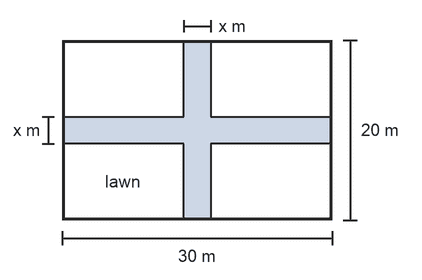
A rectangular lawn is 30 m long and 20 m wide. Two paths, each of the same width m, run through the middle of the lawn, one parallel to each side, as shown. The total area covered by the two paths is 184 m. Find , and explain why the other root is rejected. Then find the cost of paving the paths at ₹ 150 per m.
- 353 marks
Question 35
Competency: Analysis
The denominator of a positive fraction is 3 more than its numerator, and both are whole numbers. A second fraction is formed by adding 1 to both the numerator and the denominator of the first. The product of the two fractions is .
(a) Form a quadratic equation and find the first fraction.
(b) Explain why the other root of your equation is rejected.
(c) Which of the two fractions is larger?
- 363 marks
Question 36
Competency: Creativity
Frame a word problem on time and work in which a faster worker alone takes 15 days and a slower worker alone takes 30 days. Your problem must give the time they take together and must lead to a quadratic equation. Write your problem, solve it to show that it gives these two times, and say why the other root is rejected.
- 374 marks
Question 37
Competency: Analysis & Evaluation
Case study: A school hall must seat exactly 360 students. The organisers tried different arrangements, each with the same number of chairs in every row, and noted four of them in a table.
Plan Rows Chairs in a row P 15 24 Q 18 20 R 24 15 S 12 30 (a) Show that each plan seats exactly 360 students. In which plan are there exactly 2 more chairs in a row than there are rows?
(b) The organisers start from one plan in the table. If they add 3 more rows and take 4 chairs out of every row, the hall still seats exactly 360. Taking the number of rows in the starting plan as , form a quadratic equation and solve it. Name the starting plan and the new plan.
(c) The principal wants a square plan, with as many rows as chairs in a row. Show that this is not possible with exactly 360 chairs. Which plan in the table is closest to a square plan?
- 385 marks
Question 38
Competency: Application & Analysis
Case study: A water tank has two inlet pipes, P and Q, and one outlet pipe, R. Pipe P alone fills the empty tank in 10 hours less than pipe Q alone. Pipe R alone empties the full tank in 30 hours. When all three pipes are opened together on the empty tank, it fills in 20 hours.
(a) Taking the time of pipe P alone as hours, form a quadratic equation and find the time each of P and Q takes alone.
(b) How long do P and Q take to fill the empty tank with R closed? How many hours does the open outlet add to the filling time?
(c) All three pipes are opened together on the empty tank, and after 8 hours pipe R is closed. How much longer do P and Q take to fill the rest of the tank? Give your answer in hours and minutes.
- 395 marks
Question 39
Competency: Application & Evaluation
Case study: During a festival sale, a shop marks each item above its cost price. It then gives a discount of on the marked price. (Hypothetical data.)
(a) The shopkeeper says, "The mark-up and the discount cancel out, so I sell every item at its cost price." For an item costing ₹ 1,000 with , find the selling price and say whether he is right.
(b) Another item costs ₹ 2,500 and its selling price in the sale is ₹ 2,400. Form a quadratic equation in and solve it.
(c) For the item in part (b), find the marked price, the discount in rupees and the loss per cent.
- 404 marks
Question 40
Competency: Application & Analysis
Case study: Naveen's bicycle lock opens with a two-digit code. His sister gives him two clues.
Clue Statement 1 The code is 27 more than the number formed by reversing its digits. 2 The sum of the squares of its digits is 45. (a) Let the tens digit be and the units digit be . Use Clue 1 to show that .
(b) Use this with Clue 2 to form a quadratic equation in and solve it. Find the code.
(c) Naveen first thinks that Clue 2 alone is enough. Find another two-digit number that satisfies Clue 2, and say which clue rules it out.