
Question 93 marksEasy
Divide 20 into two parts such that three times the square of one part exceeds the other part by 10.
Confirming your payment
Sign up now and get 250 free tokens.
Solving (simple) Problems · Question 9 of 88
Divide 20 into two parts such that three times the square of one part exceeds the other part by 10.
Solution:
Concept: Let one part be ; the other part is . “A exceeds B by 10” means .
Given: 20 is divided into two parts; three times the square of one part is 10 more than the other part.
Step 1 — Name the parts.
Let the part that is squared be . The two parts make 20, so the other part is .
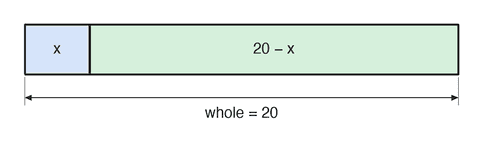
Step 2 — Form the equation.
Three times the square of , minus the other part, equals 10. The minus sign in front of the bracket changes the sign of each term inside.
Step 3 — Solve the equation.
We split the middle term. We need two numbers whose product is 3 × (−30), that is −90, and whose sum is 1. They are 10 and −9, so we write x as 10x − 9x.
A product is zero only when one of its factors is zero, so we set each bracket equal to zero.
A part of 20 cannot be negative, so we reject and keep . The other part is , which is 17.
Check: Three times the square of 3 is 27, and 27 is 10 more than 17.
Watch out: It does not matter which part we call . If the squared part is called instead, the equation has the root 17, which gives the same two parts.
Therefore, the two parts are 3 and 17.