Solution:
Concept: Three consecutive natural numbers can be written x−1, x and x+1, with x the middle one. The difference of the squares of the other two is (larger)² − (smaller)², and “exceeds … by 60” means we subtract and set the result equal to 60.
Given: Three consecutive natural numbers; (middle number)² is 60 more than the difference of the squares of the other two.
Step 1 — Name the numbers.
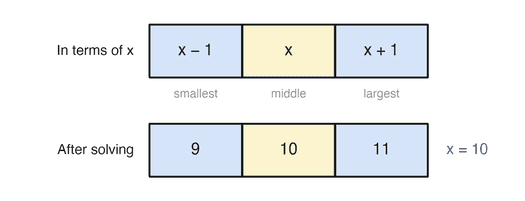
As the question says, let the middle number be x. The numbers are then x−1, x and x+1.
Step 2 — Find the difference of the squares of the other two.
We expand with (a+b)2=a2+2ab+b2 and (a−b)2=a2−2ab+b2, then subtract.
(x+1)2−(x−1)2=(x2+2x+1)−(x2−2x+1)=4x
Step 3 — Form the quadratic equation.
The square of the middle number exceeds this difference by 60.
x2−4xx2−4x−60=60=0
This is the required quadratic equation.
Step 4 — Solve the equation.
We split the middle term. We need two numbers whose product is −60 and whose sum is −4. They are −10 and 6, so we write −4x as −10x + 6x.
x2−10x+6x−60x(x−10)+6(x−10)(x−10)(x+6)=0=0=0
A product is zero only when one of its factors is zero, so we set each bracket equal to zero.
x−10=0orx+6=0
x=10orx=−6
Natural numbers are positive, so we reject x=−6 and keep x=10. The three numbers are 10−1, 10 and 10+1, that is, 9, 10 and 11.
Check: The difference of the squares of 11 and 9 is 40, and 10² exceeds 40 by 60.
112−92=121−81=40
102−40=60
Watch out: The difference of the squares of the other two is the larger square minus the smaller square, (x+1)2−(x−1)2. Taking it the other way round gives −4x and a different equation.
Therefore, the quadratic equation is x2−4x−60=0, and the three numbers are 9, 10 and 11.
