
Question 253 marksMedium
A two-digit number is such that the product of its digits is 18. When 63 is subtracted from the number, the digits are reversed. Find the number.
Confirming your payment
Sign up now and get 250 free tokens.
Solving (simple) Problems · Question 25 of 88
A two-digit number is such that the product of its digits is 18. When 63 is subtracted from the number, the digits are reversed. Find the number.
Solution:
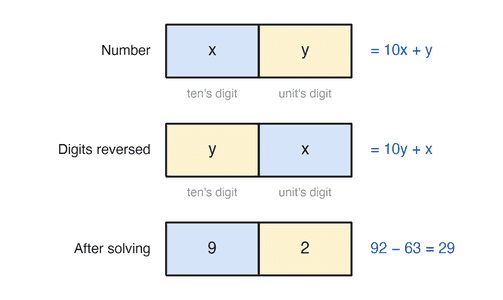
Concept: A two-digit number with ten's digit and unit's digit has the value , because the ten's digit is worth ten times its face value. Digits are whole numbers from 0 to 9, and the ten's digit of a two-digit number cannot be 0. When the digits are reversed, the number becomes .
Given: The product of the digits is 18; the number minus 63 is the number with its digits reversed.
Step 1 — Name the digits.
Let the ten's digit be and the unit's digit be . The number is , and with the digits reversed it is .
Step 2 — Use the reversal.
Subtracting 63 from the number gives the reversed number. We collect the and terms and divide by 9.
So the ten's digit is 7 more than the unit's digit, and we can write as .
Step 3 — Form the quadratic equation.
The product of the digits is 18. We put in place of .
Step 4 — Solve the equation.
We split the middle term. We need two numbers whose product is −18 and whose sum is 7. They are 9 and −2, so we write 7y as 9y − 2y.
A product is zero only when one of its factors is zero, so we set each bracket equal to zero.
A digit cannot be negative, so we reject and keep . The ten's digit is , which is 9.
Step 5 — Write the number.
The ten's digit is 9 and the unit's digit is 2.
Check: The digits of 92 multiply to 18, and taking 63 from 92 leaves 29, which is 92 with its digits reversed.
Watch out: Subtracting 63 makes the number smaller, so the ten's digit must be the larger digit. This agrees with and .
Therefore, the number is 92.