
Opening your dashboard
Class 10 Physics Chapter 9 Household Circuits: Previous Year Questions
27 questions on Chapter 9, each solved step by step. Class 10 Physics, ICSE 2026-27.
27 questions with solutions
1–4 marks · Mixed difficulty
- 12 marks
Question 1
State the characteristics required in a material to be used as an effective fuse wire.
Solve with AIWritten solution
Solution:
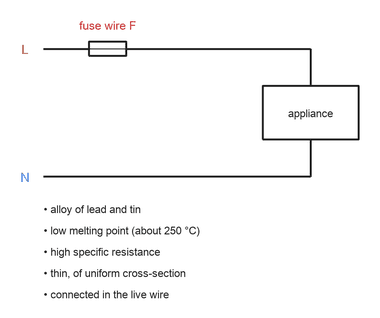
Concept: A fuse is a safety device that works on the heating effect of current. It is a short piece of thin wire of a tin–lead alloy, of high resistance and low melting point (about 250 °C), joined in series in the live wire. When the current goes above its current rating, it heats up, melts and breaks the circuit.
Step 1 — Low melting point.
The material must melt at a low temperature (the tin–lead alloy of fuse wire melts at about 250 °C), so that a small rise in current above the rating heats it enough to melt it at once.
Step 2 — High resistance.
The material must have a high resistance (high specific resistance), so that the excess current produces enough heat (H = I²Rt) to bring it quickly to its melting point.
Step 3 — Other points.
It is a short, thin wire of uniform cross-section, so that it melts at the same current along its whole length; an alloy of lead and tin is used. It is placed in the live wire, so that when it melts the appliance is cut off from the high potential.
Watch out: A good conductor such as copper is a BAD fuse material: it has a low resistance and a high melting point.
Therefore, a fuse wire material must have a low melting point and a high resistance (high specific resistance); a tin–lead alloy is used.
- 23 marks
Question 2
(i) Which particles are responsible for current in conductors?
(ii) To which wire of a cable in a power circuit should the metal case of a geyser be connected?
(iii) To which wire should the fuse be connected?
Solve with AIWritten solution
Solution:
Concept: In a metal conductor some electrons are only loosely held by their atoms (free electrons). When a potential difference is applied, they drift through the metal, and this flow of charge is the current. In earthing, the metal case of an appliance is joined to the earth wire, whose resistance is almost zero. If a fault makes the live wire touch the case, a very large current flows from the live wire through the case to the earth, and the fuse in the live wire blows at once. Only the live wire is at a high potential (220 V); the neutral and the earth are at 0 V. A device that is meant to make an appliance safe (a fuse, an MCB or a switch) must therefore cut it off from the live wire.
Step 1 — Name the particles (part i).
In a metal conductor the free electrons are responsible for the current: when a potential difference is applied they drift through the wire, and this flow of charge is the current.
Step 2 — Wire for the metal case (part ii).
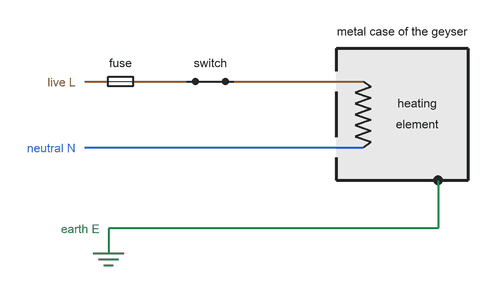
The metal case of the geyser is joined to the earth wire. If, because of a fault, the live wire touches the case, a large current flows through the earth wire to the ground and the fuse blows. The case does not stay at a high potential, so a person touching the geyser does not get a shock.
Step 3 — Wire for the fuse (part iii).
The fuse is connected in the live wire. When it blows, the geyser is cut off from the live wire, so it is at zero potential and is safe to touch and repair.
Watch out: The metal CASE goes to the earth wire; the FUSE goes in the live wire. Do not swap them.
Therefore, (i) free electrons; (ii) the earth wire; (iii) the live wire.
- 33 marks
Question 3
(i) Name the transformer used in the power transmitting station of a power plant.
(ii) What type of current is transmitted from the power station?
(iii) At what voltage is this current available to our household?
Solve with AIWritten solution
Solution:
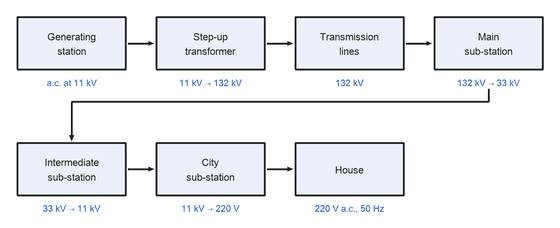
Concept: Electric power is generated as a.c. of frequency 50 Hz at 11 kV. At the grid sub-station a step-up transformer raises it to 132 kV for transmission. It is then stepped down in stages: to 33 kV at the main sub-station (for heavy industry), to 11 kV at the intermediate sub-station (for light industry), and to 220 V at the city sub-station, for the houses.
Step 1 — Name the transformer (part i).
At the power station the voltage is raised from 11 kV to 132 kV before transmission, so the transformer used is a step-up transformer.
Step 2 — Name the type of current (part ii).
Alternating current (a.c.) of frequency 50 Hz is transmitted. Only an alternating voltage can be stepped up or down by a transformer, so power is generated and sent as a.c.
Step 3 — Give the household voltage (part iii).
The voltage is stepped down in stages, from 132 kV to 33 kV, then to 11 kV, and finally to 220 V at the city sub-station. So the current reaches our homes at 220 V a.c., 50 Hz.
Watch out: A STEP-UP transformer is used at the generating end; step-down transformers are used near the consumers.
Therefore, (i) a step-up transformer; (ii) alternating current (a.c.); (iii) 220 V.
- 43 marks
Question 4
(i) Name the colour code of the wire which is connected to the metallic body of an appliance.
(ii) Draw the diagram of a dual control switch when the appliance is switched 'ON'.
Solve with AIWritten solution
Solution:
Concept: Each wire of a three-core cable has its own colour of insulation. In the new international convention the live wire is brown, the neutral is light blue and the earth is green with yellow stripes; in the old convention they were red, black and green. A dual control switch is a two-way switch: its lever joins its middle (common) terminal to one of two connecting wires that run between the two switches. The bulb glows only when both levers rest on the same connecting wire, so either switch can turn the bulb on or off.
Step 1 — Name the colour (part i).
The metallic body is joined to the earth wire, which is green in the old convention and green with yellow stripes in the new international convention.
Step 2 — Draw the circuit (part ii).
The live wire L goes to the middle terminal of switch S₂, and the middle terminal of switch S₁ goes to the bulb, whose other end goes to the neutral wire N. The upper terminals of S₁ and S₂ are joined by one wire and the lower terminals by another.

Step 3 — Check that the bulb is ON.
Both levers rest on the upper connecting wire, so the current flows L → S₂ → upper wire → S₁ → bulb → N, and the bulb glows. Changing either switch moves its lever to the other wire and breaks the circuit, so the bulb can be switched on or off from either place, as on a staircase.
Watch out: The bulb is ON when both levers are on the SAME connecting wire, not when they point the same way on the page.
Therefore, (i) the earth wire, coloured green (new convention: green with yellow stripes); (ii) the dual control circuit is as drawn, with both levers on the same connecting wire so that the bulb is ON.
- 53 marks
Question 5
(i) Which particles are responsible for current in conductors?
(ii) To which wire of a cable in a power circuit should the metal case of a geyser be connected?
(iii) To which wire should the fuse be connected?
Solve with AIWritten solution
Solution:
Concept: In a metal conductor some electrons are only loosely held by their atoms (free electrons). When a potential difference is applied, they drift through the metal, and this flow of charge is the current. In earthing, the metal case of an appliance is joined to the earth wire, whose resistance is almost zero. If a fault makes the live wire touch the case, a very large current flows from the live wire through the case to the earth, and the fuse in the live wire blows at once. Only the live wire is at a high potential (220 V); the neutral and the earth are at 0 V. A device that is meant to make an appliance safe (a fuse, an MCB or a switch) must therefore cut it off from the live wire.
Step 1 — Name the particles (part i).
In a metal conductor the free electrons are responsible for the current: under a potential difference they drift from the negative end towards the positive end.
Step 2 — Wire for the metal case (part ii).
The metal case of the geyser is joined to the earth wire. If, because of a fault, the live wire touches the case, a heavy current passes through the earth wire to the ground and the fuse blows, so the person touching the geyser is safe.
Step 3 — Wire for the fuse (part iii).
The fuse is connected in the live wire. When it blows, the geyser is cut off from the live wire and is at 0 V, which is safe. If the fuse were in the neutral wire, the geyser would stop working but would still be joined to the live wire at 220 V, and touching it could give a fatal shock.
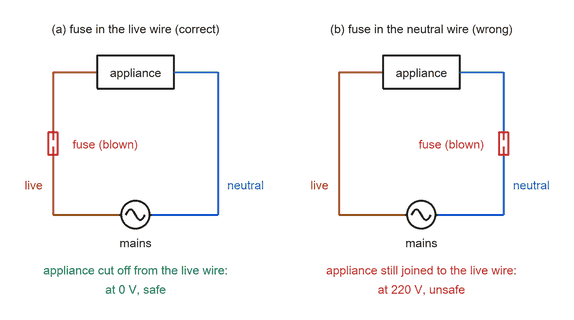
Watch out: A fuse in the NEUTRAL wire still stops the current, but it leaves the appliance at 220 V, which is dangerous.
Therefore, (i) free electrons; (ii) the earth wire; (iii) the live wire.
- 64 marks
Question 6
(i) Explain the meaning of the statement 'current rating of a fuse is 5A'.
(ii) In the transmission of power, the voltage of power generated at the generating stations is stepped up from 11 kV to 132 kV before it is transmitted. Why?
Solve with AIWritten solution
Solution:
Concept: A fuse is a safety device that works on the heating effect of current. It is a short piece of thin wire of a tin–lead alloy, of high resistance and low melting point (about 250 °C), joined in series in the live wire. When the current goes above its current rating, it heats up, melts and breaks the circuit. For a given power P = VI, the current is I = P ÷ V, so a higher voltage means a smaller current. The heat wasted in line wires of resistance R in time t is H = I²Rt, so a smaller current wastes much less energy as heat.
(i)
Step 1 — Explain the rating.
A current rating of 5 A means the fuse wire lets a current of up to 5 A flow through it safely. If the current in the circuit goes above 5 A, the fuse wire heats up to its melting point, melts and breaks the circuit, so the wiring and the appliances are protected. Such a fuse is used in a lighting circuit.
(ii)
Step 2 — Find the change in current.
For the same power P = VI, raising the voltage from 11 kV to 132 kV (12 times) makes the current one-twelfth.
Step 3 — Find the change in heat loss.
The heat wasted in the line wires is H = I²Rt, so it goes as the square of the current.

Step 4 — Conclude.
So the voltage is stepped up to reduce the loss of electrical energy as heat in the transmission line wires. (A smaller current also lets thinner, cheaper wires be used.)
Watch out: The loss falls as the SQUARE of the current: 12 times the voltage cuts the loss to 1/144, not 1/12.
Therefore, (i) the fuse lets a current of up to 5 A pass and melts if the current exceeds 5 A; (ii) the voltage is stepped up so that the current in the lines is small and much less energy is lost as heat in the transmission wires.
- 72 marks
Question 7
Identify the following wires used in a household circuit:
(i) The wire is also called as the phase wire.
(ii) The wire is connected to the top terminal of a three-pin socket.
Solve with AIWritten solution
Solution:
Concept: The supply cable to a house has three wires: the live (phase) wire at 220 V, the neutral wire at 0 V (it is joined to the earth at the local sub-station) and the earth wire at 0 V, which is only for safety. The current flows in through the live wire and back through the neutral wire. A three-pin plug has a top pin for earth (E), longer and thicker than the other two. Seen from the pin side, the pin on the left is live (L) and the pin on the right is neutral (N). The socket is the mirror image: seen from the front, the big top hole is earth, the right hole is live and the left hole is neutral.
Step 1 — Identify the phase wire (part i).
The phase wire is another name for the live wire. It is at a high potential (220 V) and brings the current from the supply to the distribution board.
Step 2 — Identify the top terminal (part ii).
The top terminal of a three-pin socket, with the bigger hole, is connected to the earth wire; the bigger hole takes the thicker, longer earth pin of the plug.

Seen from the front, the right-hand hole is live and the left-hand hole is neutral.
Watch out: 'Phase' means live, not neutral.
Therefore, (i) the live wire; (ii) the earth wire.
- 83 marks
Question 8
(i) A fuse is rated 8A. Can it be used with an electrical appliance rated 5 KW, 200 V? Give a reason.
(ii) Name two safety devices which are connected to the live wire of a household electric circuit.
Solve with AIWritten solution
Solution:
Concept: A rating such as '1540 W, 220 V' means the appliance uses that power when connected to that voltage. Its normal working current is I = P ÷ V, and a fuse used with it must be rated a little above this current, or it would melt as soon as the appliance is switched on. Only the live wire is at a high potential (220 V); the neutral and the earth are at 0 V. A device that is meant to make an appliance safe (a fuse, an MCB or a switch) must therefore cut it off from the live wire.
Given: Fuse 8 A; appliance 5 kW, 200 V.
Step 1 — Find the current drawn (part i).
The appliance draws a current I = P ÷ V, with the power 5 kW written as 5000 W.
Step 2 — Compare with the fuse (part i).
The appliance draws 25 A, much more than 8 A, so the 8 A fuse wire would melt as soon as the appliance is switched on. A fuse of rating a little more than 25 A is needed.
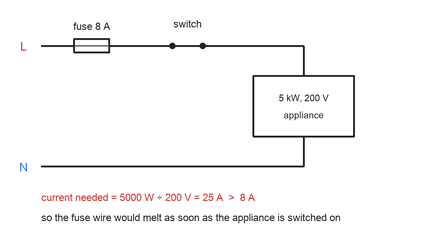
Step 3 — Name two safety devices (part ii).
The fuse (or MCB) breaks the circuit when the current becomes too large, and the switch, in the off position, cuts the appliance off from the high potential of the live wire, so it is safe to touch or repair.
Watch out: Change 5 kW into 5000 W before dividing by the voltage.
Therefore, (i) no: the appliance draws 25 A, more than the 8 A rating, so the fuse would melt; (ii) the fuse (or MCB) and the switch.
- 93 marks
Question 9
(i) Write one advantage of connecting electrical appliances in parallel combination.
(ii) What characteristics should a fuse wire have?
(iii) Which wire in a power circuit is connected to the metallic body of the appliance?
Solve with AIWritten solution
Solution:
Concept: In a house every appliance is connected in parallel across the live and the neutral wire. So each one gets the full 220 V, and each can be switched on or off by its own switch without affecting the others. A fuse is a safety device that works on the heating effect of current. It is a short piece of thin wire of a tin–lead alloy, of high resistance and low melting point (about 250 °C), joined in series in the live wire. When the current goes above its current rating, it heats up, melts and breaks the circuit. In earthing, the metal case of an appliance is joined to the earth wire, whose resistance is almost zero. If a fault makes the live wire touch the case, a very large current flows from the live wire through the case to the earth, and the fuse in the live wire blows at once.
Step 1 — One advantage of parallel connection (part i).
In parallel each appliance gets the full supply voltage (220 V), its rated voltage, so it works properly; each can also be switched on or off independently of the others.
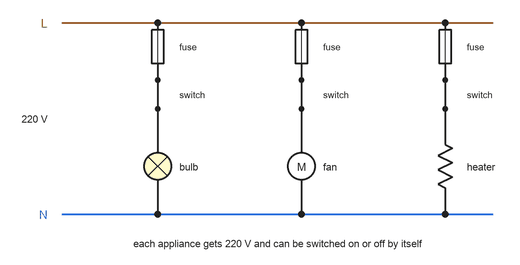
Step 2 — Characteristics of a fuse wire (part ii).
A fuse wire must have a low melting point, so that it melts quickly when the current exceeds its rating, and a high resistance (high specific resistance), so that enough heat is produced to melt it. It is usually made of an alloy of lead and tin.
Step 3 — Wire to the metallic body (part iii).
The earth wire. If the live wire touches the body by mistake, the current flows to the earth, the fuse blows, and the user is protected from an electric shock.
Watch out: Do not give 'less current' as the advantage of parallel connection; the advantage is that each appliance gets the full voltage and works independently.
Therefore, (i) each appliance gets the full 220 V and can be switched on or off independently; (ii) a low melting point and a high resistance; (iii) the earth wire.
- 103 marks
Question 10
The diagram below shows a dual control switch circuit connected to a bulb.
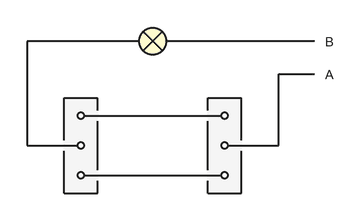
(i) Copy the diagram and complete it so that the bulb is switched ON.
(ii) Out of A & B which one is the live wire and which one is the neutral wire?
Solve with AIWritten solution
Solution:
Concept: A dual control switch is a two-way switch: its lever joins its middle (common) terminal to one of two connecting wires that run between the two switches. The bulb glows only when both levers rest on the same connecting wire, so either switch can turn the bulb on or off. Only the live wire is at a high potential (220 V); the neutral and the earth are at 0 V. A device that is meant to make an appliance safe (a fuse, an MCB or a switch) must therefore cut it off from the live wire.
Step 1 — Complete the circuit (part i).
Draw each lever from the middle terminal to the upper terminal of the same switch (or draw both to the lower terminals), so that both levers rest on the same connecting wire.
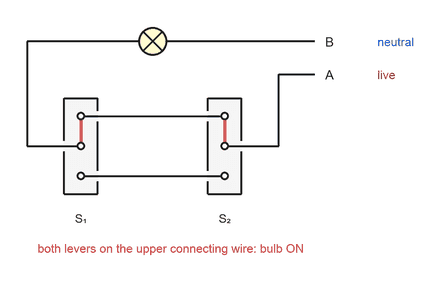
Step 2 — Trace the current.
The path A → middle terminal of S₂ → upper connecting wire → middle terminal of S₁ → bulb → B is complete, so the bulb glows.
Step 3 — Identify live and neutral (part ii).
A switch must always be connected in the live wire. Wire A goes to switch S₂, while wire B goes straight to the bulb. So A is the live wire and B is the neutral wire; when the switches are off, the bulb is cut off from the live wire and is safe.
Watch out: The bulb is ON only when both levers are on the SAME connecting wire.
Therefore, (i) both levers are drawn to the upper (or both to the lower) terminals; (ii) A is the live wire and B is the neutral wire.
- 112 marks
Question 11
Why is it not advisable to use a piece of copper wire as fuse wire in an electric circuit?
Solve with AIWritten solution
Solution:
Concept: A fuse is a safety device that works on the heating effect of current. It is a short piece of thin wire of a tin–lead alloy, of high resistance and low melting point (about 250 °C), joined in series in the live wire. When the current goes above its current rating, it heats up, melts and breaks the circuit.
Step 1 — Compare the melting points.
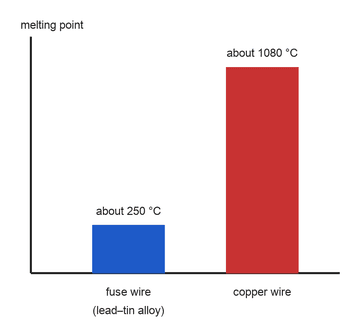
Copper melts at about 1080 °C, while the tin–lead alloy of fuse wire melts at about 250 °C. A copper wire would not melt even when the current rises well above the safe limit.
Step 2 — Compare the resistances.
Copper has a low specific resistance, so it produces little heat (H = I²Rt) and does not get hot enough to melt.
Step 3 — See the danger.
So a copper 'fuse' would not break the circuit on overloading or a short circuit. The excess current would go on flowing and could damage the appliances, overheat the wiring and even cause a fire.
Watch out: A fuse protects by MELTING; a wire that does not melt gives no protection.
Therefore, copper is not used as fuse wire because of its high melting point and low resistance: it would not melt and break the circuit when the current becomes too large.
- 121 mark
Question 12
A main switch in the main distribution board is present in :
Solve with AIAnswer
(A) a live wire
(B) a neutral wire
- Correct
(C) a live as well as neutral wire
(D) an earth wire
Answer: (C) a live as well as neutral wire
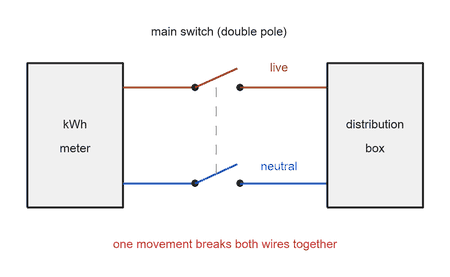
Concept: Where the cable enters a house, it passes in this order through the company (pole) fuse in the live wire, the kWh meter, and then, in the distribution box, the main switch (a double pole switch, in both wires) and the main fuse or MCB (in the live wire only).
Step 1 — Recall where the main switch is.
The main switch is fitted after the kWh meter, in the distribution box, and controls the supply to the whole house.
Step 2 — Recall its type.
It is a double pole switch: one movement breaks the live and the neutral wires together, so the whole house wiring is completely cut off from the supply during repairs.
Watch out: The switch of a single appliance is in the live wire only; the MAIN switch breaks both wires.
Why the other options are wrong:
- (A) a live wire: a switch in the live wire alone is a single pole switch, used for each appliance; the main switch breaks the neutral wire as well.
- (B) a neutral wire: a switch in the neutral wire alone would leave the wiring joined to the live wire at 220 V, which is dangerous.
- (D) an earth wire: the earth wire carries no current in normal use; a switch there would not cut off the supply and would only remove the earthing protection.
Therefore, the main switch is in the live as well as the neutral wire, option (C).
- 133 marks
Question 13
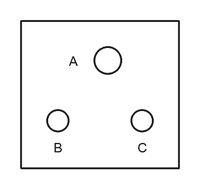
Three wires with proper colour coding are connected to the three terminals of a three-pin socket. Match the colour of the wire with the proper terminals A, B and C of the socket.
(a) Brown
(b) Green
(c) Light blue
Solve with AIWritten solution
Solution:
Concept: A three-pin plug has a top pin for earth (E), longer and thicker than the other two. Seen from the pin side, the pin on the left is live (L) and the pin on the right is neutral (N). The socket is the mirror image: seen from the front, the big top hole is earth, the right hole is live and the left hole is neutral. Each wire of a three-core cable has its own colour of insulation. In the new international convention the live wire is brown, the neutral is light blue and the earth is green with yellow stripes; in the old convention they were red, black and green.
Step 1 — Read the socket.
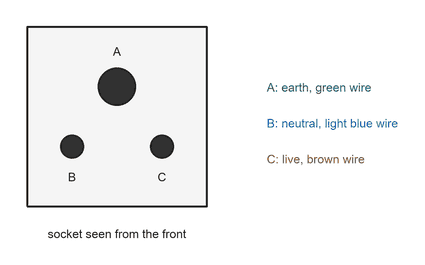
Seen from the front, a three-pin socket has its bigger top hole for earth, the right-hand hole for live and the left-hand hole for neutral. So A is earth, B (left) is neutral and C (right) is live.
Step 2 — Recall the colours.
In the new colour code, live is brown, neutral is light blue and earth is green (green with yellow stripes).
Step 3 — Match them.
Brown (live) goes to C, green (earth) goes to A, and light blue (neutral) goes to B.
Watch out: This matching takes the diagram to be the FRONT face of the socket, as it is normally drawn; from behind, left and right swap.
Therefore, (a) brown → C; (b) green → A; (c) light blue → B.
- 142 marks
Question 14
(a) Which electrical component protects the electric circuit in case of excess current and which can also be used as a switch?
(b) Name the wire to which this electrical component is connected in an electric circuit.
Solve with AIWritten solution
Solution:
Concept: An MCB (miniature circuit breaker) is an automatic switch used in place of a fuse in each circuit. When the current becomes too large because of a short circuit or an overload, it trips (switches off) in a very short time, about 25 milliseconds, and after the fault is repaired it is simply switched on again. Only the live wire is at a high potential (220 V); the neutral and the earth are at 0 V. A device that is meant to make an appliance safe (a fuse, an MCB or a switch) must therefore cut it off from the live wire.
Step 1 — Name the component (part a).
A fuse protects a circuit but cannot be used as a switch. A miniature circuit breaker (MCB) protects the circuit and can also be switched on and off by hand.
Step 2 — See how it works.
When a heavy current flows because of a short circuit or an overload, the MCB trips (switches off) within a very short time; after the fault is repaired it is simply switched back on, and no new fuse wire is needed.

Step 3 — Name the wire (part b).
It is connected in the live wire, so that when it trips the circuit beyond it is cut off from the high potential.
Watch out: A fuse cannot be switched on and off; that is why it is not the answer here.
Therefore, (a) the MCB (miniature circuit breaker); (b) the live wire.
- 151 mark
Question 15
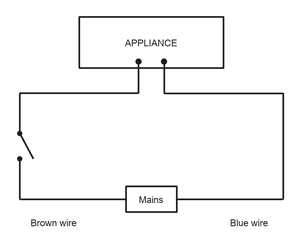
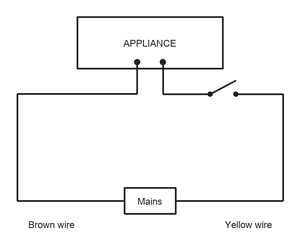
Identify the option that displays the correct wiring with correct colour code :
Solve with AIAnswer
- Correct
(A)
(B)

(C)

(D)
Answer: (A)
Concept: Each wire of a three-core cable has its own colour of insulation. In the new international convention the live wire is brown, the neutral is light blue and the earth is green with yellow stripes; in the old convention they were red, black and green. Only the live wire is at a high potential (220 V); the neutral and the earth are at 0 V. A device that is meant to make an appliance safe (a fuse, an MCB or a switch) must therefore cut it off from the live wire.
Step 1 — Decide which wires reach the appliance.
An appliance is connected between the live (brown) and the neutral (blue) wires. A yellow wire is an earth wire: it is joined to the metal body, not used to complete the circuit.
Step 2 — Decide where the switch goes.
The switch must be in the brown (live) wire, so that when it is off the appliance is cut off from the high potential.
Step 3 — Check the options.
In option (A) the switch is in the brown wire and the return wire is blue, so both conditions are met.
Watch out: A switch in the neutral wire still stops the current, but it is unsafe.
Why the other options are wrong:
- (B): the switch is correctly in the brown wire, but the circuit is completed through a yellow (earth) wire instead of the blue neutral wire.
- (C): the switch is in the blue (neutral) wire; when it is off, the appliance is still joined to the live wire and can give a shock.
- (D): the switch is in the yellow (earth) wire, and the earth wire is used to complete the circuit; both are wrong.
Therefore, option (A) shows the correct wiring: switch in the brown live wire and the blue neutral wire.
- 162 marks
Question 16
A fuse is rated 5 A. Can it be used with a geyser rated 1540 W, 220 V. Write Yes or No. Give supporting calculations to justify your answer.
Solve with AIWritten solution
Solution:
Concept: A rating such as '1540 W, 220 V' means the appliance uses that power when connected to that voltage. Its normal working current is I = P ÷ V, and a fuse used with it must be rated a little above this current, or it would melt as soon as the appliance is switched on.
Given: Fuse 5 A; geyser 1540 W, 220 V.
Step 1 — Find the current drawn.
The geyser draws a current I = P ÷ V.
Step 2 — Compare with the fuse.
The geyser draws 7 A, more than the fuse rating of 5 A, so the fuse would melt as soon as the geyser is switched on. A fuse of a little higher rating, such as 8 A, should be used.
Watch out: A fuse must be rated ABOVE the working current, not below it.
Therefore, no: the geyser draws 7 A, which is more than 5 A.
- 172 marks
Question 17
According to the NEW colour convention which colour of wire is connected to :
(a) the metal body of the appliance
(b) the switch of the appliance?
Solve with AIWritten solution
Solution:
Concept: Each wire of a three-core cable has its own colour of insulation. In the new international convention the live wire is brown, the neutral is light blue and the earth is green with yellow stripes; in the old convention they were red, black and green. In earthing, the metal case of an appliance is joined to the earth wire, whose resistance is almost zero. If a fault makes the live wire touch the case, a very large current flows from the live wire through the case to the earth, and the fuse in the live wire blows at once. Only the live wire is at a high potential (220 V); the neutral and the earth are at 0 V. A device that is meant to make an appliance safe (a fuse, an MCB or a switch) must therefore cut it off from the live wire.
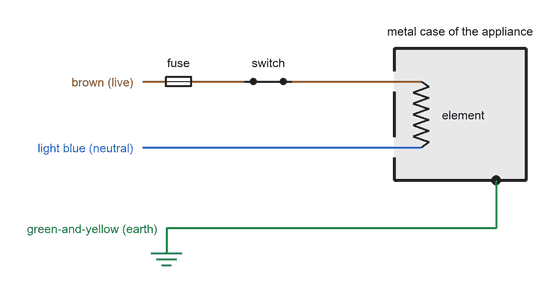
Step 1 — Metal body (part a).
The metal body is joined to the earth wire, which in the new convention is green with yellow stripes. It carries any leakage current to the ground, so the body does not stay at a high potential.
Step 2 — Switch (part b).
The switch is placed in the live wire, which in the new convention is brown. A switch in the live wire cuts the appliance off from the high potential when it is off.
Watch out: Red is the OLD colour of the live wire; the new one is brown.
Therefore, (a) green (green with yellow stripes), the earth wire; (b) brown, the live wire.
- 183 marks
Question 18
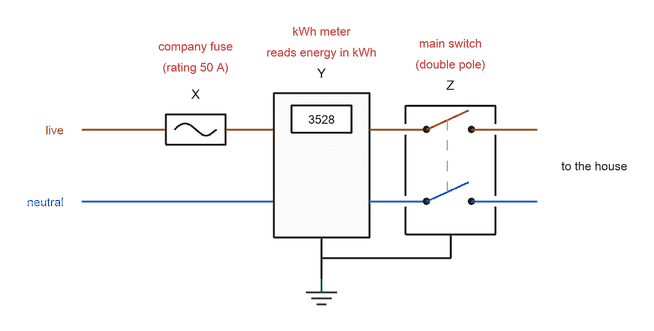
The diagram shows wiring in a meter room of a building.
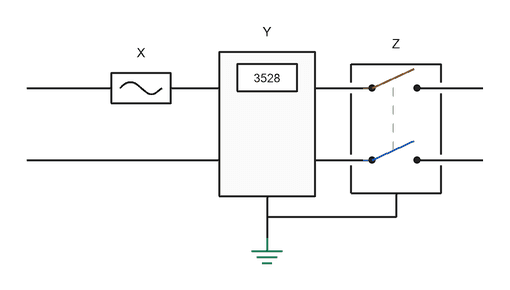
(a) What is the current rating of device X?
(b) What is the difference between the switch Z shown in the diagram and the switches you use to operate different appliances at home?
(c) What is the unit of the physical quantity displayed in Y?
Solve with AIWritten solution
Solution:
Concept: Where the cable enters a house, it passes in this order through the company (pole) fuse in the live wire, the kWh meter, and then, in the distribution box, the main switch (a double pole switch, in both wires) and the main fuse or MCB (in the live wire only).
Step 1 — Identify the devices.
The supply cable enters the building through the company (pole) fuse X in the live wire, then the kWh meter Y, then the main switch Z, before reaching the distribution box.
Step 2 — Give the rating of X (part a).
X is the company fuse, fitted in the live wire before the meter; its current rating is about 50 A.
Step 3 — Compare Z with home switches (part b).
Z is the main switch, a double pole switch: it breaks both the live and the neutral wires at the same time, so the whole building is cut off from the supply. The switches used for appliances at home are single pole switches: each breaks the live wire alone and controls one appliance.
Step 4 — Give the unit shown by Y (part c).
Y is the kWh meter; it shows the electrical energy consumed, in kilowatt hour (kWh), the 'unit' of electricity.
Watch out: The meter shows ENERGY (kWh), not power (kW).
Therefore, (a) X, the company fuse, is rated about 50 A; (b) Z is a double pole switch that breaks the live and the neutral together, while home switches are single pole switches in the live wire only; (c) kilowatt hour (kWh).
- 191 mark
Question 19
According to the NEW international convention, what is the colour coding for the live, neutral and earth wires in household circuits?
Solve with AIAnswer
(A) Live – red, Neutral – black, Earth – green
(B) Live – green, Neutral – yellow, Earth – black
- Correct
(C) Live – brown, Neutral – blue, Earth – yellow
(D) Live – red, Neutral – blue, Earth – yellow
Answer: (C) Live – brown, Neutral – blue, Earth – yellow
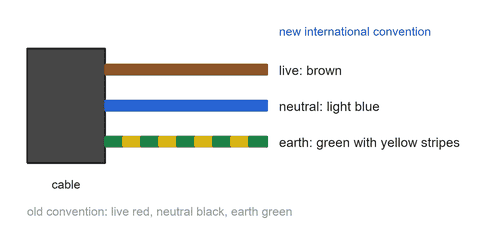
Concept: Each wire of a three-core cable has its own colour of insulation. In the new international convention the live wire is brown, the neutral is light blue and the earth is green with yellow stripes; in the old convention they were red, black and green.
Step 1 — Recall the new convention.
In the new international convention the live wire is brown, the neutral is light blue and the earth is green with yellow stripes.
Step 2 — Recall the old convention.
In the old convention the live wire was red, the neutral black and the earth green.
Step 3 — Match the options.
Option (C) gives brown, blue and yellow: the new convention, with the striped earth wire described by its yellow colour.
Watch out: Red, black and green is the OLD code.
Why the other options are wrong:
- (A) Live – red, Neutral – black, Earth – green: red, black and green is the old colour code, not the new one.
- (B) Live – green, Neutral – yellow, Earth – black: green and yellow are the earth colours; neither is used for live or neutral, and black is the old neutral colour.
- (D) Live – red, Neutral – blue, Earth – yellow: red is the old colour for live; in the new code live is brown.
Therefore, the new convention is live brown, neutral blue, earth yellow (green with yellow stripes), option (C).
- 201 mark
Question 20
Complete the following by choosing the correct answers from the bracket:
The hole in the right side of the socket is for connection to the ............... [live / neutral / earth] wire.
Solve with AIWritten solution
Solution:
Concept: A three-pin plug has a top pin for earth (E), longer and thicker than the other two. Seen from the pin side, the pin on the left is live (L) and the pin on the right is neutral (N). The socket is the mirror image: seen from the front, the big top hole is earth, the right hole is live and the left hole is neutral.
Step 1 — Recall the socket layout.
A three-pin socket, seen from the front, has a bigger hole at the top and two smaller holes below it: the top hole is for earth, the right-hand hole for live and the left-hand hole for neutral.

Step 2 — Fill in the blank.
So the hole on the right side of the socket is for the live wire.
Watch out: The SOCKET seen from the front has live on the right; the PLUG seen from its pins has live on the left.
Therefore, the hole in the right side of the socket is for connection to the live wire.
- 212 marks
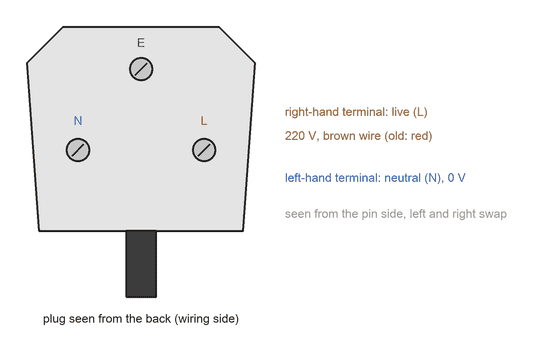
Question 21
State the potential of the wire connected to the right hand side terminal of the three pin plug and also state its colour.
Solve with AIWritten solution
Solution:
Concept: A three-pin plug has a top pin for earth (E), longer and thicker than the other two. Seen from the pin side, the pin on the left is live (L) and the pin on the right is neutral (N). The socket is the mirror image: seen from the front, the big top hole is earth, the right hole is live and the left hole is neutral. From the back (wiring) side of the plug, where the wires are joined, left and right are reversed: the right-hand terminal is live.
Step 1 — Look at the terminals.
The wires of a cable are joined to the terminals of a plug on its back (wiring) side. Seen from the back, the top terminal is earth, the right-hand terminal is live and the left-hand terminal is neutral (left and right are the other way round when the plug is seen from the pin side).
Step 2 — State the potential.
The right-hand terminal is the live terminal, so the wire joined to it is at a high potential, 220 V.
Step 3 — State the colour.
The live wire is brown in the new convention (red in the old convention).
Watch out: Decide first which side of the plug you are looking at: terminals are on the back, pins on the front.
Note: if the plug is read from the pin side instead, the right-hand pin is the neutral pin, at 0 V, with the light blue wire; the question speaks of a terminal, where the wire is joined, so the back (wiring) side is used here.
Therefore, the wire on the right-hand terminal is the live wire, at a potential of 220 V, and its colour is brown (old convention: red).
- 223 marks
Question 22
The diagram given below shows a bulb connected by dual control switches. Observe the diagrams and answer the questions that follow.


(a) Which switch can successfully turn the bulbs ON or OFF? (Circuit A, Circuit B, or both)
(b) At present, in which circuit is the bulb glowing?
(c) If the L and N wires are swapped in the circuit (your answer to (b)), will the circuit still function?
Solve with AIWritten solution
Solution:
Concept: A dual control switch is a two-way switch: its lever joins its middle (common) terminal to one of two connecting wires that run between the two switches. The bulb glows only when both levers rest on the same connecting wire, so either switch can turn the bulb on or off. Only the live wire is at a high potential (220 V); the neutral and the earth are at 0 V. A device that is meant to make an appliance safe (a fuse, an MCB or a switch) must therefore cut it off from the live wire.
Step 1 — Check both circuits (part a).
In each circuit the two connecting wires join the outer terminals of one switch to the outer terminals of the other (straight in A, crossed in B). Moving either lever always moves its middle terminal from one connecting wire to the other, so in both circuits either switch turns the bulb on or off.
Step 2 — Circuit A now (part b).
The left lever is on the top terminal and the right lever on the bottom terminal. The top and bottom terminals are joined straight across, so the levers are on different wires and the circuit is broken.
Step 3 — Circuit B now (part b).
The right lever is on the bottom terminal, and the crossed wire joins that bottom terminal to the top terminal of the left switch, where the left lever rests. The path L → right switch → crossed wire → left switch → bulb → N is complete, so the bulb in circuit B glows.

Step 4 — Swap L and N in circuit B (part c).
The bulb still glows and can still be switched on and off from both places, because the supply is a.c. and the bulb glows whichever way the current flows. But the circuit is unsafe: the switches are now in the neutral wire, so when the bulb is switched off it is still joined to the live wire, and touching the holder can give a shock.
Watch out: 'Works' and 'safe' are different questions: with L and N swapped the circuit works but is not safe.
Therefore, (a) both circuits A and B; (b) the bulb glows in circuit B; (c) yes, it still works, but it is unsafe because the switches are then in the neutral wire.
- 233 marks
Question 23
The reverse side of a three-pin plug with incorrect connection of wires is shown in the diagram below.

(a) Identify the fault in the above connection.
(b) Mention a risk factor involved, if the user operates the appliance without correcting it.
(c) Will the appliance function in the present situation? (Yes or No)
Solve with AIWritten solution
Solution:
Concept: A three-pin plug has a top pin for earth (E), longer and thicker than the other two. Seen from the pin side, the pin on the left is live (L) and the pin on the right is neutral (N). The socket is the mirror image: seen from the front, the big top hole is earth, the right hole is live and the left hole is neutral. Each wire of a three-core cable has its own colour of insulation. In the new international convention the live wire is brown, the neutral is light blue and the earth is green with yellow stripes; in the old convention they were red, black and green. In earthing, the metal case of an appliance is joined to the earth wire, whose resistance is almost zero. If a fault makes the live wire touch the case, a very large current flows from the live wire through the case to the earth, and the fuse in the live wire blows at once.
Step 1 — Read the terminals.
On the reverse (wiring) side of a three-pin plug the top terminal belongs to the thick earth pin; the live terminal is on the right and the neutral terminal on the left. In the old colour code the red wire is live, the green wire is earth and the blue wire is neutral.
Step 2 — Find the fault (part a).
The red live wire is on the top (earth) terminal and the green earth wire is on the right-hand (live) terminal: the live and the earth wires are interchanged. The blue neutral wire is on the correct terminal.

Step 3 — Find the risk (part b).
The green wire goes to the metal body of the appliance. With this wiring it carries the live potential (220 V) to the body, so anyone touching the appliance can get a severe, even fatal, shock; the appliance has also lost its earthing protection.
Step 4 — Decide whether it works (part c).
The red wire, which should bring the supply to the appliance's switch and element, is now on the earth pin, at zero potential, and the blue wire is on the neutral pin, also at zero potential. With no potential difference across the element, no current flows, so the appliance does not work.
Watch out: From the back of the plug, live is on the RIGHT; from the pin side it is on the left.
Therefore, (a) the live (red) and earth (green) wires are interchanged; (b) the metal body is at 220 V, so the user can get a fatal shock; (c) No, the appliance will not work.
- 241 mark
Question 24
Which of the following is NOT a characteristic of a fuse wire?
Solve with AIAnswer
(A) It has high resistance.
- Correct
(B) It has high conductivity.
(C) It is an alloy of lead and tin.
(D) It has a low melting point.
Answer: (B) It has high conductivity.
Concept: A fuse is a safety device that works on the heating effect of current. It is a short piece of thin wire of a tin–lead alloy, of high resistance and low melting point (about 250 °C), joined in series in the live wire. When the current goes above its current rating, it heats up, melts and breaks the circuit.
Step 1 — Link resistance and conductivity.
A high resistance (high specific resistance) means a low conductivity. So 'high conductivity' is the opposite of what a fuse wire needs.
Step 2 — See why it matters.
A wire of high conductivity, such as copper, produces little heat and has a high melting point, so it would not melt and protect the circuit.
Watch out: The question asks for the characteristic that is NOT true of a fuse wire.
Why the other options are wrong:
- (A) It has high resistance: high resistance IS a characteristic of a fuse wire: it makes the wire heat up enough to melt.
- (C) It is an alloy of lead and tin: a tin–lead alloy IS the usual fuse wire material.
- (D) It has a low melting point: a low melting point (about 250 °C) IS a characteristic of a fuse wire.
Therefore, high conductivity is not a characteristic of a fuse wire, option (B).
- 252 marks
Question 25
(a) Why are thick wires used to carry current in high power appliances such as electric heaters and radiators?
(b) Name a device used to protect the electric circuits from overloading and short circuits.
Solve with AIWritten solution
Solution:
Concept: A high-power appliance draws a large current, and the heat produced in a connecting wire is H = I²Rt; a thick wire has a low resistance (R = ρl ÷ a). A fuse is a safety device that works on the heating effect of current. It is a short piece of thin wire of a tin–lead alloy, of high resistance and low melting point (about 250 °C), joined in series in the live wire. When the current goes above its current rating, it heats up, melts and breaks the circuit.
Step 1 — See the large current (part a).
From P = VI, a heater or radiator of high power draws a large current from the 220 V supply.
Step 2 — Use a thick wire (part a).
The resistance of a wire is inversely proportional to its area of cross-section, so a thick wire has a low resistance. With a low resistance the heat produced in the connecting wire (H = I²Rt) stays small; a thin wire would overheat, its insulation could melt and it could cause a fire. That is why the power circuit of a house (about 15 A) uses thicker wires than the lighting circuit (about 5 A).
Step 3 — Name the protective device (part b).
A fuse (or an MCB, miniature circuit breaker), connected in the live wire, breaks the circuit on overloading or a short circuit.
Watch out: A thick wire is used to keep its OWN heating small, not to reduce the current the appliance needs.
Therefore, (a) thick wires have a low resistance, so the large current does not overheat them; (b) a fuse (or an MCB).
- 262 marks
Question 26
The diagram below shows a socket in which the switch is ON.

Will the bulb glow if:
(a) it is connected across B and C?
(b) it is connected across A and C?
Solve with AIWritten solution
Solution:
Concept: The supply cable to a house has three wires: the live (phase) wire at 220 V, the neutral wire at 0 V (it is joined to the earth at the local sub-station) and the earth wire at 0 V, which is only for safety. The current flows in through the live wire and back through the neutral wire. A three-pin plug has a top pin for earth (E), longer and thicker than the other two. Seen from the pin side, the pin on the left is live (L) and the pin on the right is neutral (N). The socket is the mirror image: seen from the front, the big top hole is earth, the right hole is live and the left hole is neutral.
Step 1 — Read the socket.
Seen from the front, the bigger top hole C is earth, the right-hand hole B is live and the left-hand hole A is neutral. The live wire is at 220 V; the neutral and the earth wires are both at zero potential. A bulb glows only if there is a potential difference across it.
Step 2 — Bulb across B and C (part a).
B is live (220 V) and C is earth (0 V), so there is a p.d. of 220 V across the bulb, and a current flows from the live wire through the bulb to the earth: the bulb glows.

Step 3 — Bulb across A and C (part b).
A is neutral and C is earth; both are at zero potential, so there is no p.d. across the bulb, no current flows, and the bulb does not glow.
Watch out: In normal use a bulb is connected across live and neutral; a current returning through the earth, as in (a), is a leakage current that an earth leakage circuit breaker would switch off.
Therefore, (a) yes, the bulb glows across B and C; (b) no, it does not glow across A and C.
- 274 marks
Question 27
(a) Ravi wants to install a fuse to the circuit of an oven and wants to control the oven from two different locations. Shown below is the circuit diagram which he used.

(1) Which one of the two, A or B, should be a live wire? Why?
(2) In the event of an overload, will the fuse serve its purpose?
(b) What does the statement 'A bulb is rated 600 W, 220 V' mean?
Solve with AIWritten solution
Solution:
Concept: Only the live wire is at a high potential (220 V); the neutral and the earth are at 0 V. A device that is meant to make an appliance safe (a fuse, an MCB or a switch) must therefore cut it off from the live wire. A fuse is a safety device that works on the heating effect of current. It is a short piece of thin wire of a tin–lead alloy, of high resistance and low melting point (about 250 °C), joined in series in the live wire. When the current goes above its current rating, it heats up, melts and breaks the circuit. A dual control switch is a two-way switch: its lever joins its middle (common) terminal to one of two connecting wires that run between the two switches. The bulb glows only when both levers rest on the same connecting wire, so either switch can turn the bulb on or off.
Step 1 — Find which wire carries the switches (part a1).
Both two-way switches are in the path from B to the oven, while A goes straight to the oven coil.
Step 2 — Decide the live wire (part a1).
Switches must be in the live wire, so that when the oven is switched off from either place it is completely cut off from the high potential. So B should be the live wire. If A were live, the oven coil would stay at 220 V even when switched off, and touching it could give a shock.
Step 3 — Check the fuse (part a2).
The fuse is in the wire from the oven's body to the earth C. On an overload the excess current flows through the live and neutral wires (B and A), not through the earth wire, so the fuse does not melt and the circuit is not broken: it will not serve its purpose. The fuse must be in the live wire B, before the switches, with the earth wire going straight to the oven's metal body.

Step 4 — Explain the rating (part b).
When the bulb is connected to a 220 V supply it consumes electrical energy at the rate of 600 J every second (power 600 W) and gives its normal light. From the rating we can also find its current and resistance.
Watch out: A fuse in the EARTH wire never sees the overload current.
Therefore, (a)(1) B should be the live wire, because the switches are in its path; (a)(2) no, the fuse is in the earth wire, which does not carry the overload current; (b) the bulb uses 600 W (600 J each second) when connected to a 220 V supply.