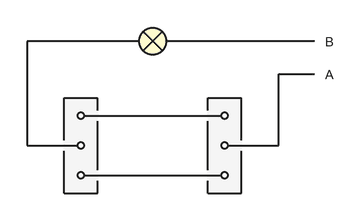
Solution:
Concept: A dual control switch is a two-way switch: its lever joins its middle (common) terminal to one of two connecting wires that run between the two switches. The bulb glows only when both levers rest on the same connecting wire, so either switch can turn the bulb on or off. Only the live wire is at a high potential (220 V); the neutral and the earth are at 0 V. A device that is meant to make an appliance safe (a fuse, an MCB or a switch) must therefore cut it off from the live wire.
Step 1 — Complete the circuit (part i).
Draw each lever from the middle terminal to the upper terminal of the same switch (or draw both to the lower terminals), so that both levers rest on the same connecting wire.
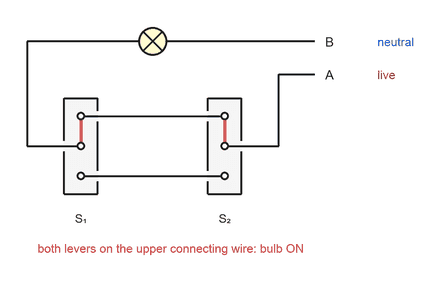
Step 2 — Trace the current.
The path A → middle terminal of S₂ → upper connecting wire → middle terminal of S₁ → bulb → B is complete, so the bulb glows.
Step 3 — Identify live and neutral (part ii).
A switch must always be connected in the live wire. Wire A goes to switch S₂, while wire B goes straight to the bulb. So A is the live wire and B is the neutral wire; when the switches are off, the bulb is cut off from the live wire and is safe.
Watch out: The bulb is ON only when both levers are on the SAME connecting wire.
Therefore, (i) both levers are drawn to the upper (or both to the lower) terminals; (ii) A is the live wire and B is the neutral wire.