
Question 112 marksAsked 2020Easy
Why is it not advisable to use a piece of copper wire as fuse wire in an electric circuit?
Confirming your payment
Sign up now and get 250 free tokens.
Previous Year Questions · Question 11 of 27
Why is it not advisable to use a piece of copper wire as fuse wire in an electric circuit?
Solution:
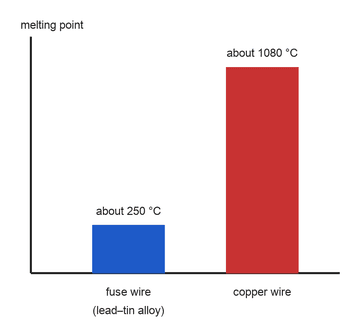
Concept: A fuse is a safety device that works on the heating effect of current. It is a short piece of thin wire of a tin–lead alloy, of high resistance and low melting point (about 250 °C), joined in series in the live wire. When the current goes above its current rating, it heats up, melts and breaks the circuit.
Step 1 — Compare the melting points.
Copper melts at about 1080 °C, while the tin–lead alloy of fuse wire melts at about 250 °C. A copper wire would not melt even when the current rises well above the safe limit.
Step 2 — Compare the resistances.
Copper has a low specific resistance, so it produces little heat (H = I²Rt) and does not get hot enough to melt.
Step 3 — See the danger.
So a copper 'fuse' would not break the circuit on overloading or a short circuit. The excess current would go on flowing and could damage the appliances, overheat the wiring and even cause a fire.
Watch out: A fuse protects by MELTING; a wire that does not melt gives no protection.
Therefore, copper is not used as fuse wire because of its high melting point and low resistance: it would not melt and break the circuit when the current becomes too large.